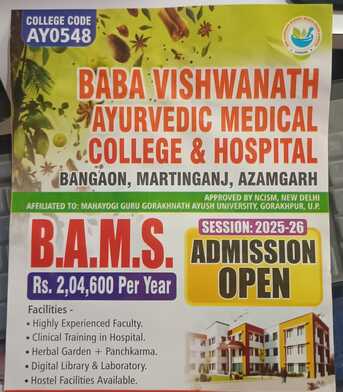
Ayurveda, meaning "the science of life," emphasizes balance among body, mind, and spirit through herbal remedies, yoga, diet, and lifestyle modifications. With rising interest in alternative medicine amid lifestyle diseases, Baba Vishwanath Ayurvedic Medical College has become a sought-after destination for students pursuing a Bachelor of Ayurvedic Medicine and Surgery (BAMS). Nestled in the serene village of Martinganj, the 5-acre campus provides an ideal setting for immersive learning. This comprehensive guide delves into the college's history, courses, facilities, admissions, and more, helping prospective students and Ayurveda enthusiasts understand why it's a top choice for Ayurvedic education in India.
Whether you're a NEET aspirant eyeing BAMS admissions in Azamgarh or someone exploring Ayurvedic colleges in Uttar Pradesh, this article uncovers the essence of Baba Vishwanath Ayurvedic Medical College. From its state-of-the-art hospital to vibrant student life, discover how this institution is shaping the future of holistic healthcare.
History and Establishment of Baba Vishwanath Ayurvedic Medical College
The roots of Baba Vishwanath Ayurvedic Medical College trace back to 2004, when visionary educators under the aegis of Maa Vindhyavasini Shodh Evam Prashikshan Nyas, Sambhupur Ghaji, Azamgarh, founded the institution to revive Ayurveda's glory in modern India. This era marked a renaissance for Ayurveda post-independence, as the Government of India integrated it into national health policies, leading to the establishment of dedicated colleges across the country. Azamgarh, with its historical ties to ancient healing practices in the Purvanchal region, proved a fitting location for such an endeavor.
The college's name honors Lord Vishwanath (Shiva), symbolizing purity and enlightenment—core tenets of Ayurveda. From humble beginnings with basic infrastructure, it has evolved into a 60-seat BAMS powerhouse, earning NCISM approval as early as the 2021-22 academic session. Under the leadership of Principal Prof. (Dr.) Manorma Mishra, a seasoned Ayurvedic expert, the institution has focused on bridging ancient texts like Charaka Samhita and Sushruta Samhita with evidence-based research.
Over the years, Baba Vishwanath Ayurvedic Medical College has weathered challenges like the medieval decline of Ayurveda during foreign invasions and colonial suppression. Yet, inspired by India's post-1947 push for indigenous medicine, it has flourished. Key milestones include the inauguration of its 60-bed hospital in the mid-2000s, expansion of the herbal garden, and collaborations with AYUSH ministries for workshops. Today, with over 891 students and 17 dedicated faculty members, it embodies resilience and innovation.
This growth reflects Uttar Pradesh's broader Ayurvedic ecosystem, home to over 100 such colleges. Baba Vishwanath's commitment to ethical education and community service has positioned it as a leader among private Ayurvedic colleges in Azamgarh, fostering alumni who practice globally—from wellness centers in the US to rural clinics in India.
Campus and Infrastructure: A Serene Haven for Learning
Sprawling across 5 acres in Martinganj, the campus of Baba Vishwanath Ayurvedic Medical College Azamgarh is designed to harmonize with Ayurveda's principles of harmony with nature. Surrounded by lush greenery and the gentle Bhadon River, it offers a pollution-free environment conducive to meditation and study—essential for grasping concepts like Dosha balance (Vata, Pitta, and Kapha).
The infrastructure boasts modern yet eco-friendly buildings, including air-conditioned classrooms equipped with projectors and smart boards for interactive lectures. The central library houses over 5,000 volumes on Ayurveda, including rare Sanskrit manuscripts and international journals on herbal pharmacology. Students can access digital resources via Wi-Fi-enabled zones, supporting research on topics like Panchakarma therapies.
Hostel facilities are a highlight: separate, well-ventilated blocks for boys and girls with 24/7 security, furnished rooms, and mess services offering sattvic (pure) Ayurvedic meals—rich in millets, herbs, and seasonal produce. Annual hostel fees stand at ₹60,000, ensuring affordability. Recreational amenities include a multipurpose hall for yoga sessions, an auditorium for cultural events, and sports grounds for kabaddi and volleyball, promoting holistic fitness.
The herbal garden, a 2-acre gem, cultivates over 200 medicinal plants like Ashwagandha, Tulsi, and Aloe Vera, serving as a living classroom for practical botany. Laboratories for Rasashastra (Ayurvedic pharmaceutics) feature distillation units and tablet-making machines, allowing hands-on formulation of medicines. Cafeterias and counseling centers round out the setup, with medical facilities on-site for minor ailments.
This thoughtful infrastructure not only meets NCISM standards but exceeds them, creating a nurturing space that aligns with Ayurveda's emphasis on environmental harmony. For students seeking Ayurvedic colleges with robust facilities in Uttar Pradesh, Baba Vishwanath's campus is unparalleled.
Academic Programs: Courses Offered at Baba Vishwanath Ayurvedic Medical College
At the core of Baba Vishwanath Ayurvedic Medical College is its rigorous yet enriching academic curriculum, centered on the flagship BAMS program. This 5.5-year course (4.5 years of academics + 1-year compulsory internship) equips students with comprehensive knowledge of Ayurvedic diagnostics, treatments, and surgery, alongside modern anatomy and pathology.
The BAMS syllabus, aligned with NCISM guidelines, spans eight semesters covering:
Foundation Subjects: Sanskrit, Padartha Vigyan (Ayurvedic philosophy), and Rachana Sharir (anatomy).
Core Ayurveda: Dravyaguna (pharmacology), Roga Nidan (pathology), and Kayachikitsa (internal medicine).
Specializations: Shalya Tantra (surgery), Prasuti Tantra (gynecology), and Agad Tantra (toxicology).
Integrated Learning: Modules on yoga, nutrition, and community health, with electives in Panchakarma and Marma therapy.
With an intake of 60 seats, the program emphasizes practical training through OPD rotations and thesis work on topics like herbal antidiabetics. While primarily undergraduate-focused, the college hints at future MD (Ayurveda) expansions in Rasashastra and Bhaishajya Kalpana, drawing from faculty expertise.
Teaching