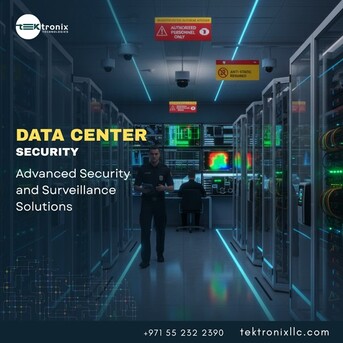
The organization will have to combine Cybersecurity for Data Centers, Data Center Firewalls, Data Center Encryption, Data Center Threat Detection, Server Room Security, Rack-level Security, and Physical Security for Data Centers to provide complete protection. The combination of these technologies constitutes the core of a safe, dependable and strong data infrastructure.
1. The Importance of Data Center Security in the GCC
With Oman and other GCC countries developing and becoming digital centres, the need to have secure and compliant data centres is currently shooting high. Data centers contain important applications and cloud environments as well as customer data, which makes them the ideal target of cyberattacks and physical attacks.
The integrity, confidentiality or the availability of data cannot be compromised whether it is financial transactions in Oman, e-commerce in Dubai or oil analytics in Saudi Arabia. That’s why organizations are now investing heavily in end-to-end data center security — covering every rack, room, and network layer.
The organization will have to combine Cybersecurity for Data Centers, Data Center Firewalls, Data Center Encryption, Data Center Threat Detection, Server Room Security, Rack-level Security, and Physical Security for Data Centers to provide complete protection. The combination of these technologies constitutes the core of a safe, dependable and strong data infrastructure.
1. The Importance of Data Center Security in the GCC
With Oman and other GCC countries developing and becoming digital centres, the need to have secure and compliant data centres is currently shooting high. Data centers contain important applications and cloud environments as well as customer data, which makes them the ideal target of cyberattacks and physical attacks.
The integrity, confidentiality or the availability of data cannot be compromised whether it is financial transactions in Oman, e-commerce in Dubai or oil analytics in Saudi Arabia. That’s why organizations are now investing heavily in end-to-end data center security — covering every rack, room, and network layer.
2. Cybersecurity for Data Centers: The Digital Shield
At the heart of modern protection lies Cybersecurity for Data Centers. The approach entails the use of enhanced security structures to protect the digital resources against the bad players.
Core Components Include:
• Intrusion prevention and detection systems (IDS/IPS) to identify cyber threats.
• Network segmentation to isolate critical workloads.
• Zero Trust architecture ensuring continuous authentication.
• AI-based analytics to detect anomalies and insider threats.
Cybersecurity for Data Centers is important in order to prevent digital breaches by identifying early, effectively confining them, and address them as soon as possible to reduce downtime and loss of money.
3. Data Center Firewalls: The First Line of Defense
As a building needs walls to secure it, Data Center Firewalls prevent outsiders to access network perimeters. These smart walls can block traffic, malicious content and protect the integrity of the data.
The benefits of Data Center Firewalls are as follows:
• Deep packet inspection (DPI) for real-time threat analysis.
• Next-generation firewall (NGFW) capabilities for advanced protection.
• Application-layer filtering to stop attacks targeting specific workloads.
• Scalable performance for virtualized or cloud environments.
Data Center Firewalls play a major role in ensuring adherence and operational safety in the hybrid and multi-cloud architectures in Oman and GCC enterprises.
4. Data Center Encryption: Safeguarding Data at Rest and in Transit
Data Center Encryption provides the security of confidential data by storing and transferring in a form that cannot be read.
The main advantages of Data Center Encryption are as follows:
• End-to-end protection for data in motion and at rest.
• Compliance with GCC data privacy regulations.
• Enhanced protection against ransomware attacks.
• Secure key management through hardware security modules (HSMs).
5. Data Center Threat Detection: Proactive Defense in Action
It is not sufficient to use reactive defense. Data Center Threat Detection provides real-time visibility into network behaviour to allow early detection of aberrant behaviour and possible breaches.
Capabilities Include:
• AI-powered threat analytics that predict and neutralize attacks.
• Machine learning models for adaptive defense.
• Automated incident response to reduce reaction time.
• Integration with SIEM platforms for centralized monitoring.
6. Server Room Security: Protecting the Heart of the Facility
Whereas the digital protection is provided by cybersecurity, physical protection begins with Server Room Security. This entails the physical location of the critical IT equipment.
Server Room Security Measures:
• Biometric access control for authorized personnel only.
• Surveillance cameras and motion sensors for real-time monitoring.
• Environmental monitoring (temperature, humidity, smoke detection).
• Fire suppression systems to prevent catastrophic loss.
Server Room Security is also concentrated in the GCC in regard to environmental stability so as to avoid overheating and downtime.
7. Rack-level Security: Protecting Every Server Individually
Security does not stop at a room level, but goes all the way down to each rack. Rack-level Security offers control and monitoring of each cabinet of servers in the data center.
Rack-level Security characteristics:
• Electronic locking systems integrated with access control.
• RFID authentication for precise identity tracking.
• Real-time temperature and intrusion alerts.
• Audit trails for maintenance and access verification.
For co-location data centers and cloud service providers, Rack-level Security can be used to ensure that tenant data is secure even in shared environments.
8. Physical Security for Data Centers: The Foundational Layer
All secure data centers start with Superior Physical Security for Data Centers. This entails designing of the facilities, surveillance and perimeter protection to prevent unauthorized access.
Best Practices for Physical Security:
• Layered access zones separating critical and non-critical areas.
• 24/7 surveillance with intelligent video analytics.
• Security personnel and biometric checkpoints.
• Vehicle barriers and intrusion detection systems.
For facilities in Oman, Qatar and the UAE where data centers can manage the infrastructure of the government, telecommunication and banking, Physical Security for Data Centers is the back bone to complete pr