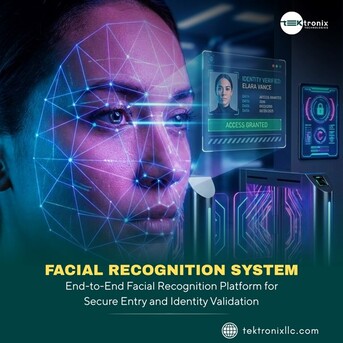
It can be the security of offices of corporations, the security of airports, or the security of residential areas, but Facial Recognition Software and Facial Recognition Devices are changing the way individuals engage with spaces opening the age of truly smarter access.
1. The Evolution of Facial Recognition in the GCC
Gulf region has always been on the lead of embracing high-tech technologies. As the movement of smart cities and digitalisation takes hold, the Facial Recognition has become an inseparable part of current access control.
Governments and private business entities in Oman, Saudi Arabia and the UAE are already embracing the Biometric Identification technologies, in the effort of intensifying security, eradicating identity fraud as well as simplifying user experiences. What was initially an invention to mobile phones, plays out and defines the national infrastructural and enterprise security plans.
2. Understanding Facial Recognition Technology
Facial Recognition is a form of Biometric Identification whereby features on the face are captured, analyzed and compared so as to identify who an individual is. A face cannot be forgotten, stolen or duplicated, as do passwords, IDs or PIN numbers, and therefore makes it one of the most secure methods of authentication currently in existence.
Key Components Include:
• Face Detection: Identifying the presence of a face in an image or video feed.
• Face Verification: Comparing the detected face against stored data to confirm identity.
• Facial Authentication: Granting or denying access based on the verification results.
Combined, the above processes drive the Facial Recognition Software and Facial Recognition Devices which protect buildings, data centers, and digital systems throughout the GCC.
3. Why Biometric Identification Is the Future of Access Control
Biometric Identification goes beyond traditional credentials. It relies on human features that are exclusive to an individual such as fingerprints, iris patterns and facial features to make sure that it is accurate and that it does not lead to impersonation.
Benefits of Biometric Identification:
• Higher security levels with minimal risk of forgery.
• Faster authentication eliminating manual entry delays.
• Touchless operation, ideal for hygiene-sensitive environments.
• Integration-ready with existing access control systems.
With Biometric Identification, Oman and GCC organizations are providing more trusted and usable access networks.
4. The Role of Face Detection in Modern Security
Face Detection is the first and most crucial step in Facial Recognition. It allows the cameras and systems to recognize human faces in video streams or images.
Face Detection provides the security of the use of AI algorithms that only the human subjects are analyzed, and irrelevant background information is left out. This technology enables real-time surveillance, attendance and crowd analytics, which is a core of Facial Recognition Devices in Oman and GCC.
5. Face Verification for Secure Authentication
Once a face is identified, Face Verification is performed to ensure that the face matches a stored profile. This measure is necessary so that unauthorized persons do not have access to sensitive areas.
Face Verification in business organizations removes the chances of misplaced cards or stolen identities. It is used in secure areas such as data centers or airports where all access points are strictly monitored and checked.
With Facial Recognition Software, the organizations can determine access control, trace entry history, and overall control over the premises with unparalleled precision.
6. Facial Authentication: Redefining Convenience and Security
Facial Authentication has the advantage of speed, accuracy, and ease of use. Users do not swipe a card or type a password; they just look at a Facial Recognition Device and within seconds one gets access to the device.
Advantages of Facial Authentication Systems:
• Instant recognition even in low-light conditions.
• Seamless user experience with no physical contact.
• Cloud integration for centralized monitoring.
• Scalable architecture for multiple access points.
Facial Authentication systems are currently being added to the Oman and GCC smart buildings, namely to the elevators, parking barriers and attendance management platform, making the experience of entering the building a seamless intelligent one.
7. Facial Recognition Software: The Digital Intelligence.
Facial Recognition Software is the brain behind every intelligent access system, which analyses, stores and processes visual data.
Key Capabilities of Facial Recognition Software:
• Machine learning-based recognition improving accuracy over time.
• Integration-ready APIs for existing HR and security systems.
• Real-time alerts for unauthorized access attempts.
• Data privacy compliance aligned with GCC cybersecurity laws.
Facial Recognition Software is an essential tool that can be used in organizations of all industries due to its capability to offer both real-time and strategic insights through the integration of AI and data analytics.
8. Facial Recognition Devices: The Gateway to Smart Access
Facial Recognition Devices are designed in many shapes and types; wall-mounted access terminals or integrated kiosk and turnstile systems. These devices rely on built-in AI chip and enhanced cameras to scan and authenticate users in a matter of milliseconds.
Common Applications in Oman & GCC:
• Corporate offices for staff access and time attendance.
• Healthcare facilities for patient verification.
• Airports and border control for traveller identification.
• Residential complexes for secure entry management.
• Industrial sites for workforce safety and compliance.
With the ongoing technological advancement in the GCC, the new trend in the building security infrastructure is the Facial Recognition Devices.
Conclusion
Facial Recognition- a combination of Biometric Identification, Face Detection, Face Verification and Facial Authentication technologies is the future of secure access in Oman and the GCC as it offers the unmatched convenience and security.
Governments and businesses are changing the manner in which people move, interact and gain entry within facilities with the various powerful Facial Recognition Software and improved Facial Recognition Devices. With the increasing rate of digital transformation, smarter access begins with the face - and the future is present.
For more information contact us on:
Tektronix Technology Systems Dubai-Head Office
[email protected]
+971 55 232 2390
Office No.1E1 | Hamarain Center 132 Abu Baker Al Siddique Rd &ndash