With cost-plus contracts, every expense must be recorded and billed correctly. This means construction companies need stronger bookkeeping practices to maintain financial clarity and manage projects successfully.
Understanding the Shift in Pricing Models
Traditionally, many construction projects used fixed-price contracts, where contractors agreed to complete a project for a set amount. While this offered predictability, it also meant contractors carried the risk if costs increased unexpectedly.
Cost-plus contracts work differently. Contractors are reimbursed for actual project expenses along with a set fee or percentage. This reduces risk but requires detailed tracking of all costs. As a result, bookkeeping for construction business plays a key role in ensuring every expense is recorded and billed accurately.
This shift is driven by rising material costs, more complex projects, and increased demand for transparency from clients.
Why Bookkeeping Needs to Adapt
As pricing models change, bookkeeping practices must evolve to keep up. Bookkeeping for construction business helps companies:
• Track detailed expenses such as labor, materials, and subcontractor fees
• Generate timely reports for accurate billing
• Monitor cash flow to avoid delays
• Reduce billing errors through proper documentation
• Support better planning and purchasing decisions
• Simplify tax preparation and compliance
• Provide clear financial reports to clients
Key Differences Between Fixed-Price and Cost-Plus Projects
Under fixed-price contracts, billing usually follows milestones and profit is predetermined. Expense tracking may not require as much detail since the total price is already agreed upon.
In cost-plus projects, bookkeeping for construction business must track actual costs closely. Detailed receipts, invoices, and cost records are necessary, and profit depends on accurate cost tracking. Reporting is also more detailed to maintain transparency with clients.
Managing Multiple Projects Effectively
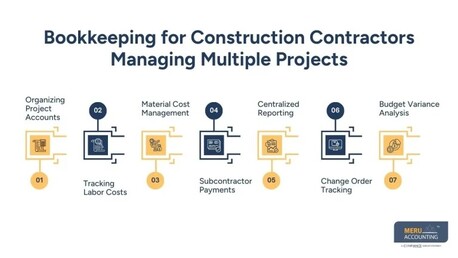
Construction companies often handle several projects at once, which makes organization essential. Bookkeeping for construction business helps by:
• Keeping separate accounts for each project
• Tracking labor hours and payroll accurately
• Recording material purchases and matching them to projects
• Monitoring subcontractor payments
• Centralizing financial data for easy reporting
• Tracking change orders and additional work
• Comparing actual costs with budgets
These practices provide a clear view of each project’s financial performance.
Important Financial Metrics to Track
To stay financially healthy, construction companies should monitor key metrics, including:
• Gross profit margin to measure overall profitability
• Project cost variance to compare estimated and actual costs
• Accounts receivable aging to track unpaid invoices
• Labor efficiency to measure productivity
• Overhead ratio to monitor indirect costs
• Equipment utilization to ensure resources are used effectively
• Change order impact on project profitability
Tracking these indicators helps businesses make informed decisions and improve performance.
Tips to Simplify Bookkeeping During Growth
As projects expand, keeping finances organized becomes more challenging. These tips can help:
• Use separate accounts for each project
• Automate data entry where possible
• Reconcile accounts regularly
• Track subcontractor work carefully
• Train staff on consistent bookkeeping practices
• Monitor budgets regularly to catch issues early
• Use cloud tools for real-time access to financial data
These steps help reduce errors and keep operations running smoothly.
Professional Bookkeeping Support
Managing finances in a changing construction environment can be complex. Working with experts like Meru Accounting can help construction businesses maintain accurate records, control costs, and improve reporting.
Professional support allows contractors to focus on delivering projects while ensuring their financial data remains organized and reliable.
Conclusion
Bookkeeping for construction business is more critical than ever as companies shift from fixed-price to cost-plus contracts. Detailed expense tracking, clear reporting, and organized financial records help construction companies manage multiple projects, maintain profitability, and reduce risks.
By adopting strong bookkeeping practices and monitoring key financial metrics, construction businesses can stay financially healthy and adapt successfully to changing project models.
Key Takeaways
• Bookkeeping for construction business is essential as pricing models evolve
• Cost-plus projects require detailed expense tracking and clear documentation
• Organized records help manage multiple projects efficiently
• Tracking financial metrics supports better decision-making
• Professional bookkeeping support improves accuracy and compliance
FOR MORE INFO: https://www.meruaccounting. ...