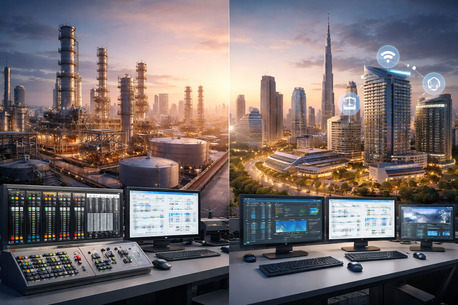
What are the typical roles and responsibilities of automation contractors in the UAE?
Automation contractors typically provide a range of services, including engineering, integration, commissioning, and support.
Control system design and integration (PLC, DCS, PAC)
SCADA/HMI development, telemetry, and reporting
Instrumentation and panels (design, wiring, testing)
Safety systems (when applicable)
Upgrades/retrofits for brownfield plants
O&M support/troubleshooting
EEIC provides industrial automation services, including PLC/DCS design and integration, SCADA/HMI and telemetry, safety instrumented systems (SIS), and tank gauging and process control.
Industrial Automation vs. Building Automation in the UAE: What’s the Difference?
Industrial automation (plants, utilities, process industries)
Industrial environments prioritize production continuity, safety, and reliability. These facilities typically rely on PLC/DCS control systems integrated with SCADA and HMI platforms. A typical industrial solution encompasses integration of PLC/DCS with SCADA/HMI and telemetry systems.
Building automation (commercial, residential, mixed-use)
Building automation focuses on enhancing comfort, optimizing energy use, orchestrating HVAC systems, and centralizing monitoring. This is achieved through Building Management Systems (BMS) and Building Automation Systems (BAS).
Market demand for building automation is also increasing. Credence Research estimates the market for building automation systems in the UAE at USD 1,116.36 million in 2023, with projections suggesting it will grow to USD 1,822.74 million by 2032. This represents a compound annual growth rate (CAGR) of 6.32% from 2024 to 2032.
Key Services Offered by Automation Companies and System Integrators in the UAE
Many prominent automation companies in the UAE identify themselves as comprehensive providers across industrial, building, and IoT sectors. For example, Startech GCC clearly outlines its expertise in industrial automation, building automation (BACS/BMS), and IoT automation systems. This includes capabilities such as PLC panel design and integration, as well as cloud-connected monitoring features.
Featured Company: Tekzone, a leading automation company
One example of an automation contractor operating in the UAE market is Tekzone, which integrates industrial construction with automation engineering.
Tekzone emphasizes the key aspects of its profile.
Tekzone is an industrial construction company located in Dubai, UAE. The organization has several engineering divisions, including Mechanical Engineering, Electrical and Instrumentation Engineering, and Industrial Automation. The company has been operational since 2005.
Tekzone states that it focuses on various industrial sectors.
Tekzone identifies key sectors for industrial automation, including oil and gas, industrial production facilities, as well as food, pharmaceutical, and dairy plants, particularly focusing on factory automation.
Automation technologies referenced by Tekzone.
Tekzone's services page FAQ states that it has completed plant automation using PLC, SCADA, and HMI systems. It also mentions various vendors like Siemens, Rockwell Automation, and WAGO.
Tekzone’s Perspective on the Acceleration of Automation in the UAE
In an article by Tekzone, industrial automation in the UAE is described as a “transformative force.” The article highlights several benefits of automation, including increased efficiency, cost reduction, enhanced safety, scalability, and improved quality control. Additionally, Tekzone outlines its comprehensive approach to automation, which includes consultation, design, implementation, and maintenance.
How to choose the right Automation Contractor in the UAE (evaluation checklist)
When evaluating automation contractors, request proof in the following areas:
Project delivery coverage: Can they provide comprehensive services from design to commissioning and handover, particularly for brownfield upgrades?
Controls platform experience: PLC, SCADA, HMI, telemetry, networking, and integration with existing systems.
Safety and reliability approach: Testing philosophy, alarm systems, redundancy strategies, and the depth of documentation.
Sector familiarity: Oil and gas, food and pharmaceuticals, and utilities have distinct constraints such as regulatory requirements, safety standards, and operational challenges that affect automation solutions.
Support readiness: Response time, spare parts strategy, remote monitoring, and maintenance model.
If you need a contractor who can integrate automation with comprehensive industrial execution, Tekzone’s services include EPC-type delivery steps, from engineering through testing and commissioning. This specifically addresses electrical, instrumentation, and automation within the EPC framework.
Conclusion
The automation landscape in the UAE is divided into two main categories: industrial automation and building automation. Industrial automation includes PLC/DCS systems, SCADA/HMI, and instrumentation. In contrast, building automation involves BMS/BAS for HVAC, security integration, and energy management.
The UAE's building automation market is expected to grow significantly until 2032, leading to a strong demand for skilled contractors and integrators. Organizations seeking a partner for industrial project execution—particularly in managing large-scale manufacturing and production projects, along with automation engineering—should consider Tekzone. Tekzone stands out as one of the leading automation companies, focusing on industrial automation and offering EPC (engineering, procurement, and construction) style delivery across multiple sectors in the UAE.
FAQs
Q1) What is the difference between an automation contractor and a company in the UAE?
In practice, the terms often overlap. The term "contractor" typically emphasizes on-site execution, installation, and commissioning, whereas "company" usually focuses on design, integration, and products. Many providers in the UAE offer both services.
Q2) What systems are most common in industrial automation projects?
Common technology stacks include PLC/DCS control systems, SCADA/HMI interfaces, telemetry, and safety systems when necessary. EEIC identifies typical deliverables to include PLC/DCS integration, SCADA/HMI/telemetry systems, safety instrumented systems (SIS), and tank gauging/process control.
Q3) Does Tekzone do PLC and SCADA-based factory automation?
Tekzone's services page FAQ states that it has implemented plant automation using PLC, SCADA, and HMI systems, specifically menti