Understanding what is owner's equity on a balance sheet is important for anyone managing or analyzing a business. Owner’s equity shows the value that belongs to the owners after all debts are paid. It helps measure financial strength, stability, and overall business worth.
What Is Owner’s Equity?
Owner’s equity is the remaining value of a business after subtracting liabilities from assets. In simple terms, it is what the owners actually “own” in the business.
It is calculated using the basic accounting formula:
Owner′s Equity=Assets−Liabilities Owner's\ Equity = Assets – Liabilities Owner′s Equity=Assets−Liabilities
This formula explains clearly what is owner's equity on a balance sheet—the leftover value after all obligations are settled.
Key Components of Owner’s Equity
Owner’s equity is made up of several parts, each showing how value is built in a business:
• Paid-in capital: Money invested by owners or shareholders
• Retained earnings: Profits kept in the business over time
• Treasury stock: Shares bought back by the company (reduces equity)
• Other comprehensive income: Gains or losses not included in regular profit
Understanding these components gives a clearer picture of what is owner's equity on a balance sheet and how it changes over time.
How It Fits into the Balance Sheet
A balance sheet has three main parts:
• Assets: What the business owns
• Liabilities: What the business owes
• Owner’s equity: What remains for the owners
Owner’s equity balances the equation and shows the company’s net worth.
Why Owner’s Equity Matters
Knowing what is owner's equity on a balance sheet helps businesses and investors in many ways:
• Shows financial health: Higher equity usually means a stronger business
• Builds investor confidence: Indicates value and growth potential
• Supports borrowing: Lenders look at equity before giving loans
• Guides decisions: Helps in planning investments and expansion
• Affects valuation: Important for determining business worth
Owner’s Equity in Different Business Types
• Sole proprietorship: Equity is the owner’s total investment plus profits
• Partnership: Each partner has a separate equity account
• Corporation: Includes shareholder investments and retained earnings
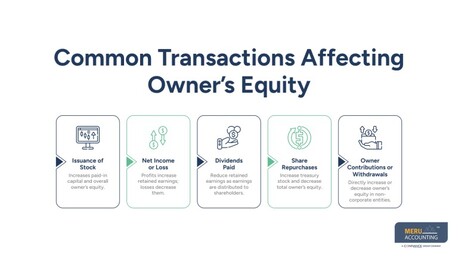
Common Transactions That Affect Equity
• Owner investments increase equity
• Profits increase retained earnings
• Losses reduce equity
• Dividends reduce retained earnings
• Share buybacks reduce total equity
Simple Steps to Calculate Owner’s Equity
1. Add total assets
2. Add total liabilities
3. Subtract liabilities from assets
This quick method helps you understand what is owner's equity on a balance sheet and evaluate business value easily.
Final Thoughts
Learning what is owner's equity on a balance sheet is key to understanding a company’s true financial position. It shows how much value belongs to the owners and how well the business is performing over time.
With a clear understanding of owner’s equity, businesses can make better financial decisions and plan for long-term growth.
Meru Accounting is a trusted name in financial services, offering comprehensive accounting solutions tailored to meet the needs of businesses of all sizes.
FOR MORE INFO: https://www.meruaccounting. ...