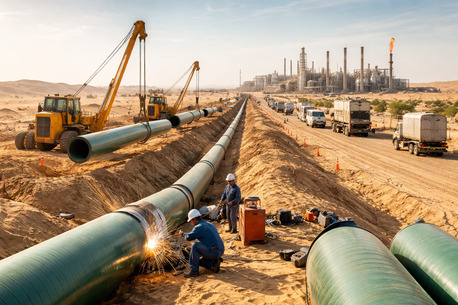
In the UAE’s oil and gas sector, pipeline construction is no longer just a question of scale—how many kilometers laid or how much steel installed. The conversation has shifted. Today, project owners and financial decision-makers are asking a far more critical question:
Will this pipeline deliver reliable returns for the next 30 years?
This shift has redefined the role of pipeline contractors across the region. They are no longer just builders. Instead, they are expected to act as long-term risk managers—partners responsible for ensuring that every design decision, weld, and coating contributes to durability, uptime, and financial performance over the long term.
From Construction to Lifecycle Thinking
Modern pipeline projects in the UAE are being designed with a lifecycle-first approach. Every stage—from material selection to installation techniques—is evaluated not just for immediate efficiency, but for its long-term impact on maintenance costs, operational reliability, and asset lifespan.
This means anticipating problems before they occur, rather than fixing them after the fact. It’s a subtle shift in mindset, but one that has a profound effect on both performance and profitability.
The Rise of the “Zero-Unplanned Downtime” Standard
In an industry where a single day of downtime can translate into millions in losses, reliability is everything. As a result, many projects now operate under a strict principle: zero unplanned downtime.
Achieving this standard requires a fundamentally different approach to engineering and execution:
Predictive, Not Reactive
Instead of waiting for issues to surface, contractors are embedding monitoring systems during construction itself. Fiber-optic sensing technologies, for instance, can detect changes in temperature, pressure, or structural stress along the pipeline in real time—allowing operators to act before small issues escalate.
Corrosion as a Financial Risk
In the UAE’s saline and often aggressive soil conditions, corrosion is inevitable—but unmanaged corrosion is expensive. Today’s projects treat corrosion protection as a financial safeguard.
Advanced coating systems such as 3-layer polyethylene (3LPE), combined with modern cathodic protection, are selected not just for technical performance but for their ability to reduce long-term repair and replacement costs.
Why Logistics Are Now a Core Engineering Strategy
While much attention is often given to welding techniques or installation methods, one of the most significant performance drivers lies elsewhere: project logistics.
A pipeline is only as strong as the conditions under which it is built.
Controlled Spool Fabrication
To avoid the challenges of extreme heat and sandstorms, many contractors now fabricate pipeline spools in controlled environments. This ensures consistent weld quality and reduces the risk of defects that could lead to costly rework on-site.
Eliminating Hidden Delays
Even factors like residual magnetism in pipes—often overlooked—can interfere with automated welding processes and slow down production. Practices such as pre-weld degaussing are increasingly being adopted to maintain efficiency and avoid unexpected delays.
ICV Compliance: More Than a Regulatory Requirement
In the UAE, In-Country Value (ICV) is not just a box to tick—it’s a strategic component of project planning. National oil companies expect a meaningful portion of project value to be reinvested into the local economy.
For contractors, this means integrating local sourcing, workforce participation, and in-country services into their execution model. When implemented effectively, ICV compliance not only meets regulatory expectations but also enhances supply chain resilience and fosters trust among stakeholders.
The Quiet Financial Power of Hot Tapping
Among the many specialized services in pipeline engineering, hot tapping stands out for its direct financial impact.
It enables new connections and expansions without interrupting operations, preventing costly downtime.
In some cases, the value preserved through uninterrupted operations far exceeds the cost of the construction work itself.
FAQs: A Financial Perspective on Pipeline Decisions
Q1. How does contractor selection affect long-term insurance costs?
Insurance providers assess risk based on construction quality, inspection standards, and corrosion protection measures. Contractors who follow advanced practices can help reduce perceived risk—and potentially lower premiums.
Q2. What is the biggest financial risk in pipeline projects?
Geotechnical uncertainty remains one of the most significant risks. Unexpected ground conditions can damage coatings and lead to long-term maintenance challenges if not properly addressed during the design phase.
Q3. Is cold cutting economically advantageous?
Yes, particularly in live systems. Unlike traditional thermal cutting, cold cutting can often be performed without a full shutdown, reducing both downtime and associated costs.
Q4. What is the typical lifespan of a well-built pipeline in the UAE?
With proper coating systems and cathodic protection in place, pipelines can reliably operate for 30 to 40 years—or longer.
Q5. What does ROI-driven pipeline construction really mean?
It means designing and executing pipelines with long-term performance in mind—integrating monitoring, corrosion protection, and operational continuity strategies to maximize financial returns over the asset’s lifespan.
Conclusion: Delivering Engineering Certainty
The future of oil and gas construction in the UAE will not be defined by speed alone. It will be shaped by those who can deliver engineering certainty—the confidence that a pipeline will perform safely, efficiently, and predictably for decades.
For project owners, choosing the right contractor is therefore not just a procurement decision. It is a long-term investment in reliability, uptime, and financial stability.
Because in today’s environment, the true value of a pipeline is not measured when it is completed—but in how consistently it performs over time.