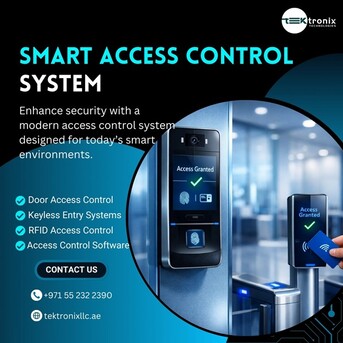
1. Why the UAE Demands a Smarter Access Control System
Rapid urbanization, a highly mobile workforce, and an increasingly complex threat landscape have raised the stakes for physical security across the Emirates. Traditional locks, security guards, and paper-based visitor logs are no longer sufficient for facilities managing hundreds — or thousands — of individuals daily. Organizations require systems that combine automation, intelligence, and accountability.
The most pressing security risks organizations face today include:
• Unauthorized entry into restricted or sensitive zones
• Credential sharing, theft, or duplication among employees and visitors
• Absence of real-time visibility into who is on-site at any given moment
• Compliance gaps with local regulatory and data protection frameworks
• Slow incident response due to fragmented security systems
A well-designed Access Control System addresses each of these vulnerabilities with precision — automating entry protocols, enforcing access policies, and generating full audit trails that serve both security and compliance needs.
2. Understanding the Access Control System: Architecture and Intelligence
A modern Access Control System is far more than an electronic lock. It is an integrated platform that combines hardware, software, and cloud intelligence to manage and monitor every access event across a facility — in real time, at scale.
Core capabilities of an enterprise-grade system include:
• Role-based access policies: Define who can enter specific zones based on job function, clearance level, or time of day.
• Real-time monitoring and event logging: Every access attempt — successful or denied — is recorded with timestamps and user identity.
• Centralized management dashboard: Administrators manage multiple buildings or floors from a single interface.
• API integration with HR, IT, and building management systems: Onboarding or offboarding an employee automatically updates their access rights.
• Automated alerts and incident escalation: Suspicious patterns trigger notifications to security teams instantly.
For organizations operating across the UAE — particularly in sectors like finance, healthcare, and government — this level of control and traceability is not optional. It is a foundational requirement
3. Biometric Access Control System: The Future of Identity Verification
Among the most powerful innovations reshaping physical security is the Biometric Access Control System. Unlike traditional credential-based systems that rely on cards, PINs, or keys, biometric solutions verify identity through unique biological traits — traits that cannot be shared, stolen, or duplicated.
Common biometric modalities in use across the UAE include:
• Fingerprint recognition — widely deployed for workforce management and office access
• Facial recognition — used in airports, government buildings, and high-traffic public spaces
• Iris scanning — preferred in environments requiring the highest level of identity assurance
• Palm vein recognition — increasingly popular in healthcare due to its hygiene advantages
• Voice authentication — emerging in remote and mobile access scenarios
The Biometric Access Control System eliminates the most common failure point in conventional security: the human factor. There are no forgotten PINs, no lost access cards, and no possibility of credential sharing among staff. Every entry is uniquely tied to a verified individual, creating an unbreakable chain of accountability that is invaluable for organizations managing sensitive data, high-value assets, or restricted operational areas.
In environments like pharmaceutical warehouses, data centers, and financial institutions across Dubai and Abu Dhabi, biometric verification has become the standard, not the exception.
Conclusion
The UAE's ambition to build the world's smartest, most secure urban environments demands security infrastructure that matches that vision. A modern Access Control System — enriched with Biometric Access Control System capabilities, anchored by intelligent Door Access Control, unified under a comprehensive Security Access Control framework, and delivered through tailored Access Control Solutions — is no longer a luxury. It is the operational standard for any organization that takes security, compliance, and efficiency seriously.
Whether you are operating in the high-rise commercial districts of Dubai, the governmental corridors of Abu Dhabi, or the industrial zones of Sharjah, the need for precision access management is universal. Tektronix LLC brings the expertise, technology, and local knowledge required to design and implement systems that protect your people, your assets, and your reputation.
For more information contact us on:
Tektronix Technology Systems Dubai-Head Office
[email protected]
+971 50 814 4086 +971 55 232 2390
Office No.1E1 Hamarain Center 132 Abu Baker Al Siddique Rd – Deira – Dubai P.O. Box 85955