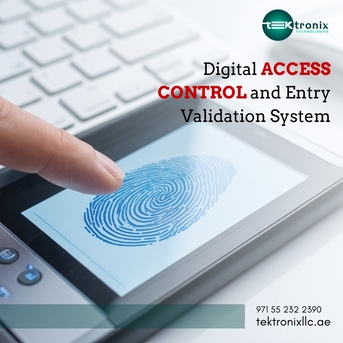
The intelligent, policy-driven answer that the UAE’s leading organisations have converged on is a purpose-engineered Access Control System. These platforms replace static physical hardware with dynamic, software-governed permission frameworks: role-based access policies that update instantly across an entire estate, multi-factor identity verification that eliminates credential fraud, real-time movement intelligence that transforms reactive security into proactive threat management, and deep integration with the broader organisational technology environment. Tektronix LLC has spent years designing and deploying these intelligent entry management platforms across the Emirates, combining certified regional expertise with internationally proven technology.
This guide covers every critical dimension of modern physical security: the architecture of enterprise-grade access control, the identity assurance of biometric technology, door-level hardware precision, unified security strategy frameworks, the reader technology ecosystem, industry-specific applications across UAE sectors, smart building integrations, and the implementation best practices that ensure deployments perform at full capability from day one.
1. Why Physical Security is a Strategic Imperative Across the UAE
The UAE’s combination of internationally mobile workforce, high-value critical infrastructure, densely occupied commercial buildings, and rapidly scaling smart city ambitions creates a physical security landscape of exceptional complexity. Facilities in this market must simultaneously accommodate seamless, frictionless access for thousands of authorised users while maintaining absolute, auditable control over restricted zones, sensitive assets, and high-risk perimeter entry points — often within the same building and within the same working hour.
Regulatory pressure is intensifying in parallel with physical growth. Sector-specific compliance standards in banking, healthcare, oil and gas, government, and critical national infrastructure now mandate documented access event trails, defined minimum retention periods for security records, and the demonstrable ability to produce audit-ready reports within hours of a regulatory request. Manual processes — paper visitor logs, physical key management registers, verbal access approvals — expose organisations to compounding compliance risk, operational inefficiency, and security liability that a well-specified digital platform eliminates entirely.
A modern Access Control System UAE deployment addresses all of these pressures simultaneously: automating entry management end-to-end, enforcing granular access policies in real time, generating tamper-evident searchable audit trails, and feeding operational intelligence into the broader physical and digital security ecosystem.
Core Security Vulnerabilities That Drive Deployment
• Unauthorised zone penetration: employees, contractors, or visitors accessing restricted areas beyond their approved clearance level without detection
• Credential vulnerability: lost, cloned, or informally shared physical keys and proximity cards creating invisible, unlogged security gaps
• Compliance audit exposure: absence of timestamped, user-attributed access event records that satisfy regulatory inspection requirements
• Reactive-only security posture: security operations responding to incidents after they have occurred rather than detecting and preventing them in real time
• Multi-site visibility gaps: organisations operating across Dubai, Abu Dhabi, and Sharjah lacking unified, consolidated oversight of access activity across all locations
2. Access Control System: Architecture, Intelligence, and Centralised Command
At its foundational level, an Access Control System is a technology platform that determines who may enter or exit a physical space, under precisely what conditions, and at exactly what times — replacing the inflexibility and invisibility of mechanical locks with dynamic, policy-driven digital permissions that can be reconfigured instantly across an entire facility estate without touching a single piece of hardware.
Enterprise-grade deployments are built on a three-layer architecture. At the edge layer, credential readers authenticate individuals at each entry point and pass encrypted authentication signals to controllers. In the processing layer, controllers evaluate that signal against stored access policies — role permissions, time schedules, zone restrictions — and issue a grant or denial response to the locking hardware in milliseconds. At the management layer, a centralised software platform provides administrators with live dashboards, policy configuration tools, compliance reporting suites, and integration connectors to HR directories, Active Directory, CCTV networks, and visitor management platforms.
For organisations operating across multiple Emirates — commercial offices in Dubai, government facilities in Abu Dhabi, and industrial or educational sites in Sharjah — a unified platform eliminates the fragmentation and inconsistency of managing separate systems per location. Policy changes propagate instantly to every site; consolidated reporting provides a single, trustworthy view of access activity across the entire estate.
Conclusion
Across the UAE, the organisations building the most resilient, efficient, and regulation-ready facilities share a common security foundation: a purpose-engineered Access Control System that combines the fraud-proof identity assurance of a Biometric Access Control System, the hardware-level enforcement precision of Door Access Control, the unified strategic framework of Security Access Control, and the sector-specific engineering of tailored Access Control Solutions — all governed through intelligent, deeply integrated software and delivered to the user population through a best-in-class Access Control Readers ecosystem. Together, these components transform a facility’s front door from a vulnerability into a controlled, intelligent, and operationally valuable security asset.
Whether your organisation operates in the commercial districts of Dubai, the government and critical infrastructure corridors of Abu Dhabi, or the industrial and educational zones of Sharjah, Tektronix LLC has the certified regional expertise, cross-sector deployment depth, and long-term support commitment to deliver a physical entry management solution precisely calibrated to your security requirements, compliance obligations, and operational environment.
For more information contact us on:
Tektronix Technology System