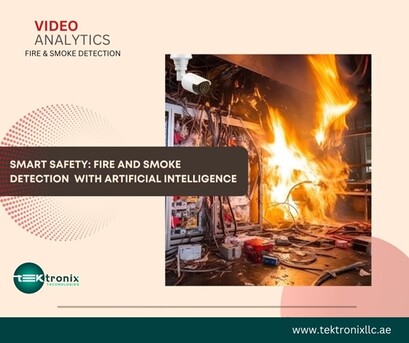
The answer lies in a technology that has fundamentally changed the fire safety equation: Video Analytics. By embedding artificial intelligence directly into the surveillance infrastructure already present in modern buildings, organisations across Dubai, Abu Dhabi, and Sharjah are now detecting smoke and flames within seconds — not minutes — of ignition.
Why Traditional Fire Detection Systems Are No Longer Sufficient
Conventional fire safety relies on threshold-based sensors. A detector trips when smoke density or temperature crosses a preset value. In a compact, enclosed room, this approach is adequate. But in the open-plan offices, atriums, logistics warehouses, and multi-storey retail environments that define modern UAE real estate, the limitations become acute.
The core problems with legacy systems include:
• Delayed detection in large, open, or high-ceiling spaces where smoke disperses before reaching a sensor
• No visual confirmation — security teams cannot distinguish a genuine fire from steam, dust, or cooking fumes without going to the scene
• High rates of false alarms, which erode staff trust and lead to slower responses over time
• Single-point coverage — a sensor covers a fixed radius and cannot adapt to changing floor layouts or occupancy patterns
• No integration with wider building intelligence systems
These gaps are not simply inconvenient — they represent a genuine risk to life and property. The UAE's Civil Defence regulations demand increasingly proactive fire safety postures, and the technology sector has responded with solutions that meet this standard. Chief among them is AI-Powered Video Analytics.
What Is AI-Powered Video Analytics and How Does It Work?
AI-Powered Video Analytics is the application of machine learning and computer vision algorithms to live CCTV video streams. Rather than passively recording footage for later review, the system analyses each video frame in real time, identifying visual patterns associated with smoke, fire, unusual crowd movement, or other hazards.
In a fire detection context, the AI model has been trained on thousands of smoke and flame behaviours across diverse environments — different lighting conditions, camera angles, smoke densities, and fire intensities. When the live feed matches a pattern in its training data, the system flags it immediately and triggers an alert, all without human monitoring.
Key capabilities of AI-powered detection include:
• Early-stage smoke identification — detecting thin wisps of smoke before visible flames appear
• Flame shape and flicker pattern recognition, distinguishing fire from reflected light or glare
• Simultaneous monitoring of dozens or hundreds of camera feeds from a single platform
• Continuous 24/7 operation with no fatigue, distraction, or shift handover gaps
• Mask-aware detection that functions across varying environmental conditions
The result is a detection system that is both faster and more reliable than any sensor-only alternative — a critical advantage in environments where seconds determine outcomes.
Video Analytics Software: The Engine Behind Accurate Detection
The intelligence behind these detection systems is delivered through specialised Video Analytics Software — the platform layer that processes incoming video data, runs AI inference models, manages alert workflows, and presents actionable information to security and operations teams.
This software layer is what differentiates a basic CCTV installation from a fully intelligent safety infrastructure. Core capabilities include:
• Real-time video processing: Frames are analysed at full resolution as they are captured, with zero meaningful delay between detection and alert.
• AI-based pattern recognition: Deep learning models identify fire-related visual signatures with high accuracy, dramatically reducing false positive rates compared to sensor-only systems.
• Customisable detection zones: Operators define specific camera regions where smoke or fire detection is active, concentrating analytical resources on high-risk areas.
• Audit trail and evidence capture: Every detection event is logged with a timestamped video clip, providing the evidentiary record required by insurers and regulatory bodies.
• Integration APIs: The software connects to fire alarm panels, building management systems, access control platforms, and emergency notification services.
When evaluating Video Analytics Software for fire detection, enterprise buyers should assess not only the accuracy of the AI models but also the platform's scalability — its ability to grow from a single building to a multi-site estate without architectural changes.
The Future of Fire Detection Technology in the UAE
The UAE's commitment to smart city infrastructure and the Vision 2031 agenda ensures that the technology curve for building safety will continue to steepen. Several emerging developments will shape the next generation of Video Analytics Solutions in the region:
• Edge AI processing: Moving inference computation onto the camera device itself, reducing latency to near-zero and maintaining detection capability during network disruptions.
• Predictive risk analytics: Machine learning models that identify environmental conditions associated with elevated fire risk before any smoke or flame appears, enabling truly preventive safety management.
• IoT sensor fusion: Combining video analytics data with air quality sensors, temperature monitors, and gas detectors to create multi-modal hazard detection with near-zero false positive rates.
• Cloud-native management platforms: Centralised administration of fire detection policies and alert data across geographically distributed building estates through secure cloud infrastructure.
• Digital twin integration: Linking video analytics data to 3D building models to give emergency responders precise visual context during incident response.
Organisations that invest in AI-powered Video Analytics infrastructure today are not only addressing their current fire safety obligations — they are building the foundation for these next-generation capabilities as they mature.
Conclusion
Fire safety in modern UAE buildings can no longer rely solely on threshold-triggered sensors and reactive detection. The speed, scale, and complexity of the country's built environment demand intelligent, proactive systems that identify hazards at the earliest possible moment and trigger coordinated responses before situations escalate.
Video Analytics — and specifically the application of AI-Powered Video Analytics to fire detection — represe