What Is a True Presence Sensor?
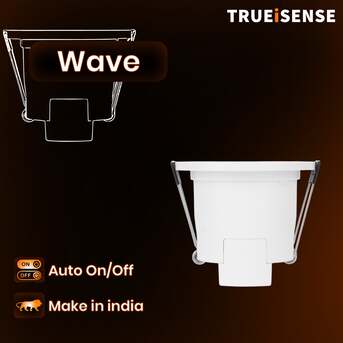
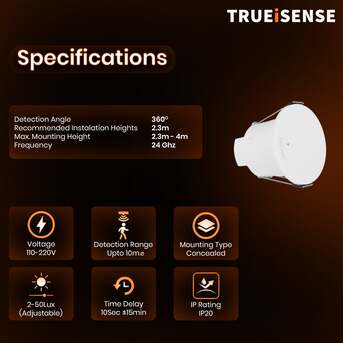
A true presence sensor uses millimetre-wave (mmWave) radar technology operating at 24 GHz or 60 GHz to detect the actual physical presence of a human being — including when they are completely still. Unlike PIR sensors that detect heat-based movement, mmWave radar detects micro-movements such as breathing, heartbeat, and minor muscle twitches that a living human body generates continuously. The result: a sensor that can distinguish between an occupied room with a stationary person and a genuinely empty room — with a false-off rate close to zero.
True Presence vs PIR vs Radar — Key Differences
PIR Sensor
Detects: Body heat movement.
Limitation: Fails to detect stationary occupants.
Best for: Corridors, entrances, parking — locations with consistent movement.
False-off rate: High in office/desk environments.
Standard Radar (Microwave) Sensor
Detects: Motion via microwave reflection.
Limitation: Better than PIR for stationary detection but still prone to false-offs with very still occupants.
Best for: Offices, meeting rooms.
False-off rate: Medium.
True Presence Sensor (mmWave)
Detects: Breathing, heartbeat, micro-movements — any living human in range.
Limitation: Higher cost than PIR.
Best for: Private offices, executive cabins, hospital rooms, washrooms, meeting rooms, critical areas.
False-off rate: Near zero.
Real Presence Sensor — Applications Where It Is Essential
Executive Offices and Private Cabins
Senior executives frequently sit still for extended periods during calls, reading, or thinking. A PIR sensor will routinely switch off their lights. A Trueisense real presence sensor keeps the lights on reliably throughout the working session, switching off only when the room is genuinely vacated.
Hospital Rooms and ICUs
In healthcare environments, lighting switching off unexpectedly is a patient safety and care quality issue. Trueisense true presence sensors ensure lights in patient rooms, ICUs, examination rooms, and consultation areas remain on whenever a person — patient or medical staff — is present.
Washrooms and Restrooms
Washroom cabinets and individual toilet stalls are perhaps the most critical application for true presence sensing. In a closed stall with a stationary occupant, a PIR sensor will switch off within minutes. The Trueisense true presence sensor detects the occupant through the micro-movements of breathing and never switches off mid-use.
Meeting Rooms and Conference Rooms
Participants in a meeting frequently sit still while listening or watching a presentation. Trueisense true presence sensors keep meeting room lighting active throughout the session and switch off only when all participants have left.
Smart True Presence Sensor — Intelligence Beyond Detection
The Trueisense smart true presence sensor adds a layer of intelligence beyond simple on/off. It can: report occupancy count data to a central dashboard, adjust lighting intensity based on detected occupancy level (one person vs full room), integrate with HVAC and climate control systems to automatically adjust air conditioning based on room occupancy, and provide occupancy analytics for space planning — helping facility managers understand which rooms are over- and under-used.
Benefits of Presence Sensors vs Conventional Motion Sensors
Zero false-offs: Lights stay on as long as a person is present, regardless of activity level.
Superior energy savings: Lights switch off the moment a room is genuinely empty — not after a long PIR timeout waiting for movement.
Healthcare compliance: Meets hospital lighting reliability requirements.
User comfort: Eliminates the frustration and disruption of unexpected light switch-offs.
Analytics-ready: Occupancy data feeds into energy and space management dashboards.
Integration-ready: Works with BMS, DALI, LoRaWAN, and smart building platforms.
Trueisense — True Presence Sensor Manufacturer in India
Trueisense is India's dedicated true presence sensor manufacturer and sensor lighting solutions provider. Trueisense true presence sensors are designed and tested for Indian commercial, industrial, and institutional environments — offering reliability in variable temperature, humidity, and building layout conditions prevalent across India. All Trueisense sensors are available for both retrofit and new installation projects, with full technical support and on-site commissioning.
Frequently Asked Questions (FAQs)
Q: What is the difference between a motion sensor and a true presence sensor?
A: A motion sensor (PIR) detects body heat movement and fails when a person is stationary. A true presence sensor uses mmWave radar to detect micro-movements (breathing, heartbeat) and reliably detects any living person in range, including when completely still.
Q: Who is the true presence sensor manufacturer in India?
A: Trueisense is a leading true presence sensor manufacturer in India, based in Noida. Trueisense designs, manufactures, and deploys true presence sensors for offices, hospitals, commercial spaces, and industrial facilities across India.
Q: What is the detection range of a Trueisense true presence sensor?
A: The Trueisense true presence sensor has a standard detection range of 3–8 meters radius depending on the model, with adjustable sensitivity to suit room sizes from small private offices to large conference rooms.