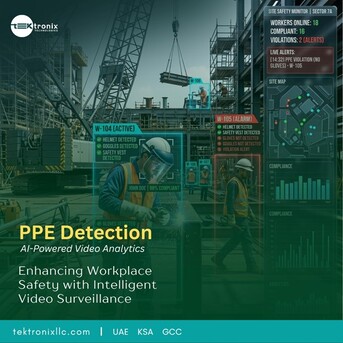
Saudi Arabia’s industrial sector is undergoing a seismic transformation under Vision 2030, accelerating investment across oil and gas, construction, manufacturing, mining, and logistics. In every one of these high-risk environments, Personal Protective Equipment (PPE) compliance is both a legal obligation and a frontline defence against preventable workplace injuries.
Manual supervision cannot keep pace with modern industrial scale. A single safety officer monitoring hundreds of workers across a sprawling refinery or construction site will inevitably miss violations — creating the blind spots that lead to incidents, regulatory penalties, and project stoppages.
Tektronix LLC delivers purpose-built video analytics solutions for the KSA and GCC market — AI-driven computer vision platforms that monitor every worker, in every camera frame, in real time, and trigger immediate alerts the moment a PPE violation is detected.
1. The Occupational Safety Imperative in Saudi Arabia
Saudi Arabia’s General Organisation for Social Insurance (GOSI) and the Ministry of Human Resources and Social Development enforce strict occupational health and safety (OHS) frameworks aligned with international standards. Non-compliance with PPE requirements carries immediate financial penalties, project suspension orders, and — in cases involving serious injury — criminal liability for responsible parties.
The human cost is equally significant. Head trauma from unhelmeted workers, hand injuries in glove-mandatory environments, and preventable eye injuries in areas requiring protective eyewear continue to occur wherever PPE enforcement relies solely on human observation.
AI-powered PPE detection technology eliminates these blind spots. For industrial operators governed by Saudi Aramco HSSE standards, SABIC safety frameworks, or internationally recognised OSHA-equivalent requirements, automated and documented PPE compliance monitoring is rapidly becoming a procurement and certification prerequisite — not merely a best practice.
2. What Is AI-Powered PPE Detection? How the Technology Works
AI-powered PPE detection is a computer vision application that uses deep learning models to analyse live or recorded video footage and determine, frame by frame, whether each visible worker is wearing the required protective equipment. Detection models are trained on large, labelled image datasets covering a comprehensive range of PPE categories:
• Hard hats and bump caps
• High-visibility (hi-vis) vests and coveralls
• Safety goggles and face shields
• Protective gloves and hand coverings
• Respiratory face masks and respirators
• Safety boots and steel-toed footwear
• Ear protection and hearing defenders
The detection workflow follows a structured sequence:
• Camera capture: Cameras at entry points, work zones, and high-risk areas stream live video to an AI processing engine.
• Frame-by-frame analysis: The engine identifies individual workers within each frame and classifies their PPE status against zone-specific requirements.
• Violation detection: When a worker is identified as non-compliant — entering a hard hat zone without a helmet, for example — the system flags the event instantly.
• Automated alerting: The system timestamps the violation, captures image or video evidence, and dispatches real-time notifications via SMS, email, or a centralised monitoring dashboard.
This entire process — from visual detection to supervisor alert — occurs within seconds, enabling intervention before a safety incident takes place rather than investigation after the fact.
3. Video Analytics: The Intelligent Safety Monitoring Platform
Video analytics is the broader technology discipline from which PPE detection is derived. It refers to the application of artificial intelligence and machine learning algorithms to video data — transforming raw camera footage from a passive recording medium into an active, real-time intelligence source.
In workplace safety applications, an enterprise-grade video analytics platform does far more than monitor PPE compliance. Core capabilities include:
• Zone intrusion detection: Flags unauthorised access to restricted or hazardous areas.
• Crowd density and mustering analysis: Identifies unsafe worker congregation in confined spaces.
• Fire and smoke detection: Supplements traditional sensor-based systems with real-time visual confirmation.
• Slip, trip, and fall detection: Triggers immediate alerts when a worker falls.
• Behavioural safety analytics: Identifies unsafe working practices such as operating at height without harness attachment.
• Vehicle and pedestrian conflict detection: Monitors traffic management zones for proximity violations.
Tektronix LLC’s video analytics solutions are engineered to deploy across these use cases simultaneously, providing industrial facilities in KSA and the GCC with a unified safety intelligence platform rather than a disconnected collection of point solutions.
4. Video Analytics Software: The Intelligence Engine Behind Safety Monitoring
The performance and reliability of any AI-powered safety deployment depends fundamentally on the quality of its video analytics software. This software layer handles:
• Ingestion and real-time processing of multiple concurrent camera streams
• Frame-by-frame inference using trained deep learning detection models
• Configurable alert logic, sensitivity thresholds, and escalation workflows
• Secure storage of violation event data and associated video evidence
• Compliance analytics dashboards and structured regulatory reporting
Enterprise-grade platforms must process dozens or hundreds of simultaneous camera feeds without latency degradation. They must provide a configurable rules engine allowing safety managers to define different PPE requirements for different zones — and integrate cleanly with access control, incident management, HR, and ERP systems.
Tektronix LLC’s video analytics software platform is designed for the operational realities of KSA and GCC environments — with Arabic-language interface support, regional regulatory reporting formats, and deployment architectures that comply with local data residency requirements.
5. Video Analytics Services: Full-Lifecycle Implementation and Optimisation
Tektronix LLC’s end-to-end managed services cover every stage of a video analytics deployment:
Site Assessment and System Design
Every engagement begins with a thorough site survey — mapping camera positions, identifying coverage gaps, defining zone-specific PPE requirements, and documenting integration requirements with existing safety infrastructure. This foundation ensures the deployed system is calibrated to the facility’s specific operational profile.
Installation and Commissioning
Hardware and software deployment is managed with minimal disruption to ongoing operations. The commissioning process includes system calibration, alert threshold configuration, integration testing with third-party platforms, and on-s