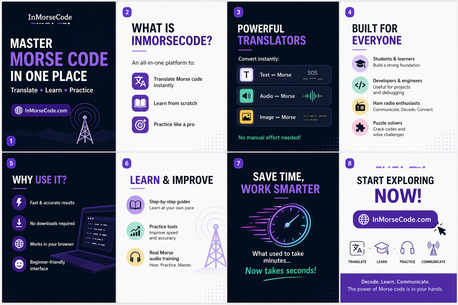
At the center of this revival are Morse code translators, tools that have transformed how people interact with encoded signals. What once required extensive training can now be done instantly with the help of online platforms.
https://inmorsecode.com/
Understanding Morse Code in a Modern Context
Morse code is based on a simple system of dots and dashes, representing letters and numbers. Its brilliance lies in its minimalism—it can be transmitted using sound, light, or even tapping.
Despite advancements in communication technology, Morse code remains useful because it:
Works without internet or complex infrastructure
Can be transmitted in multiple formats
Is easy to learn at a basic level
Remains reliable in emergency situations
These characteristics have allowed Morse code to maintain relevance even in 2026.
The Shift Toward Digital Morse Code Tools
Traditionally, decoding Morse code required manual interpretation. Operators would listen to audio signals or visually interpret dots and dashes. This process demanded focus and experience.
Modern tools have removed this barrier entirely.
Today, a user can visit an online Morse code translator and:
Convert text into Morse code instantly
Decode Morse signals from audio recordings
Upload images containing Morse patterns
Interpret flashing light signals
This transformation has made Morse code accessible to beginners while still serving advanced users.
Real-World Applications of Morse Code Translators
The use of Morse code translators is no longer limited to hobbyists. These tools are now used across various domains.
1. Education and Learning
Students and educators use Morse code to understand the fundamentals of communication systems. It helps improve pattern recognition and memory skills.
2. Puzzle Solving and Entertainment
Morse code is widely used in escape rooms, treasure hunts, and online challenges. Translators make it easier to decode hidden clues quickly.
3. Cybersecurity Challenges
In Capture The Flag (CTF) competitions, Morse code often appears as part of encrypted challenges. Fast decoding tools give participants an advantage.
4. Emergency Communication
In low-resource environments, Morse code can still be used to send signals via light or sound. Translators help interpret these signals accurately.
What Makes a Good Morse Code Translator?
Not all tools offer the same level of performance. A reliable Morse code platform should include:
Support for multiple input types (text, audio, image, light)
Fast and accurate decoding
Clean and easy-to-use interface
Real-time processing
Instead of switching between multiple tools, users benefit from platforms that combine all these features into one place. A well-designed solution like a modern morse code translator allows users to handle different formats efficiently without complexity.
The Role of AI in Modern Morse Code Decoding
Artificial intelligence is enhancing how Morse code is processed. Advanced systems can now:
Filter background noise in audio files
Recognize patterns in low-quality images
Adapt to variations in signal timing
These improvements are making Morse code translators more accurate and reliable than ever before.
Why Morse Code Is Making a Comeback
Morse code is gaining renewed interest due to its versatility and simplicity.
Key reasons include:
Growing popularity of puzzle-based content
Increased use in cybersecurity training
Educational value in teaching communication systems
Its ability to function without modern infrastructure
Final Thoughts
Morse code may be one of the oldest communication systems, but it continues to evolve with modern technology. Digital translators have transformed it from a specialized skill into a widely accessible tool.
As technology advances, Morse code translators will become even more powerful—bridging the gap between traditional communication methods and modern digital needs.