What Is Virtual Accounting?
Virtual accounting involves outsourcing financial tasks to remote professionals using cloud-based tools. It includes bookkeeping, payroll, tax preparation, and financial reporting, all managed online with real-time access to data.
What Is In-House Accounting?
In-house accounting refers to hiring full-time accountants who work within the organization. They handle daily financial tasks, reporting, and compliance while being physically present in the office.
Key Differences: Virtual Accounting vs In-House
• Cost Structure:
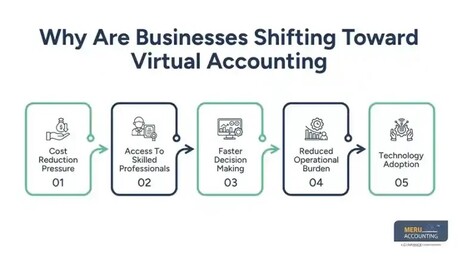
Virtual accounting reduces expenses related to salaries, office space, and training, while in-house teams require fixed costs and benefits.
• Flexibility & Scalability:
Virtual services can scale up or down based on workload, whereas in-house teams are less flexible and harder to adjust quickly.
• Access to Expertise:
Virtual accounting provides access to specialized professionals and advanced tools, while in-house teams may have limited expertise.
• Accessibility:
In-house accountants offer immediate, face-to-face support, while virtual accountants work remotely but provide real-time data access through cloud systems.
• Technology & Efficiency:
Virtual accounting leverages automation and cloud platforms for faster processing, while in-house accounting may rely more on manual processes.
Benefits of Virtual Accounting
• Lower operational costs
• Real-time financial insights
• Access to expert professionals
• Improved efficiency through automation
• Easy scalability for growing businesses
Benefits of In-House Accounting
• Direct communication and control
• Better understanding of internal operations
• Immediate availability for urgent tasks
• Strong integration with company teams
Which One Should You Choose?
• Choose virtual accounting if you want cost savings, flexibility, and expert support without hiring full-time staff.
• Choose in-house accounting if your business requires constant on-site presence, complex operations, or direct supervision.
Conclusion
The debate between virtual accounting vs in-house accounting depends on your business priorities. Virtual accounting offers flexibility, cost efficiency, and scalability, while in-house accounting provides control and direct interaction. Many modern businesses are adopting a hybrid approach to gain the best of both worlds.
In the context of virtual accounting vs in-house, Meru Accounting helps companies simplify financial management through structured remote accounting support.
FOR MORE INFO : https://www.meruaccounting. ...