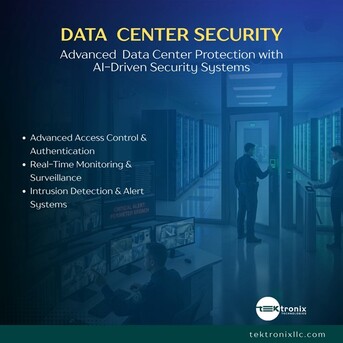
Tektronix LLC is a specialist physical and cyber-security integrator serving Bahrain and the wider GCC, with over a decade of experience designing and deploying layered protection for hyperscale co-location facilities, enterprise server rooms, government cloud nodes, and telecom exchange points. Our six-layered methodology — spanning perimeter hardening, access control, surveillance, threat detection, encryption, and incident response — has become the regional benchmark for operators who cannot afford downtime, data loss, or regulatory penalty.
1. The Threat Landscape: Why Data Centres in Bahrain and the GCC Are High-Value Targets
Modern data centres are not simply server rooms — they are the nervous systems of national economies, banking networks, healthcare platforms, and government services. Their concentration of sensitive data, high-bandwidth connectivity, and physical density of compute infrastructure makes them uniquely attractive to a broad spectrum of adversaries: state-sponsored APT (Advanced Persistent Threat) groups targeting sovereign data, ransomware operators seeking maximum operational leverage, and insider threats exploiting privileged physical and logical access.
Across the Data Center Security GCC landscape, threat actors have increasingly demonstrated the ability to combine cyber and physical attack vectors — a trend known as convergence exploitation. A social-engineering attack that gains physical entry to a cold-aisle server rack can bypass the most sophisticated network security architecture entirely. Equally, a phishing attack that compromises administrator credentials can grant logical access to systems that were thought to be protected by physical perimeter controls. Effective Data Center Threat Detection must therefore operate simultaneously across physical, network, application, and identity planes.
Key Threat Categories Facing GCC Data Centres
• Advanced Persistent Threats (APTs): Nation-state and sophisticated criminal actors conducting long-dwell reconnaissance and exfiltration campaigns targeting financial, government, and energy-sector data assets.
• Ransomware-as-a-Service (RaaS): Industrialised ransomware groups increasingly targeting Tier III and Tier IV facilities, where downtime costs can exceed USD 1 million per hour for co-location clients.
• Insider Threats: Privileged administrators, contractors, and supply-chain personnel with physical or logical access represent the highest-probability breach vector in access-controlled environments.
• Physical Intrusion: Tailgating, social engineering of security personnel, and compromised access credentials enable direct hardware access — theft of drives, installation of keyloggers, or deliberate infrastructure damage.
• Supply Chain Attacks: Compromised firmware, counterfeit network hardware, and malicious software updates introduced through trusted vendor channels bypass perimeter controls entirely.
2. Layer One — Perimeter and Physical Security: The First Line of Defence
The outermost protective ring of any robust Data Center Security architecture is the physical perimeter. No amount of cryptographic sophistication can compensate for a facility that an unauthorised individual can walk into. For Bahrain and GCC operators, physical security design must account for the region's unique threat profile: high ambient temperatures that affect sensor reliability, sand ingress that degrades mechanical locking systems, and the co-location of critical infrastructure within urban commercial developments that present shared-access challenges.
Tektronix LLC's physical perimeter deployments for data centre clients incorporate reinforced anti-ram bollard systems at vehicular entry points, mantrap (airlock) vestibule configurations at pedestrian access, bullet-resistant glazing and anti-climb perimeter fencing rated to CPNI (Centre for the Protection of National Infrastructure) standards, and 360-degree IP PTZ camera coverage with AI-powered video analytics capable of detecting loitering, perimeter breach, and abandoned object scenarios in real time.
Physical Security Technology Stack
• Mantrap Vestibules: Dual-door airlock entry with biometric authentication on both doors — prevents tailgating and forces sequential identity verification for every individual entering the secure zone.
• Anti-Ram Barriers: PAS 68 / IWA 14-1 certified hostile vehicle mitigation (HVM) bollards and barriers at all vehicular approach points, rated to stop a 7,500 kg vehicle at 64 km/h.
• Perimeter Intrusion Detection System (PIDS): Vibration-sensing fence-mounted sensors, buried fibre-optic detection cables, and microwave beam barriers create an invisible detection perimeter beyond the physical boundary.
• AI Video Analytics: Deep-learning camera algorithms classify objects, detect behavioural anomalies, and generate real-time alerts to the security operations centre (SOC) — reducing false-alarm rates by up to 90% versus motion-detection-only systems.
3. Layer Two — Data Center Access Control: Zero Trust From the Door Inward
Controlling who enters which zone of a data centre — and creating an immutable, time-stamped record of every movement — is the defining function of enterprise Data Center Access Control. In a Tier III or Tier IV facility, access policy must reflect the principle of least privilege: every individual is granted access only to the specific cage, suite, or cabinet their role requires, and no further. This granular zone-by-zone access architecture prevents the lateral movement that enables an insider threat or a social-engineered visitor to progress from a public meet-me room to a mission-critical server row.
Modern data centre access control architectures deploy multi-factor authentication (MFA) combining biometric verification (fingerprint, iris, or facial recognition), smart-card credentials (HID Seos, MIFARE DESFire EV3), and PIN-based confirmation for the highest-security zones. Tektronix LLC integrates these credential layers with enterprise PACS (Physical Access Control Systems) platforms from leading manufacturers including HID Global, Lenel S2, Honeywell Pro-Watch, and Genetec Security Centre — enabling centralised policy management, real-time access-event monitoring, and automated deprovisioning when personnel roles change or employment terminates.
Access Control Architecture for Multi-Tenant Co-Location Facilities
• Segregated Tenant Zones: Dedicated cage and suite access credentials per tenant, with cross-tenant access physically impossib