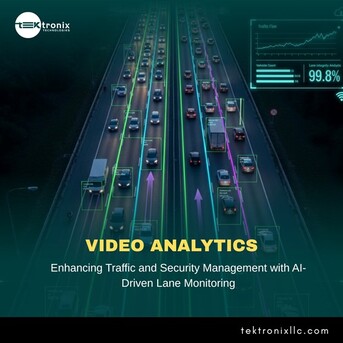
The answer is not more traffic officers or wider lanes — it is smarter infrastructure. Video Analytics powered by artificial intelligence is redefining how road operators, municipalities, and transport authorities monitor, manage, and future-proof their networks. Specifically, AI-Powered Video Analytics for lane monitoring transforms every camera on every motorway into an intelligent, always-on sensor that measures lane occupancy, detects wrong-way drivers, identifies stopped vehicles, flags lane-change violations, and predicts congestion before it materialises.
Tektronix LLC — a specialist physical and cyber-security integrator with over a decade of deployment experience across Bahrain and the wider GCC — delivers end-to-end Video Analytics Solutions for lane monitoring that are purpose-engineered for the region’s climate, infrastructure profile, and regulatory context. Our intelligent transport systems (ITS) division has designed, deployed, and manages AI-driven lane monitoring platforms for government road agencies, toll operators, smart-city projects, and critical highway concessions across the Gulf.
1. Understanding AI-Powered Video Analytics for Lane Monitoring
What Is Video Analytics Software for Roads?
Video Analytics Software is an AI-driven layer that sits above raw camera feeds, applying computer vision algorithms, deep-learning models, and statistical inference to extract actionable intelligence from moving images in real time. In a lane monitoring context, this software classifies every object in a camera’s field of view — vehicle type, speed, trajectory, and lane position — and generates structured event data that feeds traffic management centres, enforcement platforms, and predictive modelling engines.
Unlike legacy video management systems (VMS) that record passively and require human review, modern Video Analytics Solutions operate autonomously. They detect, classify, and alert without waiting for an operator to notice an anomaly. This shift from reactive monitoring to proactive, intelligence-led management is the defining advantage of AI-powered systems over their predecessors.
The Core Capabilities of Lane Monitoring Analytics
A fully deployed AI lane monitoring platform built on Video Analytics Software delivers the following core capabilities across every instrumented lane segment:
• Real-Time Tracking of individual vehicles across multiple lanes, maintaining object identity even through occlusion, lane changes, and camera handoffs at motorway speeds.
• Predictive Analytics engines that forecast congestion onset 8–15 minutes in advance using historical flow patterns, incident data, and real-time density modelling — enabling pre-emptive signal timing and ramp metering adjustments.
• Intrusion Detection for restricted-access lanes, emergency vehicle corridors, and contraflow zones — generating sub-second alerts when an unauthorised vehicle enters a protected lane segment.
• Lane occupancy measurement and vehicle classification (motorcycle, passenger car, light goods vehicle, heavy goods vehicle, bus) at per-lane granularity.
• Wrong-way driver detection with immediate alert propagation to Variable Message Signs (VMS), motorway control centres, and emergency dispatch.
• Stopped vehicle and debris detection with geo-tagged alert output for incident response teams.
• Speed violation identification and automatic number plate recognition (ANPR) integration for enforcement workflows.
2. Why Bahrain and GCC Roads Demand AI-Driven Lane Intelligence
The Regional Traffic Challenge
The GCC’s road network faces a convergence of pressures that conventional traffic management cannot resolve. Vehicle ownership rates across the Gulf rank among the highest globally: Bahrain registers approximately 580 vehicles per 1,000 inhabitants, while Qatar and the UAE exceed 600. Motorway networks designed for the traffic volumes of a decade ago now carry peak flows that strain capacity, elevate accident frequency, and inflate commute times for millions of daily road users.
Compounding the volume challenge is the region’s environmental profile. High ambient temperatures — regularly exceeding 45°C in summer — degrade road surfaces and tyre performance, increasing stopping distances and accident risk. Sandstorms reduce visibility to near-zero across wide highway segments, rendering operator-dependent monitoring systems temporarily blind. Heat haze distorts conventional camera imagery, introducing false negatives in systems that rely on simple motion detection rather than deep-learning object classification.
The business case for Video Analytics GCC deployment is therefore not merely operational — it is economic and safety-critical. The World Health Organization estimates road traffic accidents cost GCC economies in excess of USD 6 billion annually in medical treatment, lost productivity, and infrastructure damage. Every incident prevented by early detection represents a measurable saving in both human and financial terms.
Bahrain’s Smart Roads Vision
Bahrain’s Ministry of Works, Municipalities Affairs and Urban Planning has articulated a clear commitment to intelligent transport systems as a component of the national Economic Vision 2030. The Kingdom’s expanding motorway network — including the Shaikh Khalifa bin Salman Causeway, the Northern Highway expansion, and the urban arterial improvement programme in Manama and Muharraq — presents a defined requirement for Video Analytics Bahrain deployments that meet both operational performance standards and the data-sovereignty requirements of the Bahrain Personal Data Protection Law (PDPL) No. 30 of 2018.
Tektronix LLC’s lane monitoring solutions are designed with Bahrain’s regulatory framework at their core. Our Video Analytics Software processes and anonymises vehicle data within the Kingdom’s borders, satisfying PDPL compliance requirements while delivering the full intelligence capability that road operators require. All personally identifiable information — including number plate images — is processed under role-based access controls with full audit logging, satisfying both the PDPL and the Central Bank of Bahrain’s operational data-governance standards for any adjacent financial infrastructure.
3. The Tektronix LLC Lane Monitoring Architecture
A Multi-Layer Intelligence Platform
Tektronix LLC’s lane monitoring platform is structured as a four-layer intelligence architecture that moves from raw video ingestion at the edge to strategic decision support at the command centre. Each layer adds analytical depth, and the entire stack is built on a foundation of AI-Powered Video Analytics engines that opera