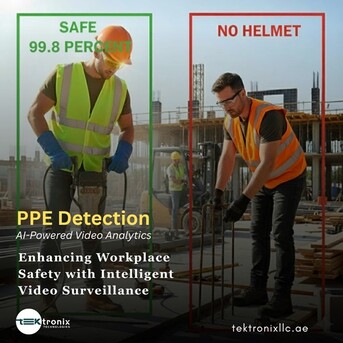
Across construction sites in Dubai, oil and gas facilities in Abu Dhabi, and manufacturing floors in Sharjah, the failure to wear hard hats, high-visibility vests, safety gloves, and protective footwear remains the single largest contributor to preventable workplace injuries. Traditional compliance enforcement — reliant on safety officers conducting periodic walkthroughs — cannot provide continuous, site-wide coverage. AI-Powered Video Analytics eliminates this gap by converting existing CCTV infrastructure into an intelligent PPE monitoring network that operates continuously, without fatigue, and with documented accuracy.
Why UAE Industries Are Adopting AI-Driven PPE Monitoring
The UAE's construction sector alone accounts for the highest share of workplace fatality reports filed with MOHRE each year. A significant proportion of these incidents involve workers who were not wearing the prescribed PPE at the moment of injury. This is not a training failure or a policy failure — it is a supervision failure, rooted in the physical impossibility of monitoring hundreds of workers across a dynamic site with human inspectors alone.
The business case for AI-Powered Object Recognition-based safety monitoring is straightforward: a site with 300 workers requires, on conservative estimates, six to eight dedicated safety officers to maintain meaningful coverage. A single Video Analytics Software deployment covering the same site with 20 cameras delivers continuous, multi-point PPE monitoring, documented exceedance logs, and real-time alert dispatch — at a fraction of the ongoing staffing cost and with zero coverage gaps during shift changes, breaks, or adverse weather conditions.
UAE federal construction safety regulations (UAE Cabinet Resolution No. 32 of 1982 and subsequent emirate-level OSHAD-SF and Trakhees frameworks) require employers to demonstrate active PPE compliance management. High Accuracy Detection systems backed by audit-trail reporting provide the documented evidence that satisfies both internal HSE audits and third-party regulatory inspection requirements.
Core Technologies Powering Modern Video Analytics Solutions
Computer Vision and Deep Learning: The Detection Engine
At the foundation of every Video Analytics Solutions deployment is a computer vision engine trained on large datasets of PPE-wearing and non-PPE-wearing workers across diverse environmental conditions — dust, low light, high contrast, crowded scenes, and partial occlusion. Modern deep learning architectures, including YOLO-family and transformer-based object detection models, enable the system to identify the presence or absence of hard hats, safety vests, gloves, goggles, and steel-capped footwear with sub-second inference latency.
The High Accuracy Detection capability of enterprise-grade systems deployed by Tektronix LLC achieves greater than 95% precision in standard industrial environments — a benchmark validated against UAE construction site and refinery deployment data. False-positive rates are suppressed through multi-frame confirmation logic, ensuring that alert fatigue — the primary cause of safety system disengagement — does not undermine operational uptake.
AI-Powered Object Recognition: Beyond Simple Detection
Where basic motion detection simply flags activity, AI-Powered Object Recognition classifies what is happening, who is involved, and what is missing. In a PPE context, this means the system can simultaneously: identify individual workers within a zone, classify each detected person against a multi-attribute PPE checklist, determine the specific item of missing equipment, and geo-reference the non-compliance event to a named camera zone for precise incident location reporting.
This granularity is critical for UAE site managers operating under OSHAD-SF's requirement to document the specific nature of every safety non-compliance event. A system that logs "PPE violation detected — Zone 4B, Camera 12, Worker without hard hat, 14:32:07" provides direct input into the OSHAD-SF incident register — eliminating manual data entry and the transcription errors that accompany it.
Real-Time Alert Architecture and Escalation Logic
Detection is only as valuable as the speed and reliability of the response it triggers. Enterprise Video Analytics Software platforms deployed by Tektronix LLC incorporate a multi-channel alert cascade: an immediate on-screen notification at the site security/safety desk, a push notification to the zone supervisor's mobile device, and — for persistent or high-severity violations — an escalating SMS and email alert to the HSE manager.
Alert logic is configurable per zone, per shift, and per equipment type. A scaffolding zone requires hard hat and harness compliance simultaneously; a chemical handling area requires gloves, goggles, and face shield detection. Zone-specific rule sets ensure that alert precision matches site-specific hazard profiles, reducing irrelevant notifications while maintaining complete coverage for genuinely hazardous non-compliance events.
City-Specific Video Analytics Deployments Across the UAE
Video Analytics Dubai: Scaling Safety Across a Construction-Intensive Economy
Dubai's infrastructure pipeline — anchored by Expo City legacy developments, Dubai Urban Master Plan 2040 infrastructure projects, and a continuously expanding commercial real estate sector — places extraordinary demand on construction site safety supervision. Video Analytics Dubai deployments from Tektronix LLC are engineered for this scale: multi-site dashboard management covering all active Dubai project locations, integration with Dubai Municipality's Contractor Classification System safety scoring, and rapid-deployment hardware configurations that bring a new site onto the monitoring network within 48 hours of equipment installation.
Dubai's logistics and warehousing sector — centred on Jebel Ali Free Zone (JAFZA), Dubai South, and the Dubai Logistics Corridor — also represents a major demand vertical for PPE monitoring technology. Forklift operators, goods handlers, and dock staff in high-throughput warehouses are among the most frequently cited PPE non-compliance subjects in Dubai Municipality workplace inspection reports. AI-powered monitoring transforms compliance from a periodic inspection event into a continuous operational standard.
Video Analytics Abu Dhabi: Precision Safety for Energy and Healthcare
Abu Dhabi's economic profile — dominated by ADNOC upstream and downstream operations, the Khalifa Industrial Zone (KIZAD) manufacturing cluster, and a rapidly expanding healthcare infrastructure sector — creates a safety monitoring environment where the consequences of PPE failure are acute. In hydrocarbon processing environments