Smart City Lighting Solutions — What They Include
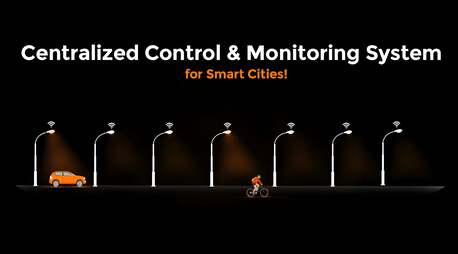
A complete smart city lighting solution encompasses: LED street light luminaires (replacing existing sodium/metal halide fittings), smart control nodes (mounted in each luminaire for communication and dimming control), a communication network (LoRaWAN, GSM, NB-IoT, or RF mesh connecting all nodes to the cloud), a centralized management platform (the CCMS dashboard for monitoring, control, and reporting), and an energy monitoring system (sub-metering at each pole for accurate consumption reporting).
LoRaWAN Street Lighting Solutions — The Technology Behind Smart Street Lights
LoRaWAN (Long Range Wide Area Network) is the preferred communication technology for smart street lighting in India — and for good reason. A single LoRaWAN gateway covers a 3–5 km radius in urban environments, connecting hundreds of luminaire nodes without laying any additional cable. LoRaWAN nodes consume microwatts of power (battery-powered operation for years, or easily powered from the luminaire driver), operate on unlicensed sub-GHz spectrum, and penetrate building structures and foliage that defeat WiFi and Zigbee.
Trueisense LoRaWAN street lighting nodes are pre-certified for Indian TERM regulations and interoperable with all major LoRaWAN network servers (TTN, Chirpstack, AWS IoT, Azure IoT Hub).
Wireless Lighting Control Systems — No New Cable Required
The defining advantage of LoRaWAN-based wireless lighting control is that no new communication cable is required between poles. Existing power cabling is retained; only the luminaire and node are replaced. This dramatically reduces civil works costs — one of the largest cost components in conventional street lighting retrofit projects. Trueisense wireless lighting control systems have been deployed on existing pole infrastructure across Indian cities without any new trenching or ducting.
LED Street Lighting Retrofit — The Business Case for Municipalities
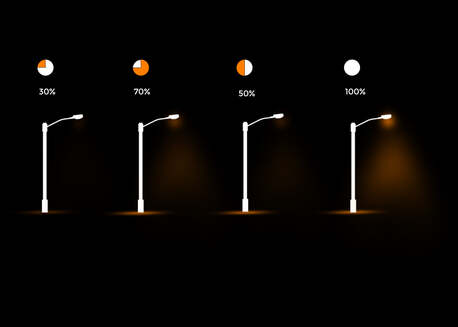
For a municipality with 10,000 street lights converting from 150W sodium vapor to 60W Trueisense smart LED with 40% mid-night dimming: annual electricity saving = 7.9 million kWh. At ₹6/kWh, this equals ₹4.7 crores in annual savings. Typical project cost for 10,000 poles (LED fitting + smart node + CCMS): ₹12–18 crores. Payback period: 2.5–4 years. After payback: ₹4.7 crores annual saving — indefinitely. Most LED fittings carry 5-year warranty, nodes 3-year warranty. Net project lifetime saving (10 years): ₹30+ crores.
Remote Street Light Monitoring — The Operational Revolution
Before CCMS, municipal street light maintenance operated on complaint-driven response: a resident calls the helpline to report a dark street, an engineer logs the complaint, a maintenance crew is dispatched (often the next day), and the fault is rectified. Average fault-to-fix time: 48–96 hours, during which the street remains dark — a public safety risk. With Trueisense remote street light monitoring, faults are detected automatically within minutes, maintenance tickets are generated and dispatched to field teams instantly, and average fault-to-fix time falls to 4–8 hours.
Frequently Asked Questions (FAQs)
Q: What is LoRaWAN and why is it used for smart street lighting?
A: LoRaWAN is a low-power wide-area wireless protocol that enables kilometers-range communication from battery-powered devices. It is used for smart street lighting because a single gateway covers hundreds of poles, no new cable is required, and the nodes consume minimal power — making it the most cost-effective connectivity solution for large-scale outdoor lighting networks.
Q: Can Trueisense CCMS manage solar street lights alongside grid-connected lights?
A: Yes. The Trueisense CCMS platform manages both grid-connected and solar street lights from the same dashboard. Solar poles report battery level, solar charging data, and lamp status; grid poles report voltage, consumption, and fault status. Both appear on the same GIS map interface.
Q: How is LoRaWAN connectivity established in an area without a LoRaWAN gateway?
A: Trueisense installs LoRaWAN gateways as part of the project — typically 1 gateway per 2–3 km radius of pole network. Each gateway connects to the Trueisense cloud via 4G/broadband. In areas with very limited connectivity, GSM (4G) nodes connect each pole individually.