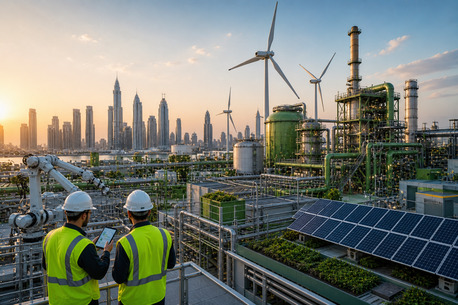
Dubai is no longer just building infrastructure—it is engineering a new model for sustainable industrial growth. As the UAE accelerates its long-term decarbonization strategy, EPC (Engineering, Procurement, and Construction) contractors are evolving into strategic enablers of intelligent, low-carbon ecosystems.
Guided by national frameworks and entities such as Dubai Electricity and Water Authority and Abu Dhabi National Oil Company, the country’s infrastructure agenda is shifting from scale-driven expansion to efficiency-driven innovation. At the center of this transformation lies industrial automation—embedded across every phase of EPC delivery.
Today, leading EPC contractors in Dubai are not simply executing projects; they are integrating digital intelligence, predictive systems, and sustainable engineering practices to future-proof critical infrastructure.
Sustainability Mandates Are Redefining EPC Strategy
The UAE’s policy direction—supported by institutions like the Ministry of Climate Change and Environment—has fundamentally reshaped how EPC projects are conceived and delivered.
Rather than treating sustainability as a compliance requirement, it is now a design principle.
Key forces driving this shift include:
Net-Zero Targets: The UAE’s clean energy ambitions are accelerating the adoption of renewable integration and energy-efficient systems
Regulatory Evolution: ESG frameworks increasingly require real-time monitoring of emissions, energy consumption, and resource utilization
Capital Allocation Trends: Investors are prioritizing EPC firms capable of delivering measurable sustainability outcomes
The result is clear: automation is no longer optional—it is foundational.
From Engineering to Execution: How Automation Transforms EPC Delivery
What distinguishes next-generation EPC contractors is their ability to embed automation across the full project lifecycle—from concept design to long-term asset management.
Intelligent Engineering
Advanced EPC firms now deploy AI-driven simulation models to optimize energy performance before construction even begins. These tools allow engineers to:
Predict lifecycle emissions
Minimize material waste
Optimize system configurations for efficiency
This early-stage intelligence significantly reduces downstream inefficiencies.
Smart Procurement Strategies
Procurement is becoming increasingly data-driven and sustainability-focused. Contractors are:
Partnering with suppliers of low-energy sensors, smart controllers, and IoT-enabled devices
Prioritizing modular components that support future upgrades without large-scale retrofits
This ensures infrastructure remains adaptable in a rapidly evolving energy landscape.
Precision-Led Construction
On-site execution is being transformed through automation technologies such as:
Real-time energy monitoring systems
Intelligent valves and automated control mechanisms
Digitally guided construction tools that reduce material waste
These innovations not only improve efficiency but also enhance safety and build quality.
Measurable Performance Outcomes
Automation delivers tangible, data-backed benefits across EPC projects:
Industry benchmarks suggest energy savings of up to 25% in energy consumption through optimized systems
Real-time emissions tracking for ESG compliance
Improved resource efficiency via predictive analytics
Faster delivery timelines and reduced lifecycle costs
For asset owners, this translates into infrastructure that is both sustainable and economically resilient.
High-Impact Applications Across Key UAE Sectors
Automation-driven EPC strategies are delivering the greatest value in sectors central to the UAE’s economic diversification.
Renewable Energy
In solar and hybrid energy projects, distributed control systems (DCS) dynamically balance energy loads, improving grid stability and maximizing output.
Water Treatment and Utilities
Advanced treatment facilities now use sensor-driven automation to recycle and reuse up to 90% of water during industrial processes—critical in a water-scarce region.
Manufacturing and Industrial Zones
In hubs like Jebel Ali, automated production systems and adaptive robotics are enabling manufacturers to reduce raw material waste while increasing output efficiency.
Oil & Gas Transition
Even traditional sectors are evolving. Automated flaring systems, emissions monitoring, and hybrid plant models are helping reduce the environmental footprint of hydrocarbon operations.
Overcoming Barriers to Automation Adoption
Despite its advantages, scaling automation within EPC projects is not without challenges.
Key Constraints:
High upfront capital investment
Shortage of specialized automation talent
Integration complexity with legacy infrastructure
How Leading EPC Firms Respond:
Partnering with global automation providers to share risk through pilot projects
Investing in workforce development through UAE-based technical institutions
Leveraging digital twins and cloud-based simulations to reduce on-site trial costs
Projects that integrate automation early consistently outperform—often achieving significantly faster returns on investment.
The next competitive advantage in EPC will not be cost, but intelligence embedded in infrastructure.
2026 and Beyond: The Rise of Intelligent EPC Ecosystems
As digital transformation accelerates, EPC contractors in Dubai are moving toward fully integrated, data-driven ecosystems.
Key trends shaping the next phase include:
AI-Augmented Digital Twins
Real-time virtual models that predict performance, optimize energy use, and forecast emissions across asset lifecycles.
Edge Computing
Localized data processing that enables ultra-fast decision-making in remote or high-demand environments.
Blockchain-Enabled Supply Chains
Transparent tracking of materials and carbon footprints, ensuring accountability across the value chain.
Bio-Inspired Engineering Systems
Design frameworks modeled on natural efficiency principles, enabling smarter energy and resource utilization.
Strategic Implications for Industry Stakeholders
This transformation is redefining what it means to be a leading EPC contractor in the UAE.
Future competitiveness will be defined by the ability to:
Integrate engineering with digital intelligence
Deliver measurable sustainability outcomes
Align with national and global ESG benchmarks
Contractors that fail to evolve risk becoming operationally obsolete in a market that is rapidly prioritizing performance, transparency, and environmental responsibility.
FAQs: EPC, Automation, and Sustainability in the UAE
Q1. Why is automation critical for sustainable EPC projects?
Automation enables real-time optimization of energy use, reduces waste, and ensures compliance with evolving ESG standards—making it essential for long-term sustainability.
Q2. How are EPC contractors in Dubai implementing automation?
They integrate automation technologies across design, procurement, construction, and operations—creating intelligent, self-optimizing