The Office Lighting Problem — Why LED Alone Is Not Enough
The transition from fluorescent to LED cut Indian office lighting wattage by 40–60% — a significant achievement. But after the LED retrofit, many facility managers found that their electricity bills were reduced by less than expected. The reason: LED switching to lower wattage does not change the hours of operation. If the lights were on for 12 hours with fluorescent, they are on for 12 hours with LED. Sensor control — ensuring lights are on only when occupied — is the second half of the energy efficiency equation. Together, LED + sensor control delivers 60–75% reduction versus the fluorescent baseline.
Sensor Types for Office Lighting — Choosing the Right Sensor
For Individual Desks and Workstations — mmWave True Presence
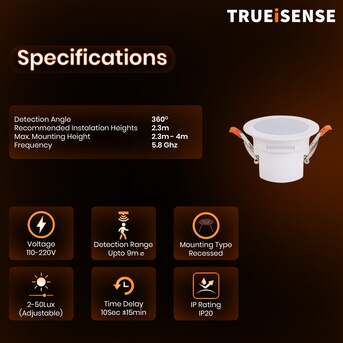
Desk-level lighting must never false-off. An employee at their workstation may spend long periods reading, thinking, or on a call — activities with minimal physical movement. Only mmWave true presence sensing reliably maintains lighting for a stationary desk occupant. Trueisense recommends its true presence sensor LED panels for all individual workstation zones.
For Meeting Rooms — Radar or True Presence
Meeting room participants frequently sit still while listening to presentations or participating in video calls. Radar (5.8 GHz microwave) sensors handle this better than PIR but may still false-off occasionally with a fully stationary audience. For board rooms and executive meeting rooms, Trueisense recommends true presence sensing. For general meeting rooms, high-sensitivity radar is an acceptable compromise.
For Corridors and Common Areas — PIR or Radar
Corridors and common areas always have movement when occupied — walking, accessing lifts, using vending machines. Standard PIR or radar sensors are fully adequate for these zones, with 10–20% baseline dimming providing constant safety visibility and 100% activation on movement detection.
For Washrooms — True Presence (Individual Stalls)
Office washrooms require true presence sensing in individual cubicle zones — where PIR sensors routinely switch off mid-use on a stationary occupant. Trueisense true presence sensors for washrooms eliminate this problem entirely.
Zone Design for Office Sensor Lighting
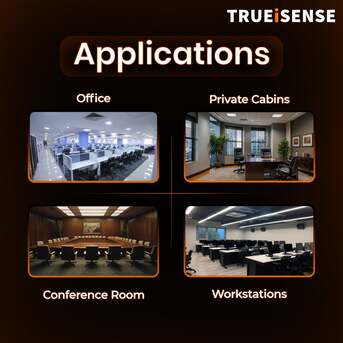
Effective office sensor lighting requires careful zone design — matching sensor detection zones to the physical layout of the office. Key principles: each zone should correspond to a functionally distinct space (individual desk cluster, meeting room, corridor segment); sensor detection ranges should not overlap into adjacent zones where independent control is required; in open-plan offices, zone boundaries should align with physical screens, partitions, or desk clusters.
Trueisense provides free office sensor lighting zone design as part of the pre-project consultation — a floor plan is submitted and Trueisense engineers return a sensor placement plan with estimated energy savings calculation.
Office Lighting Automation Solutions — Beyond Occupancy Sensing
Trueisense office lighting automation solutions layer multiple control functions on top of occupancy sensing:
Time scheduling: Lights cannot switch on before 7 AM or after 10 PM regardless of sensor input — preventing early/late occupancy triggering wasteful lighting during building maintenance.
Lux-level targeting with daylight harvesting: Maintains constant desk-level illumination regardless of time of day or weather.
Scene control: 'Meeting' scene (60% brightness, warm white), 'Focus' scene (100% brightness, cool white), 'Video call' scene (80% with display-side dimming).
Integration with access control: Lights in a zone automatically turn on when access card is swiped at that zone's door, and switch off when access card is recorded as leaving.
Energy Monitoring Systems for Office Spaces
The Trueisense energy monitoring system for offices provides real-time electricity consumption data at zone and floor level. Monthly automated reports compare actual consumption against baseline and against the energy savings projection — verifying that the sensor lighting system is delivering the promised savings. Anomaly alerts flag any zone where consumption significantly exceeds the expected pattern — typically indicating a sensor fault, a driver fault, or unauthorised override.
Sensor and Sensor Lighting Solution Provider in Noida — Trueisense
Trueisense is Noida's leading sensor and sensor lighting solution provider for corporate offices, government buildings, hospitals, and institutional clients. With a local engineering team, on-site survey capability, in-house product design, and a post-installation support team based in Noida, Trueisense provides the full-service office lighting transformation that imported catalogue products and generic installers cannot match.
Frequently Asked Questions (FAQs)
Q: How many sensors are needed per office floor?
A: The number of sensors depends on floor layout and zone design. As a rough guide, a 10,000 sq ft open-plan office floor requires approximately 15–25 sensor-LED panels for desk zones, plus 8–12 units for corridors, meeting rooms, and washrooms. Trueisense provides precise zone design with product count for any floor plan.
Q: Will office sensor lighting work with my existing LED panels?
A: In many cases, yes. The Trueisense standalone sensor node can be retrofit to existing LED panels with DALI or 0–10V drivers. For panels without dimming capability, a full panel replacement with integrated sensor panels is recommended. Trueisense assesses retrofit suitability as part of the free pre-project survey.
Q: What is the typical energy saving for an office with Trueisense sensor lighting?
A: Trueisense office sensor lighting deployments consistently deliver 35–55% reduction in lighting electricity consumption versus a static LED baseline. For an office with a monthly lighting bill of ₹1 lakh, this represents ₹35,000–₹55,000 in monthly savings.