Why Hospital Lighting Is Different
Hospitals operate 24/7, with every zone having distinct and critical lighting requirements. Patient rooms require soft, restful lighting at night but bright clinical lighting for nursing rounds and examinations. ICUs require 24-hour staff vigilance lighting balanced against patient sleep quality. Operating theatres require 800–1,000 lux task lighting with zero shadow. Corridors need consistent, reliable illumination at all times for patient and staff safety. Emergency lighting must activate instantly and maintain for hours during power failure. Conventional static lighting systems address these needs through fixed high-intensity installations — consuming maximum energy at all times regardless of actual need. Trueisense intelligent lighting solutions meet each zone's need precisely — at minimum necessary energy.
True Presence Sensors for Patient Rooms
Patient rooms are the highest-priority application for Trueisense true presence sensing in hospitals. A hospitalized patient — particularly one sedated, in recovery, or with limited mobility — is precisely the type of occupant that a PIR motion sensor will fail to detect. False-offs in a patient room are unacceptable: a patient in darkness, unable to locate a call button or navigate to the bathroom, is a safety incident.
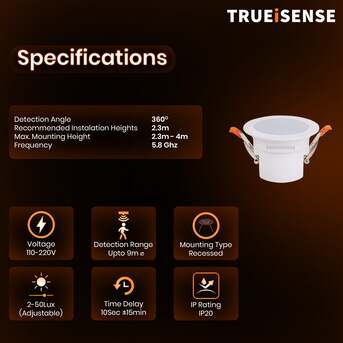
Trueisense true presence sensors in patient room ceiling panels detect resting, sedated, and immobile patients as reliably as ambulatory staff. Lighting never switches off while a patient is in the room. When the room is genuinely empty (patient transferred, discharged, or in diagnostics), lighting switches off automatically — saving the energy of hours of vacant room lighting.
Dimmable Lighting for Patient Comfort
Patient rooms require different lighting scenarios across the 24-hour cycle: bright clinical lighting (500 lux, 5000K) for examination and nursing rounds, medium ambient lighting (200 lux, 4000K) during daytime visiting hours, and dim overnight lighting (30–50 lux, 2700K warm white) for patient sleep. Trueisense DALI dimmable lighting solutions enable nursing staff to switch between these scenes via a simple bedside or nurse station control panel — or automatically via the BMS schedule integrated with shift timings.
DALI Lighting Control for Healthcare Environments
DALI (Digital Addressable Lighting Interface) is the preferred control protocol for hospital lighting because it enables: individual luminaire addressing (any light in any room can be individually controlled), zone scene presets (examination mode, recovery mode, night mode — with one-button activation), integration with nurse call systems (nurse call automatically brightens the patient room and corridor segment), BMS integration (central control and monitoring from the facilities management office), and maintenance reporting (any lamp failure is automatically logged and reported).
Emergency Lighting Management Solutions
Emergency lighting is a critical safety system in any hospital — but particularly so in ICUs, operating theatres, and high-dependency wards where power failure during a procedure would be catastrophic. Trueisense emergency lighting management solutions include: LED emergency downlights and panels with 3-hour battery backup, automatic self-test cycles with digital test logging (eliminating manual monthly test procedures), remote test results reporting to the facilities dashboard, and integration with the building's UPS and generator systems.
Corridor Lighting for Hospitals — Safety Without Waste
Hospital corridors operate 24/7 but vary significantly in occupancy level — at 3 AM, a ward corridor may have one nursing round per hour; during day shift changeover, it may be fully occupied continuously. Trueisense radar sensor panel lights for hospital corridors maintain 100 lux base level at all times (minimum for patient safety navigation) and boost to 300 lux when staff or patient movement is detected. This delivers safety-level illumination at all times while reducing corridor lighting energy by 50–65% versus continuous full-brightness operation.
Energy Savings in Hospital Lighting — The Numbers
A 200-bed hospital with a monthly electricity bill of ₹15–25 lakhs typically spends ₹5–8 lakhs on lighting. Trueisense intelligent lighting deployments in comparable facilities have delivered 40–55% lighting electricity reductions — ₹2–4.4 lakhs per month in savings. With a project investment of ₹25–40 lakhs, payback is achieved in 10–18 months, after which every rupee saved adds directly to the hospital's operating margin.
Frequently Asked Questions (FAQs)
Q: Can presence sensors detect a sedated or unconscious patient?
A: Yes. Trueisense mmWave true presence sensors detect breathing and cardiac micro-movements — both present in a sedated or unconscious patient. Resting, immobile, and medically sedated patients are reliably detected within the sensor's range.
Q: What lux level is recommended for hospital patient rooms?
A: BIS SP 72 recommends 100–300 lux general illumination for hospital wards and 300–1000 lux for examination lighting. Trueisense DALI dimmable systems provide the full range — from 30 lux night-mode to 1000 lux examination mode — via bedside or nurse station scene control.
Q: Does Trueisense provide emergency lighting for operating theatres?
A: Yes. Trueisense emergency lighting products include IP54-rated, flicker-free LED panels with 3-hour battery backup for operating theatre environments. Contact trueisense.in for operating theatre-specific lighting specifications.