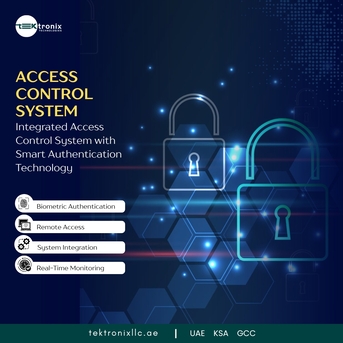
A biometric access control system uses unique physiological characteristics—fingerprints, facial geometry, iris patterns, or voice—to authenticate identity and regulate entry. Unlike conventional systems, biometrics cannot be lost, cloned, or shared, making them the gold standard in modern security access control.
In this definitive guide, we explore everything businesses in Dubai and the UAE need to know about access control systems: from the core technology and solution types to compliance, smart integration, ROI, and emerging trends.
1. What Is a Biometric Access Control System?
A biometric access control system is a physical security technology that verifies an individual's identity using measurable biological or behavioral traits before granting or denying access to a secured area, device, or network.
Unlike passwords or access cards—which authenticate something you know or have—biometrics authenticate who you are. This intrinsic link between credential and identity makes biometric systems inherently more secure and reliable.
Core biometric identifiers used in access control:
• Fingerprint patterns (loops, whorls, arches)
• Facial geometry and 3D mapping
• Iris and retinal vasculature
• Voice cadence and tone
• Vein pattern recognition (palm or finger)
Each identifier is enrolled during onboarding, encrypted, and stored as a mathematical template—never as a raw image—ensuring both security and privacy compliance.
2. Why Dubai Businesses Need Advanced Access Control Systems
Dubai's economy hosts thousands of multinational corporations, financial institutions, government entities, and technology firms operating from premium office space. This concentration of high-value operations creates an elevated threat landscape that demands enterprise-grade protection.
Key drivers for adopting advanced access control in the UAE:
• Rising insider threat and tailgating incidents in shared commercial buildings
• Increased regulatory scrutiny around data protection and workplace safety
• Government smart-city mandates requiring digitally integrated security infrastructure
• Post-pandemic demand for touchless, hygienic authentication methods
• Growth in hybrid workplaces requiring flexible, remote-manageable access policies
Implementing a certified access control system in UAE is not only a security imperative—it is increasingly a legal and operational necessity.
3. Evolution of Access Control: From Keys to Biometrics
Understanding the trajectory of access control helps organizations appreciate the significance of biometric adoption.
Technology Security Level Primary Vulnerability
Traditional Locks & Keys Low Duplication, loss, unauthorized copying
Proximity Card / Key Fob Moderate Card theft, cloning, tailgating
PIN / Password Systems Moderate Shoulder surfing, sharing, forgetting
Smart Card + PIN (2FA) High Card loss combined with PIN compromise
Biometric Systems Very High Spoofing (mitigated by liveness detection)
AI-Powered Multi-Modal Biometrics Highest Minimal—requires simultaneous multi-trait bypass
4. Types of Biometric Access Control Systems
Different biometric modalities suit different security environments, budgets, and workflow demands. Here is a detailed breakdown of the primary technologies deployed across Dubai offices.
4.1 Fingerprint Recognition
The most widely deployed biometric modality globally, fingerprint recognition captures the unique ridge-and-valley pattern on a fingertip and matches it against enrolled templates. Modern optical and capacitive sensors deliver sub-second identification with false acceptance rates (FAR) below 0.001%.
Best for: Small-to-medium offices, time-and-attendance integration, cost-conscious deployments.
4.2 Facial Recognition Access Control
Facial recognition access control analyzes up to 80 distinct facial nodal points—including distances between eyes, nose width, and jawline contours—to create a unique faceprint. Advanced systems employ 3D structured-light or infrared sensors to defeat photograph or mask spoofing, even in low-light or backlit environments.
Best for: High-traffic corporate entrances, hands-free zones, post-pandemic hygiene requirements, executive areas.
4.3 Iris & Retina Scanning
The iris—with over 200 unique features compared to 40 in fingerprints—offers one of the highest biometric accuracy rates available. Iris scanners work at distances of 20–40 cm without physical contact. Retinal scanners analyze blood vessel patterns at the back of the eye and are reserved for ultra-high-security environments.
Best for: Data centers, government facilities, financial vaults, research labs.
4.4 Voice Recognition
Voice biometrics authenticate users based on vocal characteristics including pitch, tone, and cadence. While less common as a primary access credential, voice recognition excels as a secondary factor in multi-factor authentication (MFA) or remote verbal command systems.
Best for: Hands-free environments, remote verification, MFA workflows.
4.5 Vein Pattern Recognition
Near-infrared light illuminates the vascular pattern beneath the skin of the palm or finger. Since vein patterns are internal, they are immune to surface damage (cuts, calluses) and extremely difficult to spoof. This modality is gaining traction in UAE healthcare and banking sectors.
Best for: Healthcare facilities, banking institutions, environments where fingerprints are unreliable.
5. Key Features of Modern Access Control Solutions
Enterprise-grade access control solutions deployed across Dubai combine hardware authentication with sophisticated software management platforms. Essential features to evaluate:
• Real-time monitoring dashboards with live entry/exit feeds
• Cloud-based access management with role-based permission assignment
• Mobile credential support (smartphone-based Bluetooth/NFC entry)
• Seamless CCTV, alarm, and video analytics integration
• Multi-factor authentication (biometric + PIN, biometric + mobile OTP)
• Comprehensive audit trails with exportable compliance reports
• Anti-pass back and tailgating detection
• Automated lockdown and emergency evacuation protocols
• API-first architecture for integration with HR, payroll, and visitor management platforms
• GDPR-aligned and UAE PDPL-compliant data handling
Conclusion: Securing Dubai's Future with Intelligent Access Control
In one of the world's most dynamic and competitive business environments, security infrastructure is a foundational pillar of organizational excellence. A biometric access control system delivers the trifecta of protection, efficiency, and compliance that Dubai businesses demand.
From contactless facial recognition access control at high-traffic lobbies to multi-modal biometric vaults securing sensitive data centers,