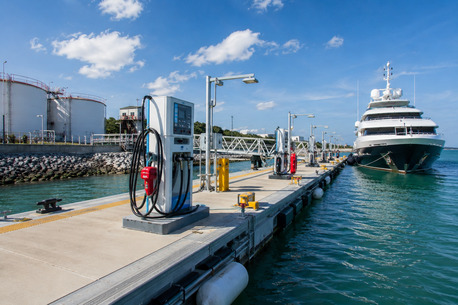
Marine fuel stations are among the most technically demanding sectors of fuel infrastructure engineering. Unlike conventional land-based fueling facilities, marine fuel systems must operate safely under tidal movement, corrosive saltwater exposure, hazardous fuel vapors, and strict environmental regulations.
Marine pontoons rise and fall with tidal movement. Despite this motion, the fuel connection between shore tanks and vessels must remain completely leak-proof. Conventional piping systems cannot safely accommodate continuous tidal movement. To maintain leak-proof fuel transfer, marine fueling systems require specialized flexible connections designed for dynamic motion. Companies with marine fuel dispenser installation experience understand the importance of selecting appropriate materials, as standard metals corrode rapidly when exposed to saltwater spray.
Key Components of Marine Fuel Dispenser Installation Systems
A professionally installed marine fuel station integrates several interdependent subsystems:
Pontoon Platform Type Selection
The floating platform foundation comprises three main types of materials. The GRP (glass-reinforced plastic) pontoon combines a lightweight structure with outstanding corrosion resistance, making it ideal for recreational marinas. The concrete pontoon provides the necessary mass and stability for large commercial ships operating in areas with significant wave motion. Aluminum pontoons provide a balance between structural strength, weight efficiency, and corrosion resistance, making them suitable for medium-duty marine applications.
Secondary Containment Design
The system uses double-walled pipes to provide environmental security. The internal pipe is responsible for carrying fuel, whereas the outer pipe serves as the containment barrier. If any leakage occurs in the internal pipe, it will be detected instantly by sensors installed in the annular space between the two walls.
Anchor and Access Systems
The marine pile not only fixes the pontoon but also allows for vertical movement. The gangway system links the floating pontoon to the land. This system requires precise engineering, as incorrect angles can create safety hazards, particularly during low water levels. Gangways that are too narrow can hinder emergency response and evacuation.
Regulatory Requirements for Marine Fuel Infrastructure in the UAE
Marine fueling operations in the UAE are subject to stringent environmental and fire safety regulations to minimize the risks associated with fuel storage and dispensing near marine environments. The Department of Energy insists on registration of all fuel tank facilities within thirty days of their operational start date. Civil defense authorities must approve fire safety measures, since standard firefighting foam may be ineffective on water.
Environmental authorities stress the importance of spill prevention and vapor control. Spillage of marine fuels has immediate environmental consequences. For these reasons, fuel dispensers installed by licensed firms must demonstrate the presence of secondary containment, automated valve shut-off, and leak detection systems before being permitted to operate.
Marine Fuel System Installation Process Explained
Marine fuel system installation follows a carefully engineered multi-stage process:
Site Analysis: Bathymetric surveying assesses water depth and sea bottom conditions. Tidal surveys calculate maximum vertical range. Vessel traffic determines the best location for the pontoons.
Zone Identification: The area around the fuel dispenser is classified as Zone 1 (explosive environment possible under normal circumstances). This requires explosion-proof electrical equipment and carefully engineered cable routing.
Pile Driving: Pile depths are engineered based on seabed conditions, tidal variation, pontoon loading, and long-term structural stability requirements. Pontoon buoyancy is calculated to ensure safety under maximum tidal wave conditions and peak vessel loading.
Installation Process: Dual-walled piping systems connect the shore tanks to pontoon dispensing units. Flexible joints are installed to accommodate vertical movement. All piping connections undergo pressure testing to verify system integrity before final enclosure and commissioning.
Electrical & Controls: Safe wiring supplies dispensers, leak detectors, and shutdown functions. Integrated SCADA systems offer real-time monitoring of fuel inventory, dispensing activity, leak detection alarms, and operational safety parameters.
Commissioning & Certification: Hydrotesting verifies the integrity of the piping system. Calibration guarantees metering precision. Final inspection and certification are completed before operational handover.
Even a minor fuel leak in a marina environment can result in operational shutdowns, environmental penalties, and costly cleanup procedures.
Tekzone’s Technical Approach
Tekzone applies end-to-end EPC expertise to the design, engineering, installation, and commissioning of marine fuel infrastructure systems across the UAE. Tekzone’s engineering approach includes GRP and concrete pontoon construction, installation of double-walled pipes, and deployment of dispensers approved by ADNOC. Tekzone is responsible for EPC activities ranging from bathymetry to civil defense and DoE approval processes.
Specific to the maritime industry, their specialization involves barges for transporting large amounts of fuel, operator stations with environmental controls, and gangways that facilitate access even under extreme tides. With a strong commitment to secondary containment and real-time monitoring, Tekzone delivers systems that prioritize leak prevention without compromising accessibility.
FAQs
Q1. What is the expected lifespan of a fuel station that uses a GRP pontoon?
Professionally engineered GRP pontoons typically deliver an operational lifespan of 25–30 years in marine environments, provided periodic inspections and maintenance procedures are followed. The GRP pontoons do not corrode, thus avoiding rust issues prevalent in steel materials.
Q2. How do double-wall pipes help identify leakage in pipelines?
The space between the inner and outer pipe layers contains pressure, vacuum, or liquid monitoring sensors that instantly detect leaks. Any leakage on the inner surface alters the pressure level and sets off an audible alarm.
Q3. Can existing dispensers for fuels on land be used on marine pontoons?
No. Conventional land-based fuel dispensers are not designed for marine environments and lack critical features such as corrosion-resistant housing, emergency breakaway couplings, and flame arrestors.
Q4. What permits are necessary before starting operations?
Obtaining an operational permit requires DOE registration, a civil defense fire safety certificate, and approval from the relevant environmental agency. Additionally, port and marina authorities may impose their own operating requirements.
Q5. How is the electrical equipment protected in the hazardous area?
All equipment should either be f