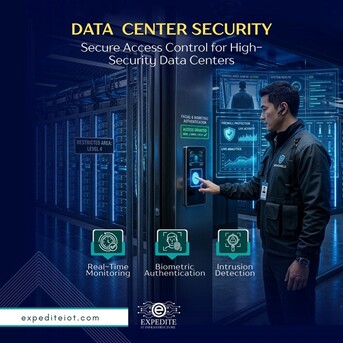
The case illustrates how Data Center Intrusion Detection, intelligent monitoring devices, and active risk management systems should be enhanced to protect important digital infrastructure.
The Hidden Risks Behind Physical Incidents
Data centers will have power supply with backup power sources, fire suppression, and controls. Nonetheless, physical accidents like fires may unravel loops in the physical and cyber defense layers. Failing of systems when it is not intended raises the chances of unauthorized access, breaches of data, and service failures. It is at this point that Data Center Security Monitoring Systems are of much necessity
After the fire incident, professionals underscored the need to have strong Data Center Intrusion Detection systems. These systems keep track of the physical and digital entry points so as to recognize any unauthorized entry into the system.
Key capabilities include:
• Monitoring door access and restricted zones
• Detecting suspicious network activity
• Real-time alert generation
• Integration with surveillance and access control systems
Through a combination of physical intrusion detection and network monitoring, the operators would be able to inhibit opportunistic intrusion in the event of emergency.
Cybersecurity for Data Center: Beyond Firewalls
It was also an incident that emphasized the significance of having holistic Cybersecurity to Data Center operations. Conventional firewalls cannot make sensitive infrastructure safe. There is need to implement a layered security in which case both internal and external threats are addressed.
Modern cybersecurity frameworks focus on:
• Network segmentation
• Zero-trust architecture
• Endpoint protection
• Continuous vulnerability assessments
In case of physical interruptions, cyber attackers tend to take advantage of fragile systems. This risk can be mitigated by an active cybersecurity plan.
Data Center Encryption: Protecting Critical Information
Data Center Encryption will provide protection to sensitive data in case of physical damages or illegal access. Encryption also protects both resting information and transmission information, and renders the information readable only to authorized persons.
Benefits include:
• Protection of financial and healthcare records
• Compliance with regulatory standards
• Reduced risk of data leakage
• Secure disaster recovery processes
Good encryption policies serve as a last resort in cases where the other controls are broken.
Data center Threat Detection: Proactive Risk Identification
Adapted Data center Threat Detection systems apply artificial intelligence and machine learning to detect suspicious network traffic and system actions and behaviors of users.
These tools can:
• Detect malware infiltration
• Identify insider threats
• Recognize abnormal server activity
Real-time analytics has the benefit of reducing operational downtimes and reputation losses by giving a faster response time.
Data Center Security Automation UAE: Learning from Regional Best Practices
Lots of organizations have come to follow the Data Center Security Automation UAE models as an example of making it more robust. Automation minimizes the human error and allows quicker response to an incident using present protocols.
Automation solutions typically include:
• Automated patch management
• Incident response workflows
• Intelligent system health monitoring
• Real-time compliance tracking
With the introduction of automation, data centers will be able to react to the emergencies more effectively without the violation of the integrity of security.
The Importance of Integrated Security Monitoring
This integrated strategy will make collaboration between the physical and digital security teams successful.
Integrated systems provide:
• Real-time alerts during equipment failures
• Coordinated emergency responses
• Continuous system performance tracking
• Improved audit readiness
The Kuwait fire case is likened to a reminder that the system must be fully integrated in terms of security to ensure resilience.
Building a Resilient Future for Kuwait’s Digital Infrastructure
In Kuwait, as the country grows its digital economy, securing data centers should be one of the priorities in the country. Continuous functioning is needed in government databases, financial networks and telecommunication systems.
Enhancement of intrusion detection, encryption, threat analytics and automated security structures will be used to prevent the occurrence of such weak points in the future. The investment into the next-generation monitoring technologies guarantees the continuity of operations and trust of the population.
Conclusion
The Kuwait data center fire revealed severe vulnerabilities in both physical and cyber security plans, which highlight the necessity of sophisticated Data Center Intrusion Detection system, overall Cybersecurity of Data Center as well as strong Data Center Encryption systems. Implementing smarter Data center Threat Detection, embracing Data Center Security Automation UAE best practices and implementing a unified Data center security monitoring system will enable companies to construct resilient and secure infrastructure that is future-proof. These systems need to be fortified in the present day to protect the Kuwaiti virtual future.
For more information contact us on:
Tektronix Technology Systems Dubai-Head Office
[email protected]
+971 55 232 2390
Office No.1E1 Hamarain Center 132 Abu Baker Al Siddique Rd – Deira – Dubai P.O. Box 85955