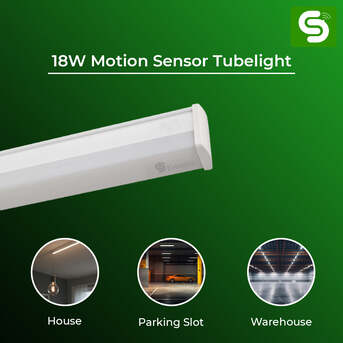
The best motion sensor tubelight for hallways in 2026 is the Esysense T5 18W Auto Dimmable (Rs.588) — it maintains a soft standby glow through the night and brightens on approach. For car parking and covered parking areas, the T5 20W Auto On/Off with radar sensing (Rs.559) is the right choice — radar detects vehicles and pedestrians reliably and is unaffected by temperature swings that cause PIR false triggers in parking environments.
Best Motion Sensor Tubelight Setup by Application
1. Home Hallway
(i) Recommended Product: T5 Auto Dimmable
(ii) Wattage: 18W
(iii) Function: Dim standby + full brightness on motion
(iv) Price: Rs.588
2. Commercial Corridor
(i) Recommended Product: T5 Auto Dimmable
(ii) Wattage: 20W
(iii) Function: Dim standby + full brightness on motion
(iv) Price: Rs.559
3. Lift Lobby
(i) Recommended Product: T5 Auto Dimmable
(ii) Wattage: 18W
(iii) Function: Dim standby + full brightness on motion
(iv) Price: Rs.588
4. Covered Car Parking
(i) Recommended Product: T5 Auto On/Off (Radar)
(ii) Wattage: 20W
(iii) Function: Full brightness on motion, fully off after delay
(iv) Price: Rs.559
5. Basement Parking
(i) Recommended Product: T5 Auto On/Off (Radar)
(ii) Wattage: 20W
(iii) Function: Full brightness on motion, fully off after delay
(iv) Price: Rs.559
6. Warehouse Aisle
(i) Recommended Product: T5 Auto On/Off (Radar)
(ii) Wattage: 20W
(iii) Function: Full brightness on motion, fully off after delay
(iv) Price: Rs.559
Full range: esysense.com/collections/motion-sensor-tubelight
Hallways and parking areas share a defining characteristic: they are traversed frequently but briefly — occupied for minutes at a time but traditionally lit for hours. In India, always-on corridors and parking lighting accounts for a disproportionate share of electricity bills in both residential apartment buildings and commercial real estate. Motion sensor tubelights eliminate this waste automatically — no policy change or manual behaviour required.
Why Are Motion Sensor Tubelights Better Than Bulbs for Hallways and Parking?
1. Linear distribution — a single T5 tube illuminates 4–6 meters of corridor length evenly, while a bulb creates a concentrated spot beneath it.
2. Better coverage for narrow spaces — the tube's length fills the corridor width rather than leaving dark edges.
3. More efficient per lumen at corridor ceiling heights — one 20W tube replaces 2–3 bulbs for corridor coverage.
4. Retrofit-ready — fits existing T5 fluorescent fittings directly after ballast bypass, no new fixtures needed.
Bottom line:
For any space longer than 4 meters, the tubelight format is simply more efficient than bulbs — it covers the full length evenly from a single fitting while using the same or less wattage.
What to Look for in a Motion Sensor Tubelight for Hallways
1. Sensor Type
(i) Recommended: Radar (Microwave)
(ii) Why It Matters: Works reliably in Indian summer temperatures without false triggers and detects movement from both corridor directions.
2. Function
(i) Recommended: Auto Dimmable
(ii) Why It Matters: Maintains a soft standby glow, preventing corridors from becoming completely dark at night.
3. Color Temperature
(i) Recommended:
(a) 3000K for residential hallways
(b) 4000K for commercial corridors
(ii) Why It Matters: Warm white suits homes, while neutral white feels cleaner and more professional for offices and apartments.
4. Wattage
(i) Recommended:
(a) 18W for corridors up to 6 meters
(b) 20W for corridors up to 8 meters
(ii) Why It Matters: Proper wattage ensures balanced brightness coverage without over-lighting.
5. Delay Time
(i) Recommended: 1–2 minutes
(ii) Why It Matters: Allows comfortable full corridor movement without lights switching off mid-walk.
6. IP Rating
(i) Recommended:
(a) IP20 for standard indoor hallways
(b) IP54 for covered outdoor corridors
(ii) Why It Matters: Correct IP rating improves reliability based on moisture and dust exposure.
Bottom line:
The single most important specification for a hallway tubelight is the dimmable function — a soft standby glow at night is far more practical than a fully dark corridor that suddenly floods with bright light when you walk through at 3am.
Why Car Parking Areas Are the Highest-Value Application for Sensor Tubelights
A covered parking facility with 50 standard fluorescent fittings running 12 hours per day consumes approximately 28,800 Wh (28.8 kWh) daily — costing around Rs.230 per day or Rs.83,000 annually. With Esysense 20W radar motion sensor tubes at 3 hours average actual use, the same facility consumes approximately 3,000 Wh per day — saving over Rs.70,000 per year.
Beyond cost, radar motion sensor tubelights improve parking area safety: spaces that are completely dark when empty but instantly illuminated when a vehicle or pedestrian enters are demonstrably safer than always-on but ageing fluorescent fittings.
Bottom line:
For a 50-tube covered parking: annual electricity saving of Rs.70,000+ with a typical payback period of 12–18 months. The business case is extremely straightforward.
Why Radar Beats PIR for Parking Areas
1. Radar (Microwave) Sensor
(i) Vehicle Detection: Excellent — reflective vehicle surfaces generate strong radar signals.
(ii) Temperature Sensitivity: Not affected by hot weather because detection uses radio waves instead of heat.
(iii) Detection Through Partial Obstruction: Yes — can detect movement between parked vehicles.
(iv) Slow Movement Detection: Excellent for slow pedestrians and gradual movement.
(v) Underground/Basement Performance: Excellent — works independently of daylight conditions.
(vi) Esysense Recommendation: Preferred choice for all parking-area lighting products.
2. PIR (Infrared) Sensor
(i) Vehicle Detection: Less reliable because detection depends on heat differences.
(ii) Temperature Sensitivity: Can experience false triggers during hot Indian summers.
(iii) Detection Through Partial Obstruction: No — requires direct line of sight.
(iv) Slow Movement Detection: Can miss slow-moving occupants.
(v) Underground/Basement Performance: Good, but influenced by surrounding temperature conditions.
(vi) Esysense Recommendation: Best suited for standard indoor home spaces.
Bottom line:
For any outdoor, semi-outdoor, or temperature-variable environment — covered parking, basement parking, service corridors — always choose the radar variant. PIR sensors can false-trigger in Indian summer heat and miss detection through parked vehicle bodies.
Lighting Layout for Covered Car Parking
1. Install tubelights above driving lanes at 3–4 meter intervals — above the path vehicles and pedestrians travel.
2. Ensure adjacent tubes' detection zones overlap slightly — prevents dark gaps as a vehicle enters.
3. Use 6500K cool white for maximum visibility and saf