Tektronix LLC, a trusted provider of monitoring and instrumentation solutions across the Gulf, offers purpose-built systems for the UAE market.
Why UAE Homes and Businesses Need Dedicated Refrigerator Temperature Monitoring
The UAE's extreme desert climate creates thermal stress that accelerates compressor wear, causes door-seal degradation, and triggers unexpected power fluctuations — all of which can push refrigerator cabinets outside safe temperature bands before an occupant even notices. Refrigerator Temperature Monitoring closes this blind spot by providing continuous, automated oversight of internal cabinet conditions.
Key risks that dedicated monitoring addresses include:
• Silent compressor failure during night-time or travel periods
• Voltage surges from the UAE grid causing cooling interruptions
• Temperature stratification inside large refrigerators, creating warm pockets
• Inadequate cold retention during frequent door openings in busy households or restaurants
• Medication spoilage for diabetic patients or households storing insulin and vaccines
According to WHO food-safety guidelines, perishable foods must be stored below 5°C and frozen products at or below −18°C. Even short excursions beyond these thresholds can multiply pathogenic bacteria to dangerous levels. Purpose-built Refrigerator Temperature Data Loggers record every deviation, providing an auditable history that proves due diligence for food businesses and healthcare providers alike.
How Smart Sensors Transform Household and Commercial Refrigeration
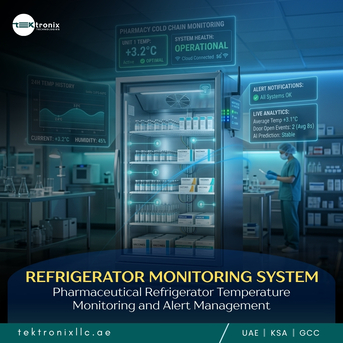
Smart Sensors are the foundation of any modern cold-chain monitoring system. Unlike traditional analog thermometers, IoT-enabled sensors measure temperature and humidity at intervals as short as one minute, transmit readings wirelessly to a cloud dashboard, and trigger instant notifications when readings breach pre-set thresholds.
Core Features of Modern Smart Refrigerator Sensors
• High-precision measurement: Class-A platinum resistance thermometers (PT100/PT1000) or calibrated NTC probes accurate to ±0.1°C — critical for pharmaceutical storage where regulatory tolerances are tight.
• Wireless connectivity: Wi-Fi, Zigbee, or cellular (4G/LTE) variants ensure uninterrupted data transmission even in the reinforced concrete structures common in UAE residential towers.
• Long battery life: Designed for 2–5 years of autonomous operation, reducing maintenance overhead in large facilities.
• Tamper detection and door-open alerts: Integrated reed switches log every door event, flagging excessive opening patterns that waste energy and compromise cold chain integrity.
• HACCP compliance logging: Automatic time-stamped logs satisfy the requirements of the Abu Dhabi Agriculture and Food Safety Authority (ADAFSA) and Dubai Municipality food-safety inspections.
When integrated with a centralised building management system (BMS), smart sensors enable facility managers to correlate refrigerator performance data with ambient HVAC conditions — delivering a holistic view of cold-chain health across an entire property.
Effective Refrigerator Monitoring is no longer a luxury reserved for commercial cold chains — it is a practical necessity for every UAE household, restaurant, pharmacy, and food business. In a region where ambient temperatures regularly exceed 45°C, a malfunctioning refrigerator can silently destroy hundreds of dirhams' worth of groceries, medications, and perishables within hours. By deploying the right technology today, residents and businesses across the Emirates can protect their investments, maintain food safety compliance, and gain complete peace of mind.
Tektronix LLC, a trusted provider of monitoring and instrumentation solutions across the Gulf, offers purpose-built systems for the UAE market.
Why UAE Homes and Businesses Need Dedicated Refrigerator Temperature Monitoring
The UAE's extreme desert climate creates thermal stress that accelerates compressor wear, causes door-seal degradation, and triggers unexpected power fluctuations — all of which can push refrigerator cabinets outside safe temperature bands before an occupant even notices. Refrigerator Temperature Monitoring closes this blind spot by providing continuous, automated oversight of internal cabinet conditions.
Key risks that dedicated monitoring addresses include:
• Silent compressor failure during night-time or travel periods
• Voltage surges from the UAE grid causing cooling interruptions
• Temperature stratification inside large refrigerators, creating warm pockets
• Inadequate cold retention during frequent door openings in busy households or restaurants
• Medication spoilage for diabetic patients or households storing insulin and vaccines
According to WHO food-safety guidelines, perishable foods must be stored below 5°C and frozen products at or below −18°C. Even short excursions beyond these thresholds can multiply pathogenic bacteria to dangerous levels. Purpose-built Refrigerator Temperature Data Loggers record every deviation, providing an auditable history that proves due diligence for food businesses and healthcare providers alike.
How Smart Sensors Transform Household and Commercial Refrigeration
Smart Sensors are the foundation of any modern cold-chain monitoring system. Unlike traditional analog thermometers, IoT-enabled sensors measure temperature and humidity at intervals as short as one minute, transmit readings wirelessly to a cloud dashboard, and trigger instant notifications when readings breach pre-set thresholds.
Core Features of Modern Smart Refrigerator Sensors
• High-precision measurement: Class-A platinum resistance thermometers (PT100/PT1000) or calibrated NTC probes accurate to ±0.1°C — critical for pharmaceutical storage where regulatory tolerances are tight.
• Wireless connectivity: Wi-Fi, Zigbee, or cellular (4G/LTE) variants ensure uninterrupted data transmission even in the reinforced concrete structures common in UAE residential towers.
• Long battery life: Designed for 2–5 years of autonomous operation, reducing maintenance overhead in large facilities.
• Tamper detection and door-open alerts: Integrated reed switches log every door event, flagging excessive opening patterns that waste energy and compromise cold chain integrity.
• HACCP compliance logging: Automatic time-stamped logs satisfy the requirements of the Abu Dhabi Agriculture and Food Safety Authority (ADAFSA) and Dubai Municipality food-safety inspections.
When integrated with a centralised building management system (BMS), smart sensors enable facility managers to correlate refrigerator perfo