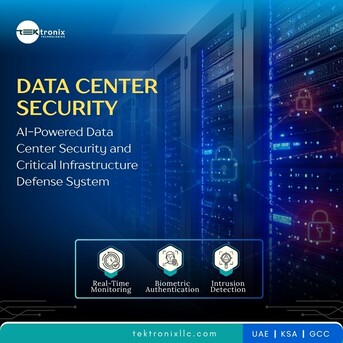
Why Data Center Security Is a Strategic Priority Across the GCC
The GCC's data center market is one of the fastest-growing in the world, with Saudi Arabia, the UAE, and Qatar collectively committing billions of dollars to next-generation digital infrastructure. Hyperscale campuses, carrier-neutral colocation facilities, and sovereign cloud projects are proliferating at a pace that outstrips legacy security models. At the same time, the threat surface has expanded dramatically: ransomware gangs, nation-state actors, and insider threats now specifically target critical infrastructure.
Modern facilities require a holistic, multi-layered approach — one that integrates physical perimeter controls, network-layer defenses, real-time analytics, and zero-trust architecture into a single, auditable security posture. The six-layer security model pioneered by industry leaders addresses each attack vector systematically, ensuring that a breach at one layer does not cascade into a facility-wide compromise.
Data Center Security Sharjah — Emerging Tier III Hub
Data Center Security Sharjah is gaining prominence as a cost-competitive alternative to Dubai for enterprise and mid-market colocation. Sharjah's proximity to Dubai, combined with lower land and power costs, is attracting regional enterprises seeking geographic redundancy for disaster recovery. SIRA (Sharjah Investment and Development Authority) mandates align with UAE federal cybersecurity standards, and new facilities in Sharjah Media City and the Hamriyah Free Zone are being purpose-built to TIA-942 Tier III specifications with integrated security operations centers.
Regulatory Compliance and Frameworks Driving Security Investment
Security investment across Saudi Arabia and the GCC is increasingly driven by a maturing regulatory landscape. Key frameworks include:
• Saudi NCA ECC-2:2022 & OTCC-1:2022 — Essential and Operational Technology Cybersecurity Controls mandating layered defenses for critical national infrastructure.
• UAE IA Standards (NESA) — Information Assurance standards for federal and critical-sector entities, requiring annual assessment and continuous monitoring.
• ISO/IEC 27001:2022 — The international benchmark for Information Security Management Systems, widely adopted as a baseline across GCC colocation contracts.
• PCI-DSS v4.0 — Payment Card Industry standards mandatory for any facility hosting fintech, banking, or e-commerce workloads.
• HIPAA/GDPR-equivalent local laws — Saudi PDPL (Personal Data Protection Law) and UAE PDPL impose data residency and breach notification obligations.
• Uptime Institute Tier Certification — Tier III and Tier IV design and operational certification validates resilience standards demanded by enterprise clients.
Facilities that achieve and maintain these certifications gain a competitive advantage in attracting sovereign wealth fund tenants, global cloud providers, and enterprise anchor clients — all of whom conduct rigorous due diligence on security posture before committing to long-term leases.
Emerging Technologies Reshaping Facility Protection in the Region
The next generation of GCC data center security infrastructure will be defined by several converging technology trends:
• AI-Driven Security Operations: Generative AI and large language models are being integrated into SOC workflows, enabling analysts to query security telemetry in natural language, auto-generate incident reports, and predict attacker behaviour based on campaign intelligence.
• Zero Trust Network Access (ZTNA): The elimination of implicit trust within facility networks — every device, user, and workload must continuously prove its identity and health posture before accessing resources.
• Post-Quantum Cryptography (PQC): With NIST's PQC standards finalized, forward-thinking GCC operators are beginning cryptographic agility programs to replace RSA and ECC algorithms before quantum computing renders them obsolete.
• Immersive Physical Security Twins: Digital twin technology now models a facility's complete physical security posture — camera coverage, blind spots, access control gaps — enabling operators to simulate breach scenarios and optimize guard patrol routes.
• Sustainable Security Infrastructure: As GCC operators commit to net-zero targets, security systems are being redesigned for energy efficiency — transitioning from legacy analog CCTV to low-power IP cameras and consolidating security compute onto shared GPU platforms.
Why Tektronix LLC Is the GCC's Trusted Security Partner
With over two decades of hands-on experience designing and deploying critical infrastructure protection systems across the UAE, Saudi Arabia, Qatar, and Oman, Tektronix LLC brings unmatched regional expertise to every engagement. Our engineers hold industry-leading certifications including CISSP, CISM, CEH, and Uptime Institute Accredited Tier Designer credentials. We have secured facilities ranging from 10-rack colocation suites to 40,000 sqm hyperscale campuses — serving sovereign wealth funds, Tier 1 telecoms, national banks, and global cloud providers.
Our proprietary Six-Layered Data Center Security framework integrates physical perimeter defense, access control, surveillance, intrusion detection, network security, and encryption into a single, continuously monitored security posture. Every deployment is backed by a 24/7 NOC/SOC, a tested incident response plan, and a compliance-ready audit trail — giving our clients the confidence to host their most sensitive workloads.
Conclusion
The data center security landscape in Saudi Arabia and the GCC is at an inflection point. Driven by Vision 2030, UAE digital economy strategies, and a maturing regulatory framework, the region is investing at a scale and pace that demands world-class protective infrastructure. Facilities that embrace multi-layered, AI-augmented security architectures — combining sophisticated threat detection, robust encryption, next-generation firewalls, biometric access control, AI-powered surveillance, and proactive intrusion detection — will be the foundations upon which the region's digital economy is built.
Whether you are an enterprise evaluating colocation options in Dubai, a government agency planning sovereign cloud infrastructure in Abu Dhabi, a hyperscale operator breaking ground in Riyadh, or a mid-market business seeking resilient disaster recovery in Sharjah, the security posture of your facility is your ultimate competitive advantage. Partner with experienced specialists who understand both the technical