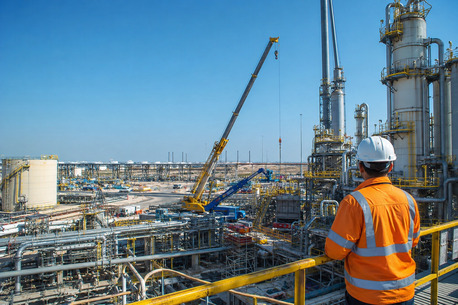
Industrial construction in the UAE has evolved far beyond traditional engineering and large-scale build execution. Today, success is defined less by how fast a facility is delivered and more by how seamlessly construction activities can take place without interrupting ongoing industrial operations.
From refinery expansions in Ruwais to automated logistics facilities in Dubai, industrial operators now expect contractors to function as risk-managed execution partners rather than simple builders.
This shift has significantly changed the role of industrial construction companies in the UAE, especially those involved in brownfield modifications, shutdown execution, and live plant integration.
The Shift Toward Production Reliability in UAE Industrial Construction
Across sectors such as oil and gas, manufacturing, and logistics, operational downtime is no longer acceptable unless it is strictly planned and tightly controlled.
Modern industrial contractors are now expected to:
Work inside active production environments
Coordinate complex shutdown schedules
Execute upgrades without disrupting output
Integrate automation systems into live plants
In this environment, industrial construction companies in Dubai and across the UAE are increasingly judged on one critical factor: their ability to maintain live plant stability and uninterrupted production within active hydrocarbon processing and industrial zones.
Brownfield Construction in Ruwais: Engineering Within Constraints
Ruwais remains one of the most complex industrial zones in the region due to its dense network of operating hydrocarbon facilities. Here, most construction work is classified as brownfield development, where modifications are carried out within existing live infrastructure.
Key Challenges in Brownfield Projects
Working in such environments requires a specialized engineering approach:
Live plant integration: Expansions and tie-ins must be executed without interrupting ongoing production systems
Confined space execution: Work often takes place in restricted, regulated plant environments, operational zones
Reverse engineering requirements: Existing plant systems must be digitally mapped before modification
Clash-free design execution: Laser scanning and 3D modeling are essential to avoid system conflicts
Unlike greenfield projects, brownfield construction in Ruwais demands extreme precision, advanced planning, and strict safety compliance at every stage.
Industrial Shutdown & Turnaround Execution: Managing Critical Time Windows
Shutdown projects are one of the most critical components of industrial construction in the UAE.
A shutdown refers to a planned, time-bound stoppage of operations during which essential maintenance, upgrades, or tie-ins are completed.
Why Shutdown Execution is Critical
Production losses during delays can be extremely high
Execution windows are often limited to days or weeks
Every activity must be pre-planned in detail
Coordination between multiple contractors is required
In Ruwais and similar industrial hubs, shutdown execution is treated as a high-stakes, time-sensitive engineering operation, where even minor delays can have a significant financial impact.
Industrial Construction in Dubai: Automation and Smart Infrastructure
While Ruwais focuses heavily on hydrocarbon infrastructure, industrial construction companies in Dubai operate in a more diversified ecosystem that includes logistics, manufacturing, food processing, and pharmaceuticals.
Here, the focus shifts toward automation-driven infrastructure and smart industrial systems.
Key Construction Priorities in Dubai
Automation integration: PLC and SCADA systems are implemented with minimal disruption to existing operations
Modular construction methods: Prefabricated systems are assembled off-site and installed quickly on-site
Hygienic construction standards: Especially critical in food and pharmaceutical facilities
Phased commissioning: Systems are activated incrementally to avoid operational disruption
Dubai’s industrial growth has created demand for contractors who can combine construction expertise with digital system integration capabilities.
Contracting Companies in Ruwais: Operating in High-Risk Environments
Ruwais is not a conventional construction environment—it is a fully integrated energy ecosystem with strict safety, operational, and regulatory requirements.
Contracting companies operating here must meet exceptionally high standards.
Core Execution Capabilities Required
Permit-to-work (PTW) compliance for all site activities
Hot work management systems with continuous gas monitoring
Zero-entry inspection techniques using robotic and remote tools
Commissioning coordination to maintain system integrity during upgrades
In many cases, even routine tasks require detailed risk assessments and multi-layer approvals before execution begins.
Modular Construction and Technology-Driven Execution
One of the most significant trends in UAE industrial construction is the shift toward modular and off-site fabrication techniques.
Instead of building entirely on-site, contractors now:
Prefabricate mechanical and electrical skids off-site
Transport fully assembled modules to the site
Install and commission them during controlled shutdown windows
This approach reduces:
On-site risk exposure
Execution time
Operational disruption
It also improves overall project predictability and quality control.
Role of EPC Contractors Like Tekzone in the UAE
EPC contractors such as Tekzone play a crucial role in supporting the evolving industrial ecosystem. By providing integrated engineering, procurement, construction, and automation services, they help clients minimize coordination complexity and enhance execution efficiency.
Their scope typically includes:
Mechanical, electrical, and civil construction
Industrial automation integration
Pipeline and plant modification works
Shutdown and turnaround execution support
Factory relocation and system upgrades
In critical industrial zones, such as Ruwais, EPC contractors are expected to closely adhere to industry safety frameworks and operational protocols, which include stringent Permit-to-Work (PTW) systems and procedures compliant with ADNOC standards.
Modern EPC execution prioritizes controlled downtime and safe execution over speed alone. Success is no longer defined by how quickly projects are delivered, but by how safely and seamlessly they are executed within live operational environments.
The Future of Industrial Construction in the UAE: Digital Transformation & Predictive Engineering
The next phase of industrial construction in the UAE is being shaped by digital transformation and predictive engineering.
Emerging trends include:
Digital twin modeling for plants and infrastructure
AI-based construction scheduling and risk prediction
Real-time sensor monitoring during execution
Predictive maintenance integration during construction phases
The industry is moving toward a model where construction is not just reactive, but predictive and continuously optimized.
Conclusion
Industrial construction in the UAE is undergoing a stru