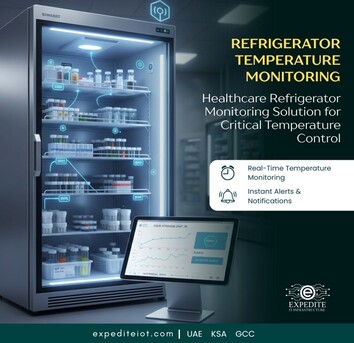
Traditional manual log-sheets and standalone thermometers cannot meet the real-time visibility demands of modern cold-chain governance. The solution — an end-to-end IoT-powered Refrigerator Monitoring system equipped with smart sensors, cloud-connected dashboards, and instant temperature alerts — is transforming how Qatar's most critical facilities protect their valuable inventory and maintain regulatory compliance.
The Cold-Chain Risk Landscape in Qatar's Healthcare Sector
Qatar's healthcare infrastructure has grown dramatically over the past decade, anchored by flagship facilities such as Hamad Medical Corporation, Sidra Medicine, and a proliferating network of specialty clinics and pharmaceutical distribution hubs. Each of these environments stores temperature-sensitive assets — vaccines, insulin formulations, oncology biologics, blood products, diagnostic reagents, and compounded sterile preparations — whose efficacy is entirely dependent on unbroken cold-chain management.
The consequences of a cold-chain failure are severe. According to the World Health Organization, approximately 50% of global vaccines are wasted annually due to temperature excursions. In Qatar's climate, where ambient temperatures routinely exceed 45°C in summer, power fluctuations or equipment malfunctions can push refrigerator temperatures outside the required 2°C–8°C range within minutes — long before a manual check would detect the deviation. A single undetected excursion in a hospital pharmacy can render an entire batch of high-value biologics non-viable, triggering regulatory scrutiny, financial loss, and — most critically — compromised patient care.
What Is an IoT Refrigerator Monitoring System?
An IoT Refrigerator Monitoring system is a connected network of wireless probes, gateway devices, and cloud-based analytics software that continuously measures, records, and communicates the internal temperature — and optionally humidity — of every cold storage unit in a facility. Unlike standalone thermometers, the IoT architecture delivers:
• Continuous, automated measurement — readings captured at configurable intervals (every 1, 5, or 15 minutes)
• Instant temperature alerts — push notifications, SMS, and email dispatched the moment a threshold is breached
• Tamper-proof digital audit trails — every reading is time-stamped and stored in an immutable cloud log for regulatory inspection
• Remote temperature monitoring — facility managers, quality assurance officers, and pharmacists access live and historical data from any device, anywhere
• Predictive maintenance signals — trend analysis flags aging compressors and door-seal failures before they cause an excursion
The Role of Smart Sensors in Modern Cold-Chain Management
Smart sensors are the nerve endings of an IoT cold-chain platform. Mounted inside refrigerators, freezers, and cryogenic storage units, these miniaturized devices combine a precision thermocouple or NTC thermistor with a microprocessor and a wireless radio — typically Zigbee, LoRaWAN, or Wi-Fi — that transmits readings to a central gateway in real time. Modern smart sensors deployed across Refrigerator Monitoring Doha projects offer:
• Accuracy to ±0.1°C — meeting WHO PQS E006 and USP 1079 standards for pharmaceutical storage
• Battery life of 3–5 years — eliminating the maintenance burden of frequent replacements in large installations
• Dual-sensor redundancy — a backup probe continues logging if the primary fails, ensuring data continuity for audits
• Door-open detection — a separate contact sensor logs every door event, critical for root-cause analysis after an excursion
• IP67 ingress protection — enabling deployment in wet laboratories, blood banks, and walk-in cold rooms where condensation is constant
The sensor data flows to an on-site IoT gateway — or directly to the cloud over cellular LTE in facilities without dedicated Wi-Fi infrastructure — where it is processed, stored, and made accessible through a role-based web and mobile dashboard.
Temperature Data Loggers vs. IoT Sensors: Understanding the Difference
Temperature data loggers are standalone devices that record readings to internal memory for later download — traditionally a USB stick plugged into a computer at the end of a shift or a delivery run. While temperature data loggers remain a valid tool for point-in-time transport validation and regulatory submission packages, they are fundamentally reactive: they tell you what happened, not what is happening right now.
IoT-connected smart sensors bridge this gap by combining the precision of a calibrated data logger with continuous cloud connectivity. For hospital pharmacies and pharmaceutical warehouses in Doha that must comply with Qatar's Ministry of Public Health (MoPH) storage guidelines, ASHRAE 90.1, and international frameworks such as the ICH Q10 Pharmaceutical Quality System and GDP guidelines (EU/WHO), the IoT approach provides the always-on, always-auditable evidence trail that temperature data loggers alone cannot deliver at scale.
Remote Temperature Monitoring: Visibility Across Every Facility
Remote temperature monitoring fundamentally changes the operational model for quality assurance teams. In a traditional setup, a QA officer must physically tour cold-storage areas on a fixed schedule, manually reading and recording thermometer values. In a multi-floor hospital with 50+ refrigeration units — blood bank, pharmacy, pathology, oncology day unit, and research biorepository — this process is both labour-intensive and riddled with blind spots between checks.
With an IoT remote temperature monitoring platform, a single dashboard — accessible via browser, iOS, or Android — displays every unit's live status, color-coded by compliance zone. Excursions are flagged immediately, escalation chains are automated, and after-hours coverage requires no additional staffing. For Refrigerator Monitoring Qatar deployments spanning multiple sites — such as a hospital group managing facilities in Lusail, West Bay, and Al Wakrah simultaneously — centralized remote temperature monitoring eliminates the need for on-site QA staff at each location during overnight or weekend periods.
Temperature Alerts: From Passive Logging to Active Risk Prevention
The most operationally impactful feature of any IoT monitoring platform is its temperature alerts engine. Modern systems support a tiered escalation architecture:
1. Soft alert (advisory) — temperature approaches the threshold limit (e.g., 7.5°C for a 2°C–8°C range); notification sent to primary custodian
2. Hard alert (breach) — temperature crosses the defined upper