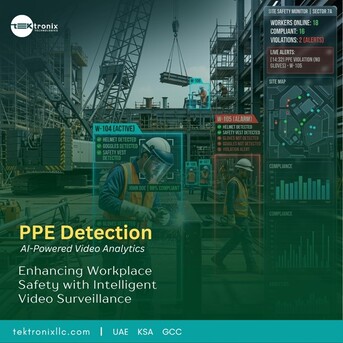
This guide explores how AI-powered PPE detection and video analytics solutions are transforming night-shift safety management across oil and gas facilities, petrochemical plants, construction megaprojects, and logistics hubs throughout the Gulf Cooperation Council. From the science of low-light detection to regulatory compliance, ROI modelling, and real-world deployment considerations, this is the practitioner-grade resource your safety and technology teams need.
1. The Night Shift Safety Crisis in GCC Industrial Operations
Across the GCC, a significant share of industrial fatalities and serious injuries occur between the hours of 10 PM and 6 AM. The reasons are well-documented: reduced supervisor presence, worker fatigue, compressed visibility, and a documented tendency for PPE compliance rates to fall during night hours when direct oversight is lowest. Studies from GCC occupational health bodies consistently show PPE adherence drops by 25–40% during overnight rotations compared with daytime shifts.
The consequences are severe. A worker on a petrochemical site in Jubail or a construction tower in NEOM who removes their hard hat, forgets their high-visibility vest, or skips eye protection for “just a moment” during a night operation creates a liability that no safety briefing or manual inspection regime can reliably prevent. Traditional human supervisors cannot maintain constant vigilance across expansive facilities in darkness. Camera systems alone, without intelligence, produce footage that is reviewed only after incidents occur — too late to matter.
1.1 The Limitations of Manual Night-Time Safety Enforcement
• Supervisor fatigue: Human monitors become progressively less effective after hour four of a night shift, with attention deficits well-documented in occupational psychology research.
• Facility scale: A single offshore platform, industrial complex, or Tier 1 construction site may cover hundreds of thousands of square metres — physically impossible to patrol continuously.
• Documentation gaps: Manual observation cannot produce the timestamped, auditable compliance records that regional regulators and international insurers increasingly require.
• Reactive rather than preventive: Without automated alerting, safety breaches are typically discovered only when an incident has already occurred or during post-shift video review.
These limitations create the precise conditions in which AI-Powered Video Analytics delivers its highest return: continuous, objective, fatigue-free monitoring that operates as effectively at 3 AM as it does at noon.
2. How Video Analytics Software Detects PPE in Low-Light Conditions
Understanding the technology stack behind night-time PPE detection is essential for decision-makers evaluating Video Analytics Software vendors and deployment architectures. Modern systems have evolved far beyond simple pixel-comparison motion detection — they represent a convergence of computer vision, deep learning, and edge computing engineered specifically for challenging industrial environments.
2.1 Low-Light and Thermal Imaging Infrastructure
Effective night-shift PPE detection begins with the right imaging hardware integrated with the analytics engine:
• StarLight and ultra-low-lux cameras: Advanced image sensors that produce colour video at illumination levels as low as 0.001 lux — capturing detail in conditions where the human eye sees only darkness.
• Near-infrared (NIR) illumination: Covert or visible IR illuminators that flood a scene with wavelengths the camera sensor captures but workers do not perceive, preserving workplace ambience while enabling full-detail imaging.
• Thermal imaging integration: Radiometric cameras that detect body heat signatures regardless of ambient light, enabling detection of human presence and rough positional data even in complete darkness or through dust and smoke.
• PTZ auto-tracking: Pan-tilt-zoom cameras with AI-driven auto-tracking that follow workers through a scene, maintaining the angular resolution required for accurate PPE classification without static blind spots.
2.2 AI-Powered Object Recognition for PPE Classification
At the core of any effective system is AI-Powered Object Recognition — the ability of a trained deep learning model to identify specific PPE items on a human figure within a video frame, under challenging real-world conditions. Here is how enterprise-grade systems handle this:
• Convolutional Neural Network (CNN) architectures: Trained on millions of annotated industrial images, these models learn to recognise hard hats, safety vests, gloves, safety glasses, steel-toed boots, fall-arrest harnesses, and respiratory protection across a vast range of body positions, lighting conditions, and occlusion scenarios.
• Multi-class simultaneous detection: A single inference pass identifies multiple PPE categories on multiple workers simultaneously, enabling real-time monitoring of entire crews rather than individual workers in sequence.
• Pose estimation integration: Skeleton-based human pose models help the PPE classifier understand body orientation, resolving ambiguities that arise when a worker is viewed from behind or at an angle where a standard bounding-box detector would fail.
• Confidence scoring and threshold management: Each detection is accompanied by a confidence score. Operators can set classification thresholds appropriate to their risk environment: a nuclear facility may require 95%+ confidence before clearing a worker; a lower-risk warehouse may accept 85% as operationally sufficient.
2.3 Edge vs. Cloud Processing Architectures
GCC industrial operators face a practical choice between on-premises edge processing and cloud-based analytics pipelines:
• Edge computing: AI inference runs on ruggedized edge servers co-located with cameras at the facility. Advantages include ultra-low latency (sub-100ms alert generation), full operation during WAN outages, and data sovereignty compliance for facilities subject to Bahrain PDPDL or Saudi PDPL requirements.
• Cloud processing: Video streams are transmitted to a hosted analytics platform. Advantages include rapid model updates, centralised management of multi-site deployments, and elastic scaling during high-occupancy periods.
• Hybrid architecture: Edge devices handle real-time alerting and local recording; cloud platforms receive anonymised analytics data and model telemetry for continuous improvement and enterprise reporting. This is the most common architecture for large GCC operators managing multiple facilities.
3. Real-Time PPE Compliance Monitoring: From Detection to Corrective Action
Detection without response is surveillance without safety. Real-Time PPE Compliance Monitoring