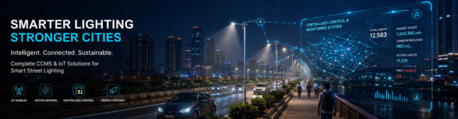
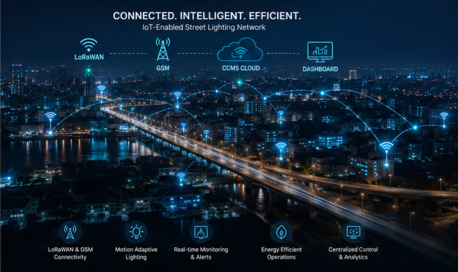
Smart city lighting solutions are intelligent, IoT-connected outdoor lighting systems that combine sensor-enabled LED streetlights with CCMS (Centralized Control and Monitoring System) monitoring platforms — enabling dynamic brightness control, real-time fault management, remote control, and energy analytics across entire urban lighting networks. TRUEiSENSE, powered by OCTIOT and India's No.1 True Presence Technology brand, provides CCMS Smart Lighting Solutions for Indian municipalities, campuses, and commercial estates — using LoRaWAN, WiFi, and GSM for IoT connectivity, delivering up to 70% energy savings, and supporting India's Smart Cities Mission with scalable, open-protocol infrastructure.
Core Technologies in Smart City Lighting — How Each Contributes
1. LED Street Light
(i) What It Does: High-efficiency source, supports dynamic dimming
(ii) TRUEiSENSE Component: Smart motion sensor street lights
2. Integrated Motion Sensors
(i) What It Does: Detects vehicles & pedestrians — traffic-responsive dimming
(ii) TRUEiSENSE Component: Embedded in each smart street light node
3. IoT Communication (LoRaWAN/WiFi/GSM)
(i) What It Does: Transmits real-time data from nodes to CCMS server
(ii) TRUEiSENSE Component: Multi-protocol CCMS communication layer
4. CCMS Monitoring Platform
(i) What It Does: Centralizes monitoring, control, analytics, fault alerts
(ii) TRUEiSENSE Component: TRUEiSENSE CCMS web dashboard
CCMS Smart Lighting: trueisense.in/pages/ccms-monitoring-sensor-street-lighting-solutions
As of 2026, India's smart city transformation is reshaping expectations for every dimension of civic infrastructure — including street lighting. Smart city lighting solutions go far beyond conventional streetlights, delivering energy efficiency, remote management, real-time fault detection, and IoT data integration. For municipalities participating in India's Smart Cities Mission, and for large campuses, industrial estates, and commercial developments, smart city lighting infrastructure is increasingly a baseline requirement rather than an advanced aspiration.
Why Do Indian Cities Need Smart Lighting Infrastructure?
Street lighting is one of the largest electricity expenditures for Indian municipalities — and one of the most addressable sources of energy waste. Most Indian streetlights run on fixed-time schedules at full brightness throughout the night, consuming the same energy during quiet 3 AM hours as during peak evening traffic. Faulty lights go undetected for days. No device-level energy data is available. Maintenance is entirely reactive.
Smart city lighting addresses both dimensions simultaneously. Sensor-based dimming reduces energy consumption by up to 70% vs conventional systems. CCMS monitoring provides real-time fault detection, automated SMS maintenance alerts, and centralized control — transforming street lighting from passive infrastructure into an intelligent, manageable, energy efficient lighting automation platform.
Street lighting is among the largest municipal electricity expenditures in India.
Fixed-schedule operation wastes energy during low-traffic periods — up to 70% recoverable.
Silent failures affect public safety and increase reactive maintenance costs.
No device-level performance data hinders evidence-based management.
CCMS monitoring transforms maintenance from reactive to proactive and data-driven.
Bottom Line:
Indian cities need smart city lighting because conventional street lighting is operationally unsustainable — wasting 40-70% of energy, failing silently, and providing no visibility of network-level performance.
What Is CCMS and Why Is It the Control Layer of Smart City Lighting?
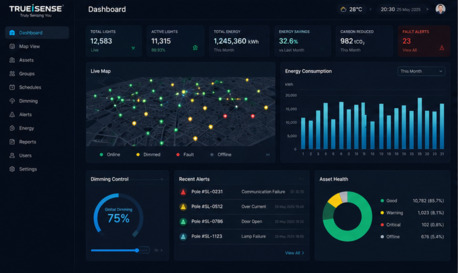
CCMS (Centralized Control and Monitoring System) is the operational backbone of a smart city lighting network — providing real-time monitoring, remote control, fault management, and energy analytics through a single web interface. Without CCMS, even sensor-enabled smart street lights operate as isolated, unmonitored nodes with no fault visibility and no energy data.
TRUEiSENSE CCMS gives city operators a real-time map view of all streetlight nodes — which are active, dimmed, or faulted. Remote dimming commands can be issued to individual nodes, groups, or the entire network. Automated dimming schedules reduce brightness during predictable low-traffic periods. Automated SMS alerts ensure maintenance teams are notified of faults immediately — without any manual dashboard monitoring.
Bottom Line:
CCMS transforms a collection of smart street lights into a coherent, monitored, and manageable city lighting network — delivering real-time visibility, automated fault management, and remote control from a single web interface.
Where Are Smart City Lighting Solutions Used Across India?
1. Municipal roads & highways
(i) Use Case: Energy savings + fault management across large networks
(ii) TRUEiSENSE Solution: CCMS + sensor street lights (LoRaWAN)
2. Smart city corridors
(i) Use Case: Real-time dimming + IoT data for urban platforms
(ii) TRUEiSENSE Solution: CCMS dashboard + smart sensor nodes
3. Industrial campuses
(i) Use Case: Centralized outdoor lighting control, energy analytics
(ii) TRUEiSENSE Solution: CCMS (WiFi/GSM) + sensor street lights
4. Educational institutions
(i) Use Case: Campus perimeter, parking, walkway lighting automation
(ii) TRUEiSENSE Solution: CCMS + sensor street lights + parking automation
5. Commercial estates & IT parks
(i) Use Case: Outdoor lighting + security + energy optimization
(ii) TRUEiSENSE Solution: CCMS + sensor floodlights + smart parking
6. Airports & large transit zones
(i) Use Case: High-traffic variable zones requiring adaptive dimming
(ii) TRUEiSENSE Solution: Smart sensor street lights + CCMS
7. Residential townships
(i) Use Case: Street and parking lighting for gated communities
(ii) TRUEiSENSE Solution: Sensor street lights + CCMS (WiFi)
8. Rural road networks
(i) Use Case: GSM-connected sensor lighting for remote stretches
(ii) TRUEiSENSE Solution: CCMS (GSM) + sensor street lights
Bottom Line:
TRUEiSENSE CCMS smart city lighting solutions are deployable across the full spectrum of Indian outdoor applications — from dense urban municipalities and industrial campuses to rural road networks and residential townships.
How Does IoT Communication Work in Smart City Lighting?
1. LoRaWAN
(i) Coverage & Use Case: Wide-area, low-power — one gateway covers several km
(ii) Best For: Large municipal networks, rural roads
2. WiFi
(i) Coverage & Use Case: Higher bandwidth — leverages existing network infrastructure
(ii) Best For: Campus-scale: industrial, educational, commercial
3. GSM (Cellular)
(i) Coverage & Use Case: Nationwide coverage via cellular networks
(ii) Best For: Rural stretches, remote locations, coverage gaps
Bottom Line:
TRUEiSENSE's three-protocol IoT architecture — LoRaWAN, WiFi, and GSM — ensures that any municipality, campus, or commercial estate in India can deploy CCMS