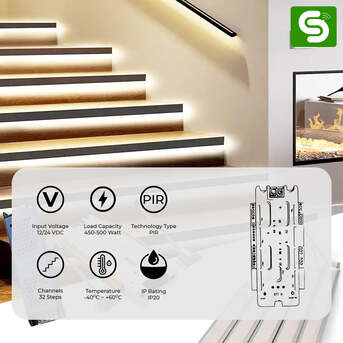
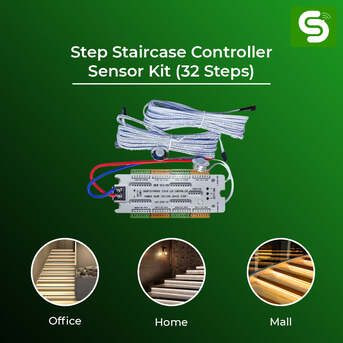
A staircase controller activates LED strip lights on individual stair treads sequentially — one step at a time — as a person ascends or descends, creating a flowing waterfall lighting effect. Esysense offers the 32-channel PIR staircase controller (up to 32 steps) and the pixel LED variant (up to 512 pixels) for homes, offices, hotels, and malls. A complete 15-step home staircase system (controller + LED strips + driver + sensors) typically costs Rs.3,000–Rs.8,000 — delivers premium visuals and zero electricity waste when unoccupied.
1. 32 Channel Staircase Controller
(i) Steps Supported: Up to 32 steps
(ii) Detection Method: PIR motion sensors
(iii) Applications: Homes, Offices, Hotels, Restaurants
(iv) Price (Complete System): Rs.3,000–Rs.8,000
(v) Best For: Most residential and commercial staircase automation projects
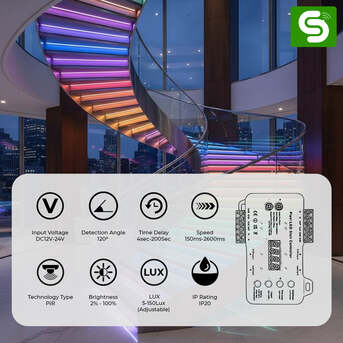
2. Pixel LED Staircase Controller
(i) Steps Supported: Up to 512 pixels
(ii) Detection Method: PIR motion sensors
(iii) Applications: Premium homes, Commercial buildings, Shopping malls, Architectural projects
(iv) Price: Higher-end system (check site)
(v) Best For: RGB effects, dynamic animations, and premium staircase installations
Controllers: esysense.com/products/pir-32-channel-staircase-controller-500w
A staircase controller is an electronic device that manages the switching sequence of LED strip lights on individual stair treads. Instead of all steps illuminating simultaneously, the controller activates each step in sequence — from the entry point upward or downward — as a person walks through the staircase. The result is a visually striking waterfall effect that is simultaneously safer, more energy-efficient, and more impressive than always-on or simple on/off staircase lighting.
How Does a Staircase Controller Work?
The system has four components working together:
(i) Two motion/IR sensors — mounted at the top and bottom of the staircase to detect an approaching person and determine direction of travel
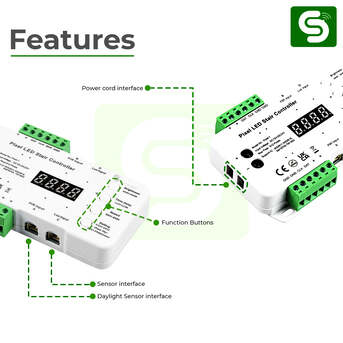
(ii) Staircase controller unit — receives sensor signals and sends sequential switching commands to each step channel
(iii) LED strip lights — one strip per step tread, connected to the controller's individual output channels
(iv) LED driver — converts 220V AC mains to 12V or 24V DC for the controller and all strips
Ascending sequence: bottom sensor triggered → Step 1 activates → Step 2 → Step 3 → ... all steps lit → delay expires → steps switch off sequentially from top. Descending sequence: top sensor triggered → activation runs in reverse order.
Bottom line:
With a day/night LDR option, the staircase controller operates only in low ambient light — disabling automatically during daytime, which prevents unnecessary activation and extends LED strip lifespan significantly.
IR Staircase Controller vs Standard PIR Controller — Which Is Better?
1. IR Beam Staircase Controller
(i) Detection Method: Infrared beam stretches across staircase width and is interrupted when a person walks through it
(ii) Direction Awareness: Yes — identifies whether the user is moving up or down
(iii) False Trigger Risk: Very low — requires an actual beam break
(iv) Best For: Direction-aware lighting, Premium installations, Commercial projects
(v) Sensor Mounting: Ankle height at the top and bottom of the staircase
(vi) Reliability: Excellent — binary detection minimizes ambiguity
2. PIR Motion Sensor Controller
(i) Detection Method: Detects body heat and movement
(ii) Direction Awareness: Partial — depends on sensor positioning
(iii) False Trigger Risk: Low to medium
(iv) Best For: Residential staircases, Standard commercial projects, Cost-effective installations
(v) Sensor Mounting: Above door level or at staircase entry points
(vi) Reliability: Very good — ideal for most Indian homes
Bottom line:
For most Indian homes and standard commercial staircases, the PIR controller is the practical choice — simpler installation, proven reliability. Choose the IR controller for premium direction-aware installations in hotels, malls, and corporate lobbies.
Which Staircase Controller Application Is Right for You?
1. Duplex / Triplex Home
(i) Steps: 12–18
(ii) Controller: 32 Channel PIR Controller
(iii) LED Strip Specification: 4.8–7.2W/m, 3000K Warm White
(iv) Design Effect: Warm waterfall effect — the most popular staircase lighting style in Indian homes.
2. Bungalow / Villa Grand Staircase
(i) Steps: 15–25
(ii) Controller: 32 Channel Controller or Pixel Controller
(iii) LED Strip Specification: 7.2W/m, 3000K Warm White or RGB
(iv) Design Effect: Architectural centerpiece with sequential lighting and optional color effects.
3. Boutique Hotel / Resort
(i) Steps: 15–20 steps per flight
(ii) Controller: IR Controller + 32 Channel Controller
(iii) LED Strip Specification: 7.2W/m, 3000K Warm White
(iv) Design Effect: Direction-aware premium lighting with a luxurious warm ambience for guests.
4. Shopping Mall
(i) Steps: 20–30 steps, 3–6m staircase width
(ii) Controller: Pixel LED Controller
(iii) LED Strip Specification: 14.4W/m RGB
(iv) Design Effect: Multi-color sequential lighting with high visual impact for high-traffic areas.
5. Office Building
(i) Steps: 10–15 steps per floor
(ii) Controller: 32 Channel PIR Controller
(iii) LED Strip Specification: 7.2W/m, 4000K Neutral White
(iv) Design Effect: Professional appearance with energy-efficient operation throughout the day and night.
6. School / Hospital
(i) Steps: 10–18
(ii) Controller: 32 Channel PIR Controller + LDR Sensor
(iii) LED Strip Specification: 7.2W/m, 4000K Neutral White
(iv) Design Effect: Safety-focused lighting that remains off during daylight and activates automatically after dark for energy savings and visibility.
Bottom line:
A complete 15-step home staircase LED controller system from Esysense (32-channel controller, LED strips, driver, sensors, wiring) typically costs Rs.3,000–Rs.8,000 — delivering a feature that adds significant visual appeal and safety value to any multi-floor home.
Installation Guide — 8 Steps
1. Count total steps between floors — this determines the controller channel count needed.
2. Measure each tread width — multiply by W/m strip wattage to get wattage per step.
3. Calculate total wattage (steps x wattage/step) and select an LED driver with 20–30% headroom.
4. Install the LED driver in an accessible wall cavity or electrical enclosure near the staircase.
5. Mount PIR or IR sensors at the top and bottom of the staircase — at ankle height for IR beam sensors.
6. Run a separate pair of DC wires (positive and negative) from the controller to each step position.
7. Install LED strips on each tread (under the nosing overhang in aluminum diffuser channels).
8. Connect: Channel 1 to Step 1, Channel 2 to Step 2, and so on. Connect sensors to top and bottom sensor inputs. Power on and test.