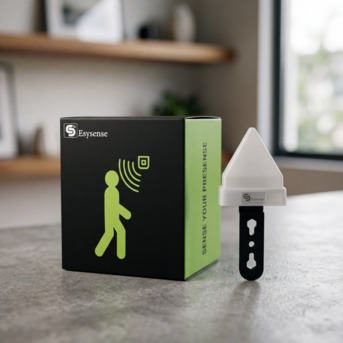
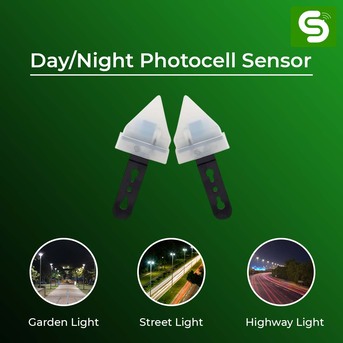
The best photocell sensor for Indian homes in 2026 is the Esysense Day Night Photocell LDR Sensor (220–270V AC, up to 20A, IP65) for entrance lights, garden lights, and balcony fixtures. For street lights and pole-mounted area lighting, the Esysense Pole Mount Photocell Sensor (NEMA twist-lock, 110–270V AC, 10A, IP65) is the right choice. Both automatically switch outdoor lights ON at dusk and OFF at dawn — no manual switching, no timer programming, zero electricity waste during daylight hours.
1. Day Night Photocell Sensor
(i) Current: 20A
(ii) Voltage: 220–270V AC
(iii) IP Rating: IP65
(iv) Best For: Entrance lighting, gardens, balconies, security lights
2. Pole Mount Photocell Sensor
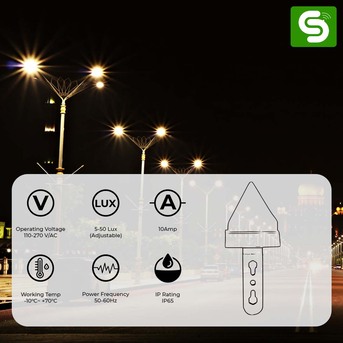
(i) Current: 10A
(ii) Voltage: 110–270V AC
(iii) IP Rating: IP65
(iv) Best For: Street lights, area lights, parking lot poles
3. Inline Photocell Sensor (Standard)
(i) Current: 10A
(ii) Voltage: 220–270V AC
(iii) IP Rating: IP44
(iv) Best For: General outdoor dusk-to-dawn lighting applications
Day Night Sensor: esysense.com/products/day-night-photocell-ldr-sensor-auto-on-off
Pole Mount Sensor: esysense.com/products/photocell-sensor
A photocell LDR sensor is an ambient light-sensing device that automatically controls outdoor lighting based on the natural light level — switching lights ON when darkness falls and OFF when daylight returns. It is the most reliable, lowest-maintenance, and most energy-efficient way to control dusk-to-dawn outdoor lighting for Indian homes, offices, and public areas.
How Does a Photocell LDR Sensor Work?
The LDR (Light Dependent Resistor) inside the photocell changes its electrical resistance based on light intensity:
(i) In bright daylight: LDR resistance is very low. The circuit holds the connected light OFF.
(ii) At dusk (light level drops below threshold): LDR resistance rises dramatically. The sensor's relay closes — connected light switches ON automatically.
(iii) At dawn (light level rises above threshold): LDR resistance drops. Relay opens — light switches OFF automatically.
(iv) Threshold adjustment: a small potentiometer on most Esysense photocell sensors allows tuning — set higher for areas needing light even on overcast afternoons, lower for bright urban environments.
(v) Hysteresis: built-in to prevent flickering when light levels hover at the threshold — prevents rapid on/off cycling at dusk.
Bottom line:
A photocell sensor consumes less than 0.5W in standby (daytime monitoring) — negligible against the electricity saved by preventing outdoor lights from running during daylight hours.
Photocell Sensor vs Other Dusk-to-Dawn Methods
1. Photocell / LDR Sensor
(i) Accuracy: Excellent — automatically adapts to actual daylight levels and seasonal changes
(ii) Energy Waste: Very low
(iii) Maintenance: Minimal — no programming required
(iv) Best For: Any dusk-to-dawn outdoor lighting system
2. Mechanical Timer
(i) Accuracy: Poor — fixed schedules do not adjust to changing sunrise and sunset times
(ii) Energy Waste: High, especially during seasonal daylight variations
(iii) Maintenance: Requires periodic adjustment
(iv) Best For: Budget-oriented fixed-time installations
3. Astronomical Timer
(i) Accuracy: Very good — calculates sunrise and sunset based on location
(ii) Energy Waste: Low
(iii) Maintenance: One-time setup
(iv) Best For: Smart homes and building automation systems
4. Manual Switch
(i) Accuracy: Depends entirely on user operation
(ii) Energy Waste: Very high
(iii) Maintenance: Requires daily manual use
(iv) Best For: Generally not recommended for outdoor lighting
5. Motion Sensor Only
(i) Accuracy: Not designed for dusk-to-dawn operation
(ii) Energy Waste: Very low when occupancy-based
(iii) Maintenance: Minimal
(iv) Best For: Security lighting and parking areas (ideally combined with a photocell sensor)
Bottom line:
For outdoor lighting that must operate reliably from dusk to dawn every night — entrance lights, garden lights, security perimeter, street lights — the photocell LDR sensor is the most accurate, lowest-waste, and lowest-maintenance solution available in India.
Where to Use a Photocell Sensor — Application Guide
1. Home Entrance / Porch Light
(i) Sensor Type: Day Night Photocell
(ii) IP Rating: IP65
(iii) Why: Automatically turns lights on at dusk and off at dawn, ensuring a welcoming entrance every evening
2. Garden Path Lights
(i) Sensor Type: Inline Photocell
(ii) IP Rating: IP44
(iii) Why: One sensor can control multiple garden fixtures simultaneously
3. Balcony Light
(i) Sensor Type: Day Night Photocell
(ii) IP Rating: IP65
(iii) Why: Prevents unnecessary daytime operation and maximizes energy savings
4. Security Perimeter Lighting
(i) Sensor Type: Inline Photocell
(ii) IP Rating: IP44–IP65
(iii) Why: Provides reliable dusk-to-dawn operation; can be paired with PIR sensors for enhanced security
5. Apartment Common Areas
(i) Sensor Type: Day Night Photocell
(ii) IP Rating: IP65
(iii) Why: Automates parking, entrance, and garden lighting without caretaker intervention
6. Street Light (Municipal / Colony)
(i) Sensor Type: Pole Mount Photocell (NEMA)
(ii) IP Rating: IP65
(iii) Why: Weatherproof pole-top installation with easy replacement capability
7. Parking Lot Pole Light
(i) Sensor Type: Pole Mount Photocell (NEMA)
(ii) IP Rating: IP65
(iii) Why: Can be combined with motion sensors to maximize energy efficiency and reduce operating costs
Bottom line:
Combining a photocell sensor (dusk-to-dawn gating) with a motion sensor (on-demand full brightness) reduces outdoor lighting electricity consumption by 80–90% compared to always-on alternatives — the most energy-efficient outdoor lighting configuration available.
Installation Guide — Inline Photocell Sensor
1. Isolate power at the circuit breaker serving the outdoor light.
2. Locate the Live (brown/red) wire between the distribution board and the outdoor light fitting.
3. Cut the Live wire at a convenient accessible point.
4. Connect each cut end to the photocell sensor's terminal connectors (Live IN and Live OUT).
5. Mount the sensor in a weatherproof enclosure positioned to face open sky — not toward the light it controls (which would cause false 'always-off' switching).
6. Restore power. The photocell now automatically controls the Live feed — light ON at dusk, OFF at dawn.
7. Optional: adjust the threshold potentiometer to fine-tune the switching light level.
Critical: only the Live (phase) wire is interrupted by the photocell. Neutral and Earth pass through unchanged. Use a licensed electrician for all mains wiring connections.
Pole Mount (NEMA) Photocell Installation
1. Confirm the luminaire or pole has a NEMA twist-lock socket on top (standard on most Indian street and area lighting poles)
2. Align the photocell's three pins with the NEMA socket and insert
3. R