Core Technology Stack: How the System Delivers Campus-Wide Intelligence
Visitor Registration System - Structured Pre-Arrival and On-Site Enrolment
The foundation of intelligent campus visitor control is a robust Visitor Registration System that captures complete, verified visitor data before access is granted. Tektronix LLC's platform supports dual-channel registration: pre-arrival digital invitations sent by hosts via email or SMS, enabling visitors to complete identity submission, visit purpose declaration, and terms acceptance before they arrive at the campus perimeter - and on-site self-service kiosk registration for walk-in visitors that captures Emirates ID or passport data via document scanning, collects visit details, and automatically notifies the host of arrival.
For multi-building campuses, registration data captured at any entry point is instantly shared across the entire campus network - meaning a visitor registered at Building A's main lobby is immediately visible to security teams at Buildings B, C, and D with full profile access and access permission parameters already established.
Visitor Identification - Precision Identity Verification at Every Access Point
Visitor Identification in Tektronix LLC's platform goes far beyond collecting a name and signature. The system employs multi-modal identity capture including Emirates ID chip reading for UAE residents and GCC nationals, international passport OCR scanning for overseas visitors, QR code verification for pre-registered visitors presenting digital passes, and facial recognition matching against the registered profile photograph - ensuring that the individual presenting at the access point is verifiably the same person who completed registration, not someone who has transferred or shared credentials.
Identity verification is completed in under eight seconds per visitor, maintaining lobby flow even during peak arrival periods - critical for educational campuses managing lecture-start rushes or corporate campuses handling morning shift arrivals across multiple buildings simultaneously.
Visitor Authentication - Layered Security Clearance for Sensitive Zones
Visitor Authentication extends the identification layer into active access control integration - translating verified identity into dynamic, zone-specific access permissions enforced at physical barriers including turnstiles, electronic door locks, boom gates, and elevator floor restrictions. Authentication policies can be configured at granular levels: a maintenance contractor may be authenticated for plant room access in Building 3 only, during a defined 4-hour window, with automatic expiry at the scheduled completion time. A visiting academic may be authenticated for lecture theatres and faculty common areas but explicitly denied access to research laboratories or server rooms.
Multi-factor authentication options - combining digital QR visitor badges, biometric facial recognition, and host-confirmation PIN codes - provide layered security for high-sensitivity zones without creating friction for standard visitor flows in lower-security building areas.
Visitor Tracking - Real-Time Location Intelligence Across Every Building
Visitor Tracking is where Tektronix LLC's centralized architecture delivers its most transformative campus safety capability. As a visitor moves between buildings, passes through internal access points, uses building-specific amenities, or interacts with secure zones, every event is logged in real time and displayed on the central security dashboard's campus map view - giving security teams an accurate, continuously updated picture of every visitor's location and movement history.
Automated alerts trigger when: a visitor enters an area outside their authorised access permission; a visitor's badge has expired and they remain on campus; a visitor has not been met by their host within a defined waiting period; a visitor attempts repeated access to a restricted zone; or a visitor is identified as a person of interest against watchlist databases. Each alert delivers actionable intelligence - visitor identity, current location, access history, and host contact details-to the responding security team member within seconds.
Visitor Management Software - The Intelligent Command Layer
Visitor Management Software is the operational brain of the Tektronix LLC platform - the web-based and mobile application layer through which security managers, reception staff, facility administrators, and host employees interact with the visitor intelligence system. The software provides a unified dashboard aggregating real-time visitor counts by building, active alert feeds, host notification queues, visitor history logs with full audit trails, scheduled visit calendars, and compliance reporting tools - all accessible from desktop workstations at the security command centre or from mobile devices for roving security personnel.
Role-based access controls ensure that each user sees and can action only the data relevant to their responsibility level - a building receptionist manages their building's lobby queue, a campus security manager monitors the entire estate, and a facility compliance officer accesses the audit and reporting module - all operating simultaneously on the same underlying data platform without conflicting permissions or information silos.
Visitor Management Device - Hardware Built for UAE Campus Environments
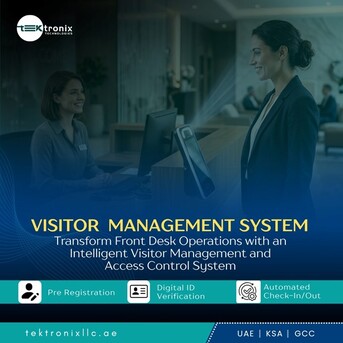
The platform's physical interface layer - the Visitor Management Device ecosystem - is engineered for the demanding operational conditions of UAE campuses: high visitor throughput, outdoor and semi-outdoor lobby environments, extreme ambient temperature ranges, and the cosmopolitan international visitor demographics that UAE institutions routinely host. Device options include freestanding self-service kiosks with integrated document scanners, facial recognition cameras, badge printers, and touchscreens; wall-mounted compact units for secondary access points; counter-mounted receptionist workstations with dual-screen visitor-facing displays; and tablet-based mobile check-in units for temporary event or construction site access management.
All devices communicate via encrypted network protocols, operate with local processing capability to maintain functionality during network interruptions, and integrate natively with the central software platform - ensuring that no device operates as an isolated data island regardless of its physical location on the campus.
Conclusion
UAE campuses have grown too complex, too populous, and too security-sensitive to rely on fragmented, building-by-building visitor control approaches that leave dangerous gaps between sy