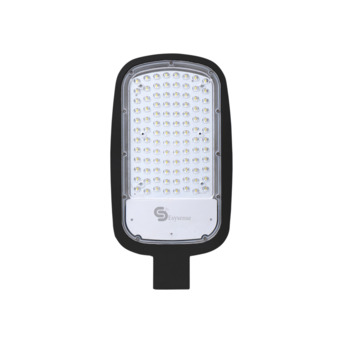
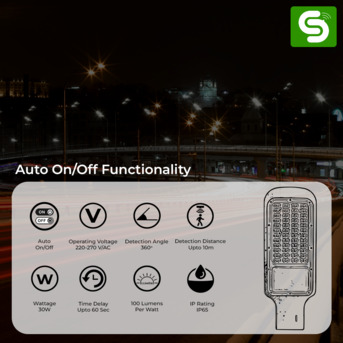
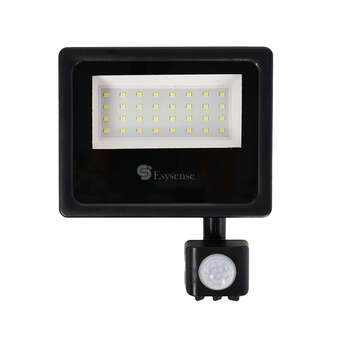
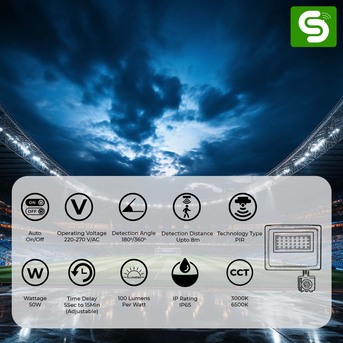
The best outdoor motion sensor lighting for Indian homes and colonies in 2026: for driveways and home security, the Esysense 20–30W Motion Sensor LED Floodlight (IP65, radar + photocell) activates at full brightness when movement is detected after dusk and dims to 10–20% standby when unoccupied. For colony roads and campus pathways, the Esysense 20–40W Motion Sensor Street Light (IP65, pole mount) provides sequential coverage. Both use radar sensing for reliable activation in Indian summer temperatures and are fully monsoon-rated at IP65.
1. Motion Sensor LED Floodlight
(i) Wattage: 20W–50W
(ii) Type: Wide-beam floodlight
(iii) Sensor: Radar + Photocell
(iv) IP Rating: IP65
(v) Best For: Driveways, building perimeters, parking areas, security lighting
2. Motion Sensor Street Light
(i) Wattage: 20W–40W
(ii) Type: Road-optimized street light
(iii) Sensor: Radar + Photocell
(iv) IP Rating: IP65
(v) Best For: Colony roads, campus pathways, pedestrian walkways, pole-mounted installations
3. Outdoor Sensor Combination System
(i) Wattage: 30W+ (typical)
(ii) Type: Combined outdoor lighting solution
(iii) Sensor: Radar + PIR + Photocell
(iv) IP Rating: IP65
(v) Best For: Commercial campuses, industrial yards, warehouses, large outdoor areas
Street Light: esysense.com/products/motion-sensor-street-light
Floodlight: esysense.com/products/motion-sensor-led-floodlight
Motion sensor outdoor lighting activates full brightness when a pedestrian or vehicle is detected and dims to standby (10–20%) or switches off when the area is empty. Combined with a photocell (LDR) for day/night gating — the light is completely off during the day — this delivers electricity savings of 80–92% compared to traditional always-on sodium or halogen outdoor lighting.
Motion Sensor Street Light vs Motion Sensor Floodlight — Key Differences
1. Motion Sensor Street Light
(i) Design Purpose: Road and pathway illumination from elevated mounting heights
(ii) Mounting Height: Pole mounted at 4–8 meters
(iii) Light Distribution: Asymmetric road pattern optimized for roadway coverage
(iv) Detection Range: 6–12 meters — activates before pedestrians reach the lit zone
(v) Best For: Colony roads, campuses, apartment pathways, pedestrian walkways
(vi) Typical Spacing: 12–20 meters between poles
2. Motion Sensor LED Floodlight
(i) Design Purpose: Wide-area flood illumination
(ii) Mounting Height: Wall, fascia, or pole mounted at 2.5–4 meters
(iii) Light Distribution: Wide symmetrical beam (approximately 120°–150°)
(iv) Detection Range: 5–10 meters — activates as vehicles or people approach
(v) Best For: Driveways, parking lots, gates, building exteriors, security lighting
(vi) Typical Coverage: One floodlight per gate, entrance, or 50–100 sqm area
Bottom line:
For Indian residential colony roads: choose the motion sensor street light at 5-metre pole height, 30–40W, 12–15 meter spacing. For home driveways and security perimeters: choose the 20–30W floodlight at 2.5–3 meter wall mounting height.
Why Radar Sensing Is Essential for Outdoor Applications
(i) Temperature independence: PIR sensors fail in Indian summer outdoor temperatures (40–48 degrees C ambient) where the heat differential with a human body drops near zero. Radar works identically at any temperature.
(ii) Rain and monsoon immunity: microwave signals propagate through rain, fog, and humidity without degradation. PIR sensors can be affected by rain condensation on the sensor window.
(iii) Vehicle detection: radar signals reflect strongly off metal vehicle bodies — ensuring reliable activation when a vehicle enters a driveway or parking area. PIR sensors may miss slow-moving vehicles.
(iv) Wind immunity: PIR sensors can false-trigger from wind-moved vegetation or large insects. Radar sensors detect only Doppler-shifted moving bodies — unaffected by wind, leaves, or ambient heat.
Bottom line:
For outdoor applications in India — where summer temperatures, monsoon rain, and ceiling fans are simultaneously present — radar is not a premium choice, it is the reliable choice. PIR outdoor lighting will false-trigger daily in Indian summer conditions.
Photocell + Motion Sensor Combination — Maximum Efficiency
The most energy-efficient outdoor lighting strategy combines two sensors in one fixture:
(i) Photocell (LDR) layer: gates the entire circuit — light is completely off during the day (12 hrs) regardless of motion. Zero daytime electricity use.
(ii) Motion sensor layer: within the dusk-to-dawn window, controls brightness level: no motion detected = dim standby at 10–20% power motion detected = full 100% brightness.
1. Daytime (Photocell Controlled)
(i) Duration: 12 hours
(ii) Power Consumption: 0W
(iii) Daily Energy Use: 0 Wh
(iv) Benefit: Photocell prevents any daytime operation
2. Nighttime Standby Mode
(i) Duration: 10 hours
(ii) Power Consumption: 3W (approximately 10% brightness of a 30W fixture)
(iii) Daily Energy Use: 30 Wh
(iv) Benefit: Provides low-level security lighting while minimizing energy usage
3. Full Brightness Mode (Motion Detected)
(i) Duration: 2 hours (cumulative)
(ii) Power Consumption: 30W
(iii) Daily Energy Use: 60 Wh
(iv) Benefit: Full illumination only when people or vehicles are present
4. Total Daily Consumption
(i) Total Duration: 24 hours
(ii) Total Energy Use: 90 Wh/day
(iii) Comparison: Only 90 Wh/day versus approximately 1,200 Wh/day for a traditional 100W HPS street light running continuously
(iv) Result: Up to 90%+ energy savings while maintaining security and visibility
Bottom line:
A 30W Esysense radar + photocell motion sensor street light consumes 90 Wh/day vs 1,200 Wh/day for a traditional 100W sodium street light — a 92.5% energy reduction. Annual saving per fitting: approximately Rs.3,197 at Rs.8/unit.
Installation Guide — Motion Sensor Floodlight (5 Steps)
1. Select a wall, fascia, or pole mounting point at 2.5–4 meters height with an unobstructed view of the target area. Ensure the photocell window faces the open sky — not toward the floodlight's own output.
2. Route the supply cable to the mounting point through conduit or surface cable channel from the distribution board.
3. Attach the floodlight bracket firmly using appropriate concrete anchors or pole clamps. Angle the floodlight to direct the beam across the target zone (driveway, entrance, perimeter).
4. Connect supply cable to floodlight terminals (Live-Neutral-Earth) and seal the cable entry gland for IP65 integrity.
5. Restore power after dusk and test — walk through the detection zone. Adjust floodlight angle and sensor sensitivity dial if needed.
Use a licensed electrician for all mains supply connections. Ensure all outdoor cable joints are made inside IP65 junction boxes.
Explore More Smart Lighting Solutions by Esysense
Looking for more smart sensor lighting for your home or offic