Conventional locker systems — whether key-operated or combination-lock — generate a steady accumulation of operational and security problems that scale with organisational size:
• Lost keys trigger locksmith callouts, replacement hardware costs, and security re-keying exercises that consume facilities management time and budget disproportionately
• No audit trail means there is no record of who accessed which locker, when, and for how long — making theft investigations impossible to conduct with any rigour
• Static allocation wastes space: lockers permanently assigned to individuals who only use them occasionally create a chronic underutilisation problem, particularly relevant in hot-desking and hybrid working environments
• Combination code sharing is universal in practice, eliminating any meaningful security boundary between users
• Manual key management registers are administratively burdensome, prone to inaccuracy, and impossible to interrogate in real time
• No integration capability means conventional lockers exist as entirely isolated hardware with no connection to building management, access control, HR, or parcel management systems
For UAE organisations operating in competitive, compliance-conscious environments — where DIFC Data Protection Law, Abu Dhabi Global Market (ADGM) regulations, or sector-specific frameworks govern asset and data security — these vulnerabilities carry real regulatory and reputational risk. The transition to intelligent locker management is not a luxury upgrade; it is an operational and security imperative.
2. Core Technology Components: What Makes a Locker System Truly Smart
2.1 Parcel Locker System
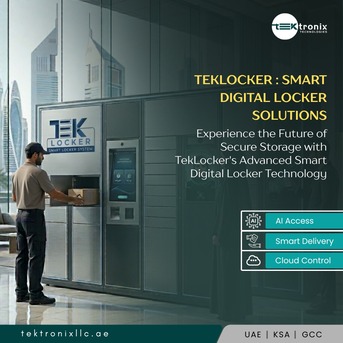
Parcel Locker System technology addresses one of the most acute operational pain points in UAE corporate environments: the management of the ever-growing volume of e-commerce deliveries, internal mail, and sensitive documents arriving at workplace reception desks. In dense corporate towers and business parks — where a single reception team may handle hundreds of parcels daily for dozens of tenants — manual parcel management creates bottlenecks, loss risk, and privacy violations.
An intelligent parcel locker deploys a bank of compartments of variable sizes, managed by a central controller. When a courier arrives, they place the parcel in an appropriate compartment and the system immediately notifies the recipient via SMS, email, or push notification with a unique collection code. The recipient collects at their convenience — without involving reception staff, without queuing, and with a full digital chain of custody from delivery to collection.
For UAE businesses operating in multi-tenant buildings — prevalent across Business Bay, Dubai Internet City, and Abu Dhabi's Al Maryah Island — parcel locker systems provide the infrastructure for a genuinely contactless, staff-free last-mile delivery service that elevates the tenant experience and dramatically reduces reception team administrative burden.
2.2 Automated Locker System
Automated Locker System functionality extends smart locker technology beyond parcel management into the full lifecycle of employee asset and storage management. Key automation capabilities include:
• Dynamic locker allocation: the system automatically assigns an available locker to a user at the point of need — eliminating the wasted capacity of static allocation and enabling true hot-desk locker provision
• Automatic release: lockers that have been unoccupied beyond a defined period — for example, 24 hours after a temporary user's work session ends — are automatically cleared and returned to the available pool
• Automated billing and chargeback: for shared workspace operators and co-working facilities, the system automatically calculates and records locker usage for departmental chargeback or member billing
• Maintenance workflow automation: the system identifies lockers with door sensor faults, battery warnings, or access failures and automatically raises maintenance requests to the facilities management team
• Expiry notifications: users who have not collected items or returned equipment by the defined deadline receive escalating automated reminders, reducing the administrative overhead of manual follow-up
2.3 IoT Locker System
IoT Locker System architecture connects individual locker units to the internet and to each other, enabling real-time data exchange, remote diagnostics, and seamless integration with the wider smart building ecosystem. In UAE smart building environments — where Estidama Pearl certification, LEED Gold standards, and WELL Building certification are increasingly standard — IoT connectivity is the infrastructure layer that allows locker systems to contribute meaningful data to building intelligence platforms.
IoT-enabled locker benefits for UAE facility managers include:
• Real-time occupancy dashboard: instant visibility of which lockers are occupied, by whom, and since when — accessible via browser or mobile app from anywhere
• Predictive maintenance alerts: sensor data identifying door mechanism wear, electronic lock degradation, or environmental conditions before they cause failure
• Energy optimisation: intelligent lighting and climate management within locker bays triggered by occupancy sensor data
• Remote lock and unlock: facilities managers can release any locker remotely — essential for emergency access situations or when users forget their credentials
• Geo-fenced access rules: time-based and location-aware access policies that restrict locker use to approved hours and locations
2.4 RFID Locker System
RFID Locker System technology uses radio-frequency identification to authenticate users and manage locker access without physical contact or memorised codes. RFID-based lockers accept access via:
• Employee ID smart cards — enabling locker access to be controlled by the same credential already used for building access control, eliminating the need for separate locker keys or codes
• NFC-enabled smartphones — allowing employees to use their mobile device as a locker credential via tap-to-open functionality
• Wearable RFID tokens — particularly relevant in healthcare, hospitality, and industrial environments where carrying a physical card is impractical
For UAE organisations that have already deployed RFID-based access control systems — the standard in DIFC, ADGM, and major corporate campuses — RFID locker integration enables a single-credential model across the entire premises. A staff member's existing access badge authenticates them at the building entrance, the car park barrier, the office floor reader, and their locker — a genuinely unified identity experience that simplifies administration and strengthens audit trail integrity..
3. Cloud-Based Locker Management: The Intelligence Layer
Cloud-Based Locker Management platforms are the operational brain of a modern smart locker deployment. Moving locker management from on-premise controllers to the cloud unlocks a suite of capabilities that would be impossible or prohibitively expensive