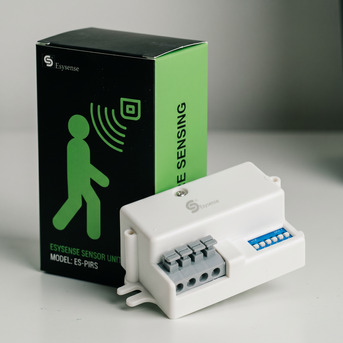
The best standalone motion sensor for Indian offices and commercial spaces in 2026: ceiling mount microwave sensor for large open areas and parking (temperature-immune, 360-degree coverage); adjustable PIR sensor for office cabins and retail (user-configurable range and delay); ceiling mount PIR for meeting rooms (omnidirectional room coverage); mini PIR for concealed and furniture installations; wall mount PIR for corridor and doorway entry detection. All connect in series with the existing light's Live wire — no new fixtures needed.
1. Microwave Motion Sensor
(i) Mounting: Ceiling or Wall
(ii) Detection Pattern: 360° coverage or directed detection
(iii) Adjustable: Yes
(iv) Best For: Offices, parking areas, outdoor spaces, large rooms
(v) Product Link: esysense.com/products/microwave-motion-sensor
2. Adjustable PIR Sensor
(i) Mounting: Wall or Ceiling
(ii) Detection Pattern: Directional cone
(iii) Adjustable: Yes (fully adjustable)
(iv) Best For: Office cabins, retail stores, libraries
(v) Product Link: esysense.com/products/180-adjustable-pir-motion-sensor
3. Ceiling Mount PIR Sensor
(i) Mounting: Ceiling
(ii) Detection Pattern: 360° coverage
(iii) Adjustable: Yes
(iv) Best For: Meeting rooms, classrooms, large rooms
(v) Product Link: esysense.com/products/infrared-pir-motion-sensor
4. Mini PIR Sensor
(i) Mounting: Concealed installation
(ii) Detection Pattern: 90°–120°
(iii) Adjustable: Partially
(iv) Best For: Furniture, wardrobes, display cases, compact spaces
(v) Product Link: esysense.com/products/mini-pir-motion-sensor
5. Wall Mount PIR Sensor
(i) Mounting: Wall
(ii) Detection Pattern: 90°–180° directional coverage
(iii) Adjustable: Yes
(iv) Best For: Corridors, doorways, staircase entrances
(v) Product Link: esysense.com/products/wall-mount-pir-sensor
A standalone motion sensor gives you flexibility that integrated sensor lights cannot — it controls any existing fixture, covers multiple lights from one sensor, and can be positioned independently from the light for optimal detection. This guide explains which standalone sensor type is right for each Indian application.
Standalone Sensor vs Integrated Sensor Light — When to Choose Each
1. Standalone Motion Sensor
(i) Flexibility: Can control almost any existing lighting fixture
(ii) Lights Controlled: One sensor can control multiple lights in parallel
(iii) Sensor Positioning: Can be installed independently for optimal detection
(iv) Installation: Connected in series with the Live wire of existing lighting
(v) Best For: Retrofitting existing lights and multi-light control systems
(vi) Wiring Required: Yes
2. Integrated Sensor Light (Bulb, Panel, Tubelight)
(i) Flexibility: Controls only the built-in light
(ii) Lights Controlled: One sensor controls one light
(iii) Sensor Positioning: Fixed within the fixture
(iv) Installation: Simple replacement of an existing bulb or fitting
(v) Best For: Quick upgrades and single-light automation
(vi) Wiring Required: No additional wiring
Bottom line:
Choose a standalone sensor when you want to keep existing decorative or specialist fixtures, need one sensor to control multiple lights, or need the sensor positioned separately from the light for better detection coverage.
Microwave Motion Sensor — Why It Is Superior for Indian Conditions
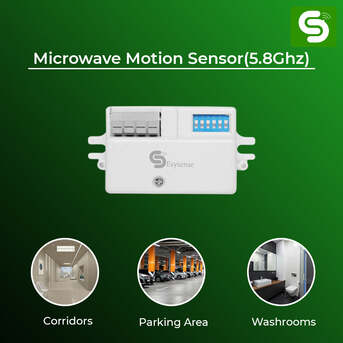
The microwave sensor emits low-power 5.8 GHz radar signals and detects Doppler frequency shifts from moving objects — completely independent of ambient temperature. This makes it the reliable choice for India:
(i) Temperature immunity: works identically at 15 degrees C winter and 45 degrees C summer — PIR fails above 38 degrees C when room temperature approaches body temperature.
(ii) Ceiling fan immunity: ignores airflow and fan motor heat — PIR sensors false-trigger from fans in most Indian rooms.
(iii) Through-partition detection: microwave signals penetrate thin glass and lightweight partitions — sensor can be mounted inside false ceilings.
(iv) Vehicle detection: strong radar reflection from metal vehicle bodies — essential for parking applications.
(v) Rain and humidity immunity: radar is unaffected by monsoon condensation that degrades PIR lens sensitivity.
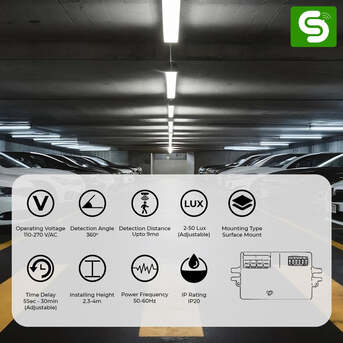
Specifications: 110-270V AC 360-degree (ceiling mount) 1-9m adjustable range
Bottom line:
For any Indian application with ceiling fans, summer temperatures above 35 degrees C, or outdoor/semi-outdoor exposure — the microwave sensor is the only reliable choice. PIR sensors work in Indian winters but degrade significantly through April to September.
Adjustable PIR Sensor — Precision Control for Each Space
The adjustable PIR sensor provides three user-configurable parameters — making it the most versatile PIR option when one fixed specification does not suit the space:
(i) Sensitivity adjustment: range potentiometer sets detection from 1m (minimum) to 7m (maximum). (ii) Reduce to prevent cross-room false triggers in adjacent offices.
(iii) Time delay adjustment: delay potentiometer from 3 seconds (short-visit utility) to 12 minutes (library reading area). Match to typical occupancy duration.
(iv) LDR threshold adjustment: sets the ambient light level at which the sensor activates — useful for day/night gating in spaces with variable natural light.
1. Office Private Cabin
(i) Sensitivity: Medium (3–5m)
(ii) Delay: 10–12 minutes
(iii) Why: Avoids triggers from outside the cabin and supports long desk-work sessions
2. Retail Checkout Counter
(i) Sensitivity: Medium (around 4m)
(ii) Delay: 30–60 seconds
(iii) Why: Short customer interactions require quick switch-off after the area becomes vacant
3. Library Reading Area
(i) Sensitivity: Medium (around 4m)
(ii) Delay: 10–12 minutes
(iii) Why: Prevents lights switching off during extended periods of quiet reading
4. Meeting Room
(i) Sensitivity: High (5–6m)
(ii) Delay: 10–15 minutes
(iii) Why: Ensures lights remain on during presentations and discussions with minimal movement
5. Small Toilet / WC
(i) Sensitivity: Low–Medium (2–3m)
(ii) Delay: 3–5 minutes
(iii) Why: Suitable for compact spaces and short occupancy periods
Bottom line:
The adjustable PIR is the right choice when you need sensor behaviour fine-tuned to a specific space — a one-size setting does not work across office cabins, reading rooms, and checkout counters simultaneously.
Ceiling Mount vs Wall Mount PIR — Which to Install?
1. Ceiling Mount PIR
(i) Coverage Pattern: 360° coverage below the sensor
(ii) Best For: Full room occupancy detection
(iii) False Trigger Risk: Low
(iv) Mounting Height: Ceiling, ideally near the room center
(v) Ideal Applications: Meeting rooms, Classrooms, Open-plan offices & Conference rooms.
2. Wall Mount PIR
(i) Coverage Pattern: 90°–180° forward-facing detection cone
(ii) Best For: Entry detection and corridor monitoring
(iii) False Trigger Risk: Mod