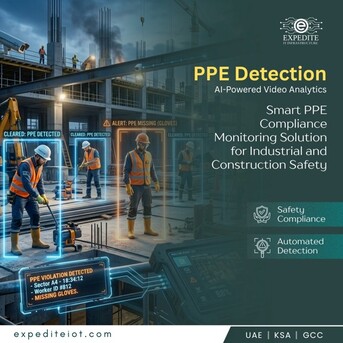
Qatar's ambitious infrastructure programme — spanning mega-projects tied to the National Vision 2030, smart city developments, and energy sector expansion — demands rigorous, scalable safety enforcement. Traditional PPE audits conducted by on-site supervisors are reactive, resource-intensive, and fundamentally unable to monitor hundreds of workers simultaneously across sprawling industrial sites. AI-Powered Video Analytics closes this gap with continuous, automated, and evidence-based monitoring that works around the clock.
1. What Is Intelligent Video Analytics and Why Does It Matter for PPE?
Video Analytics Software refers to the application of computer vision, deep learning, and artificial intelligence to automatically analyze live and recorded video streams. In the context of PPE monitoring, these systems are trained to detect the presence or absence of safety equipment — hard hats, high-visibility vests, safety goggles, gloves, ear defenders, and safety boots — on workers captured by standard IP surveillance cameras.
Unlike traditional CCTV which requires a human operator to watch footage and manually flag violations, an intelligent video analytics platform operates autonomously. It processes video frames in real time, identifies each worker as a distinct entity, checks their compliance status against predefined safety rules, and triggers instant alerts when a violation is detected — all without any human intervention.
The significance of this capability in Qatar's context cannot be overstated. The country's Labour Law and associated workplace safety regulations, enforced by the Ministry of Labour and Qatar's Supreme Committee for Delivery & Legacy, mandate strict PPE compliance on all construction and industrial sites. Automated compliance monitoring provides documented, time-stamped evidence of both adherence and violations — creating an audit trail that protects employers, contractors, and workers alike.
2. Core Technology: How AI-Powered Object Recognition Drives PPE Detection
At the technical core of modern PPE monitoring systems is AI-Powered Object Recognition — a branch of deep learning that trains neural networks to identify and classify specific objects within an image or video frame with exceptional accuracy. Leading platforms leverage convolutional neural networks (CNNs) and transformer-based vision models trained on millions of labelled images of workers in diverse PPE configurations, lighting conditions, and environmental contexts.
Multi-Class Detection Architecture
A single video frame processed by an AI PPE system simultaneously identifies multiple object classes: person, hard hat (present/absent), safety vest (present/absent), goggles (present/absent), and gloves (present/absent). Each detection carries a confidence score, and the system only triggers an alert when confidence exceeds a pre-calibrated threshold — minimizing false positives that would otherwise desensitize supervisors to alarm fatigue.
Pose Estimation and Occlusion Handling
Advanced systems augment object detection with skeletal pose estimation, which maps the joint positions of each detected worker. This enables the system to correctly assess PPE status even when partial occlusion occurs — for example, determining that a worker's head is unprotected even when only the upper torso is visible in the frame.
Edge AI Processing
For industrial sites with limited bandwidth or latency-sensitive applications, edge AI processing allows the Video Analytics Solutions to run directly on smart cameras or edge compute devices — eliminating the need to stream high-resolution video to a central cloud server. This architecture is particularly relevant for remote oil and gas installations across Qatar's energy sector where network infrastructure may be constrained.
3. High Accuracy Detection: What Performance Standards Should Qatar Operators Expect?
The value of any PPE monitoring system is directly proportional to its High Accuracy Detection capability. Industry-leading platforms achieve mean average precision (mAP) scores exceeding 90% across standard PPE categories under controlled conditions. However, real-world deployment in Qatar presents unique environmental variables that operators must account for when evaluating vendor claims.
Key performance factors include:
• Lighting variability: Qatar's outdoor worksites experience intense daylight glare, deep shadows, and complete darkness during night shifts. Systems must demonstrate consistent detection accuracy across the full luminance spectrum, supported by infrared-capable cameras for low-light environments.
• Heat haze and dust: The desert climate generates atmospheric distortion and airborne particulate that degrade image clarity. Vendors should provide accuracy benchmarks obtained in comparable GCC climate conditions, not solely controlled laboratory environments.
• Worker density: Large construction sites may have dozens of workers in a single camera frame. The system's multi-person detection capability — tracking each individual independently — must be validated at high crowd densities to ensure no workers are missed.
• PPE color and style variation: Qatar's multinational workforce wears PPE from a wide range of manufacturers with varied colors, styles, and branding. Detection models must be trained on diverse PPE datasets to avoid failures on less common equipment configurations.
• Camera angle and distance: Worksites require coverage at varying camera heights, angles, and distances. Detection accuracy must be validated at realistic installation parameters — not only at close range under optimal angles.
When evaluating vendors for Video Analytics Qatar deployments, request site-specific proof-of-concept trials and insist on accuracy benchmarks from comparable regional projects rather than relying solely on generalized marketing claims.
4. Video Analytics Solutions for PPE Monitoring: Key System Capabilities
A production-ready PPE monitoring deployment built on enterprise Video Analytics Solutions integrates multiple functional layers that together deliver end-to-end safety governance:
Real-Time Alert Management
When a PPE violation is detected, the system generates an immediate alert delivered through multiple channels simultaneously — on-screen notifications in the control room, SMS or push notifications to site supervisors' mobile devices, and automated loudspeaker announcements in the zone where the violation was observed. Alert fatigue is managed through configurable cool-down periods and zone-based escalation rules.
Worker Identification and Tracking
Integration with access control and biometric identification systems — including the facial recognition technology deployed across Qatar's major project sites — enables the analytics platform to attribute PPE violations to speci