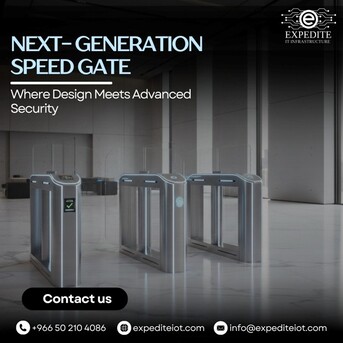
This guide examines the full spectrum of Turnstile Access Control technology available to Qatar businesses — covering product types, deployment environments, integration capabilities, and the key criteria for selecting the right solution. Whether your facility requires a low-profile optical lane or a heavy-duty perimeter solution, understanding the available options is the first step toward a smarter, more secure premises.
The Growing Demand for Pedestrian Access Control in Qatar
Qatar's transformation under its National Vision 2030 has produced an unprecedented wave of infrastructure development — smart cities, world-class stadiums, financial districts, university campuses, and government complexes. Each of these environments demands a pedestrian entry management system that can handle high volumes, integrate with digital identity platforms, and deliver verifiable access records for compliance and auditing.
Businesses operating in Qatar face several converging pressures that make Turnstile Speed Gates Qatar deployments not just preferable but operationally essential:
• Workforce management regulations requiring accurate headcount and shift-entry records
• Corporate liability obligations necessitating documented visitor access logs
• Fire safety compliance requiring real-time occupancy monitoring and emergency egress management
• Integration mandates for biometric identity verification at government and semi-government facilities
• Patron flow management at high-capacity venues, retail destinations, and transport hubs
Qatar's rapid urban growth across Doha, Lusail City, Al Wakrah, the Pearl-Qatar, and Msheireb Downtown has created a diverse portfolio of environments where turnstile solutions are now a baseline expectation rather than a premium upgrade.
Types of Turnstile Speed Gates Available for Qatar Businesses
A thorough understanding of available product categories enables businesses to specify the most appropriate solution for their footprint, throughput, and security requirements.
1. Tripod Turnstile Gates
Tripod Turnstile Gates represent the most established and economically accessible category in the turnstile family. Featuring a rotating three-arm mechanism that permits one-directional or bi-directional passage per authenticated event, tripod turnstiles are widely deployed in construction sites, factories, warehouses, stadiums, and public amenities across Qatar.
• Robust steel construction rated for heavy industrial and outdoor environments
• Waist-height design for fast pedestrian throughput in both entry and exit directions
• Integration with RFID cards, PIN pads, barcode scanners, and biometric readers
• Fail-safe and fail-secure operating modes for emergency egress compliance
• Available in indoor stainless-steel and outdoor powder-coated variants
Tripod turnstiles are a cost-effective first layer of physical access control for facilities where aesthetics is secondary to durability and throughput.
2. Full Height Turnstile Gates
Full Height Turnstile Gates provide the highest level of physical security in the pedestrian access control category. Extending from floor to ceiling or overhead frame, these units create an absolute physical barrier that prevents tailgating, climbing, or bypass — making them the definitive choice for perimeter security at critical infrastructure sites, correctional facilities, military compounds, and data centres in Qatar.
• Floor-to-ceiling rotating cage design eliminates all bypass vectors
• Rated for both indoor and outdoor installation with weatherproof housings
• Single and double-leaf configurations for varying lane widths
• Integrates with advanced biometric systems including iris recognition and facial identification
• Anti-climb and anti-vandalism hardening as standard on security-rated models
For government ministries, embassies, critical energy infrastructure, and high-security manufacturing zones in Qatar, full height units remain the gold standard in physical entry control.
3. Flap Barrier Turnstile Gates
Flap Barrier Turnstile Gates — also known as wing barriers — deploy retractable horizontal flaps that open on successful authentication and close immediately after each passage event. Their sleek, low-profile form factor makes them the preferred choice for corporate lobbies, financial institutions, luxury hotels, and high-end commercial buildings where aesthetics and branding are as important as security.
• Glass, acrylic, or stainless-steel flap variants to complement premium interior designs
• Wide-lane configurations available for wheelchair and trolley accessibility compliance
• High-speed motor mechanisms supporting up to 40–60 persons per minute throughput
• Anti-pinch sensors and reversible-flap safety features for user protection
• Integrated LED strip lighting and direction indicators for intuitive user experience
Flap barrier turnstiles are increasingly specified across Doha's West Bay financial district, Education City campuses, and premium mixed-use developments seeking a modern, branded entry experience.
4. Swing Barrier Turnstile Gates
Swing Barrier Turnstile Gates use a swinging arm panel that pivots to permit authorized passage. Their wider opening arc accommodates persons with mobility requirements, staff carrying equipment, and service personnel — making them compliant with accessibility regulations and practically suited for environments where diverse user groups require frictionless entry.
• ADA and accessibility-compliant lane widths up to 900mm for inclusive access
• Smooth, controlled swing arc with anti-panic break-away function for emergencies
• Quiet servo motor operation suitable for noise-sensitive environments such as libraries and clinics
• Configurable for unidirectional or bidirectional passage modes
• Compatible with all major access control reader technologies
Swing barrier solutions are widely specified for healthcare facilities, airport terminals, government service halls, and mixed-use developments across Qatar where inclusive design is a contractual or regulatory requirement.
5. Optical Turnstile Gates
Optical Turnstile Gates — sometimes referred to as speed lanes or barrier-free turnstiles — create a virtual access barrier through an array of infrared and optical sensors rather than a physical arm or flap. They deliver the fastest possible pedestrian throughput, making them ideal for transport hubs, conference centres, technology campuses, and media facilities where user experience and speed are paramount.
• Throughput rates exceeding 60 persons per minute in high-flow