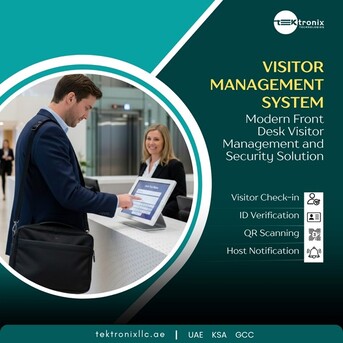
Core Capabilities of a Healthcare Visitor Management System
Visitor Identification: Accurate, Rapid, and Tamper-Resistant
Reliable Visitor Identification is the foundation of every secure healthcare environment. Manual processes — handwritten logs, verbal declarations — introduce transcription errors and provide no forensic value during incident investigations. A digital identification workflow captures:
• Emirates ID or passport OCR scanning with MRZ (Machine Readable Zone) extraction for automatic form population
• Photo capture at the point of check-in, creating a timestamped visual record linked to each visit event
• Watchlist screening against internal blacklists or restricted visitor databases, with real-time alert notifications to security staff
• Visitor badge printing with QR or barcode encoding, expiry time, zone permissions, and host name for immediate visual identification by clinical staff
Visitor Authentication: Eliminating Credential Fraud in Clinical Zones
For high-security areas — intensive care units, neonatal wards, pharmacy stores, and data server rooms — Visitor Authentication must go beyond badge issuance. Tektronix LLC integrates multi-layer authentication workflows that may include:
• Biometric verification (fingerprint or facial recognition) cross-referenced against the pre-registered visitor profile
• Host staff confirmation via mobile push notification before access is granted to sensitive clinical zones
• Time-bound, single-use QR codes sent to pre-approved visitor mobile numbers, eliminating badge forgery risk
• Integration with the hospital's Access Control System for automated door release upon successful authentication
Visitor Tracking: Real-Time Situational Awareness Across the Facility
Once inside a facility, Visitor Tracking ensures that every individual remains within their authorised zones and that any anomaly — overstay, zone violation, tailgating — is detected and escalated immediately. Tektronix LLC deploys tracking capabilities through:
• Zone-based access logging: Every door or turnstile event is timestamped and attributed to the visitor's profile, constructing a complete movement history for the visit duration.
• Dwell-time monitoring: Automated alerts trigger when a visitor exceeds pre-defined dwell limits in sensitive areas such as medication rooms or record archives.
• Integration with CCTV and Video Analytics: Visit records correlate with camera footage, enabling rapid forensic reconstruction of any security incident involving visitors.
• Emergency muster reporting: In fire or evacuation scenarios, the system produces a real-time list of all visitors currently on-site, by zone — a capability mandated by UAE Civil Defence protocols.
Visitor Management Software: The Intelligence Layer for Healthcare Operations
The Visitor Management Software platform deployed by Tektronix LLC serves as the operational brain of the entire visitor governance infrastructure. Key software capabilities include:
• Pre-registration portal: Clinical staff and patients pre-register expected visitors online or via mobile app, reducing lobby congestion and check-in time by up to 70%.
• Recurring visitor profiles: Authorised family members, regular care companions, and accredited vendor representatives are stored with pre-verified credentials, enabling expedited check-in on subsequent visits.
• Configurable visiting hour enforcement: The system automatically restricts or permits entry based on ward-specific visiting hour schedules, reducing the administrative burden on nursing staff.
• Multilingual interface: Supports Arabic and English — both official languages in use across UAE healthcare environments — for seamless interaction with the diverse patient visitor population.
• Compliance reporting dashboard: Generates visit volume, zone activity, watchlist event, and audit trail reports in formats compatible with DHA, DOH, and ADHICS inspection requirements.
• HRMS and Active Directory integration: Automatically distinguishes contractor and vendor visits from patient visitor traffic, applying appropriate policy rules to each category.
Visitor Management Device: Hardware Engineered for Clinical Environments
Software capability is only as effective as the hardware that delivers it at the point of entry. A Visitor Management Device in a healthcare setting must meet demanding standards for hygiene, durability, and user accessibility. Tektronix LLC specifies and supplies:
• Touchless kiosk terminals: Deploy facial recognition and QR code scanning for check-in without physical contact — critical for infection control compliance, particularly in post-pandemic UAE healthcare protocols.
• Emirates ID and passport scanners: Integrated OCR readers that extract identity data in under three seconds, minimising queue formation at reception.
• Thermal printer modules: On-demand visitor badge printing with variable zone colour coding for immediate ward recognition.
• IP-rated hardware enclosures: Designed for continuous operation in high-traffic reception areas, with antimicrobial surface coatings available for infection-sensitive deployments.
• Tablet-based reception consoles: Provide receptionists with a fully integrated host dashboard for approvals, watchlist checks, and visitor communication from a single screen.
Integration with the Hospital's Physical Security Ecosystem
Tektronix LLC's Visitor Management System UAE is engineered as an integrated layer within the broader hospital security infrastructure, not a siloed application. Standard integration pathways include:
• Access Control Systems: Visitor credentials dynamically provisioned and revoked in the access control panel in real time, enabling automatic door release upon authenticated check-in and automatic lock-out upon check-out or badge expiry.
• IP CCTV and Video Management Systems (VMS): Visitor check-in events tagged to corresponding camera feeds, enabling event-driven video retrieval during incident investigations.
• Nurse Call and Intercom Systems: Visitor arrival notifications pushed toward nurse stations, reducing the need for reception staff to make manual calls.
• Hospital Information Systems (HIS): Patient admission data cross-referenced with expected visitor lists, automating visiting restrictions for patients under confidentiality or safety holds.
Conclusion
Healthcare environments carry a unique duty of care — to patients, staff, and the broader community. A rigorously implemented Visitor Management System transforms the hospital entrance from a potential vulnerability into a secure, intelligent, and compliant gateway. From automated Visitor Registration System workflows that eliminate