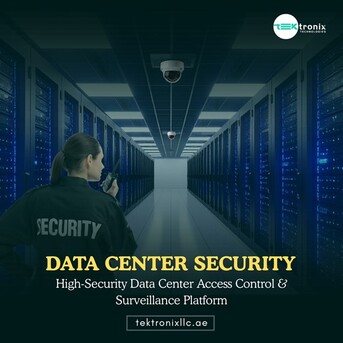
From hyperscale colocation campuses in Dubai Internet City and Abu Dhabi's Hub71 to enterprise-owned server rooms in DIFC financial towers and Khalifa Industrial Zone facilities, the UAE's data centre ecosystem is expanding at a pace that demands security frameworks equal to international Tier III and Tier IV standards — and the local regulatory obligations of the UAE's Personal Data Protection Law (PDPL), NESA National Information Assurance Standards, and sector-specific frameworks governing financial services, healthcare, and critical national infrastructure.
Why Data Center Security Is a Critical Priority in the UAE
The UAE's ambition to become a global hub for artificial intelligence, financial technology, and digital government services makes its data infrastructure an increasingly high-value target. Several converging factors amplify the urgency of a comprehensive Data Center Security posture across the Emirates:
• Escalating threat landscape: The UAE Cybersecurity Council reported a significant rise in cyberattacks targeting critical infrastructure in recent years, with ransomware, advanced persistent threat (APT) groups, and supply chain compromise incidents among the most prevalent attack vectors affecting data-intensive organisations.
• Regulatory enforcement momentum: The UAE PDPL, NESA standards, Central Bank of UAE (CBUAE) IT risk guidelines, and Dubai Electronic Security Centre (DESC) frameworks collectively impose enforceable data security obligations with material penalties for non-compliance — obligations that begin at the data centre perimeter.
• Digital transformation velocity: Rapid cloud migration, IoT proliferation, and 5G infrastructure expansion are dramatically increasing the attack surface of UAE data facilities, introducing new vulnerability categories that legacy perimeter-only security architectures cannot adequately address.
• Insider threat reality: Privileged access misuse, whether by employees, contractors, or compromised service accounts, consistently ranks among the top causes of data centre security incidents globally and in the UAE — making layered internal controls as important as external perimeter defence.
Data Center Threat Detection: From Perimeter to Process Layer
Effective Data Center Threat Detection in modern UAE facilities requires visibility across every layer of the technology stack — not merely at the network perimeter, but within the virtualisation layer, across east-west traffic flows between workloads, and at the endpoint level of every server, storage array, and network appliance in the environment.
Next-generation threat detection platforms deploy a combination of signature-based detection for known malware families, behavioural analytics powered by machine learning to identify anomalous traffic patterns and privilege escalation attempts, and deception technology — honeypots and canary tokens — that expose lateral movement by adversaries who have already breached the outer perimeter. Security Information and Event Management (SIEM) platforms aggregate log data from every layer, correlating events across network, endpoint, identity, and application sources to surface high-fidelity alerts that human security analysts can act on within minutes rather than days.
For UAE data centres operating under NESA's Information Assurance Standards or aligned with ISO/IEC 27001, a documented Data Center Threat Detection capability with defined detection SLAs, incident classification procedures, and evidence-quality log retention is not merely a best practice — it is a compliance obligation that auditors will test during annual assessments and that regulators will request evidence of following any reportable security incident.
Why Tektronix LLC Is the UAE's Trusted Data Centre Security Partner
Delivering a resilient Data Center Security UAE architecture demands a partner who brings verifiable expertise across both the physical security and cybersecurity disciplines — and who understands the specific regulatory obligations, threat landscape, and operational constraints of UAE data centre environments. Tektronix LLC's data centre security practice is distinguished by:
• Cross-domain expertise: A unified team of physical security engineers and cybersecurity architects who design integrated solutions rather than siloed point products — ensuring that physical access events and cyber threat signals are correlated in a single operational view.
• UAE regulatory fluency: Deep familiarity with NESA, PDPL, DESC, CBUAE, ADDA, and ADNOC frameworks enables Tektronix LLC to design security architectures that satisfy multiple regulatory obligations simultaneously — reducing compliance overhead for clients operating across jurisdictions.
• Vendor-certified engineering: Manufacturer certifications across leading security platforms — including Palo Alto Networks, Fortinet, Cisco, Check Point, HID Global, Genetec, and Milestone — ensure that recommended solutions are deployed to vendor specification and supported under full warranty.
• Proven UAE data centre portfolio: A verifiable track record of security design, supply, installation, and managed services engagements across Tier II, Tier III, and Tier IV data centre facilities in Dubai, Abu Dhabi, and the Northern Emirates — reference sites available upon request.
• Managed security services: For organisations without in-house SOC capability, Tektronix LLC provides 24/7 managed detection and response (MDR) services covering both physical security monitoring and cyber threat detection — a single-vendor managed security model that reduces cost and complexity while improving response speed.
Conclusion
The digital infrastructure of the UAE's most ambitious economy deserves a security architecture that is equally ambitious. A comprehensive Data Center Security strategy — built on rigorous Data Center Threat Detection, defence-in-depth Cybersecurity for Data Center architecture, next-generation Data Center Firewalls, end-to-end Data Center Encryption, layered Data Center Access Control, and unified Data Center Intrusion Detection — is not a one-time project. It is a continuously maintained programme of controls, monitoring, and improvement that must evolve as fast as the threat landscape and regulatory environment that surrounds it.
Whether your facility is located in Dubai's technology corridors or Abu Dhabi's strategic infrastructure zones, Tektronix LLC brings the certified expertise, regulatory knowledge, and integrated physical-and-cyber capability to design, implement, and manage the security architecture your data centre demands.
For more information contact us on:
Tektronix Technology Systems Dubai-Head Office