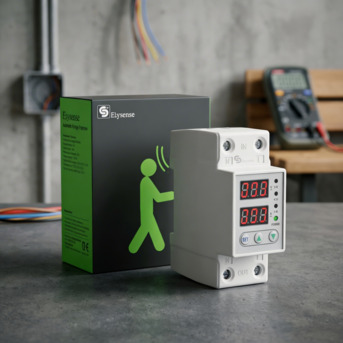
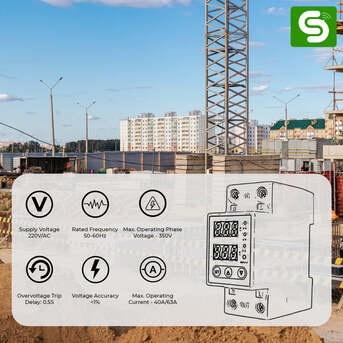
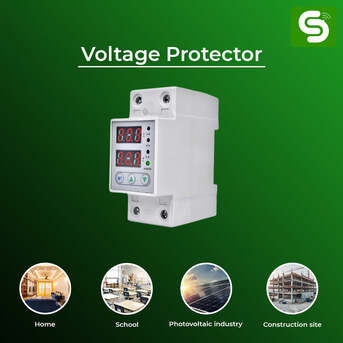
The Esysense Voltage Protector (220-240V AC, adjustable over/under voltage thresholds, 40/63A, automatic reconnection with time delay) is the recommended protection device for LED lighting circuits and home appliances in areas with Indian voltage fluctuation — which includes most of India outside major metro supply zones. It disconnects the connected load when voltage goes outside safe limits (typically 180V to 260V) and reconnects automatically after delay once voltage normalizes. A single voltage protector on a lighting circuit can protect Rs.5,000-Rs.20,000 worth of LED drivers from premature failure.
Esysense Voltage Protector
(i) Voltage: 220–240V AC
(ii) Current Rating: 40/63A (check current product listing)
(iii) Protection Threshold: Adjustable, undervoltage (80–210V) and overvoltage (130–300V)
(iv) Best For: LED lighting circuits, Refrigerators, Air conditioners, Televisions, Computers and electronic equipment
Product: esysense.com/products/voltage-protector
India's mains supply nominally operates at 230V AC (plus or minus 6%) but in practice varies far more widely — from under 180V in rural and peri-urban under-voltage zones to over 270V during sudden load shedding surges. LED drivers are particularly sensitive to this variation, and premature driver failure from voltage issues is not covered by standard warranty. A voltage protector is the most cost-effective way to extend LED lighting lifespan in Indian conditions.
The Indian Voltage Problem — Why Protection Is Essential
Two types of voltage events cause appliance damage in India:
(i) Over-voltage (above 250-270V): caused by sudden load shedding on distribution transformers, transformer tap errors, lightning surges, and poor earthing in older buildings. Sustained over-voltage overheats LED driver capacitors. Voltage spikes above 300V can instantly destroy driver ICs.
(ii) Under-voltage (below 190-200V): caused by peak demand periods (summer AC loads), long distribution lines in rural areas, and overloaded local transformers. LED drivers draw higher current to maintain output — overheating input components. Refrigerators and AC compressors draw damaging excess current.
1. Over-Voltage (250–270V+)
(i) Root Causes: Load-shedding recovery surges, Transformer tap-setting errors, Lightning-related disturbances
(ii) Effect on LED Drivers: Capacitor overheating LED lifespan reduction from ~30,000 hours to as low as 5,000–8,000 hours
(iii) Effect on Appliances: Electronic circuit damage, Display and screen failures
2. Voltage Spike (300V+)
(i) Root Causes: Lightning transients, Utility switching surges
(ii) Effect on LED Drivers: Instant IC or MOSFET failure
(iii) Effect on Appliances: Immediate electronic damage
3. Under-Voltage (Below 190V)
(i) Root Causes: Peak-demand periods, Long rural distribution lines, Overloaded transformers
(ii) Effect on LED Drivers: Increased current draw Input component overheating
(iii) Effect on Appliances: Compressor over-current, Motor overheating
4. Voltage Fluctuation (Cycling Up and Down)
(i) Root Causes: Heavy load switching on the distribution network
(ii) Effect on LED Drivers: Continuous capacitor stress Reduced driver lifespan
(iii) Effect on Appliances: Premature motor and bearing wear
Bottom line:
In Indian conditions, voltage protector cost (Rs.300-600) vs LED driver replacement cost (Rs.200-800 per driver) means the protector pays for itself after preventing just one or two driver failures on a protected circuit.
How a Voltage Protector Works
The Esysense voltage protector monitors the mains supply continuously through a voltage sampling circuit:
1. Normal voltage (180-260V): relay remains closed — load connected normally, display shows NORMAL.
2. Over-voltage detected (above ~260V): comparator triggers — relay opens within milliseconds, disconnecting the load. The display shows HIGH VOLTAGE.
3. Under-voltage detected (below ~180V): comparator triggers — relay opens, disconnecting the load. The display shows LOW VOLTAGE.
4. Voltage returns to normal range: the protector monitors continuously for the preset delay period. This prevents rapid reconnect/disconnect cycling if voltage oscillates near the threshold.
5. Delay expires: relay closes — load reconnects and powers on normally. The display shows NORMAL.
Bottom line:
The time delay before reconnection is critical — it prevents relay hunting when voltage oscillates near the threshold, and gives inductive loads (compressors, motors) time to fully stop before reconnection, preventing high inrush current damage.
Voltage Protector vs Stabilizer vs Surge Protector — Which Do You Need?
1. Voltage Protector
(i) Over-Voltage Protection: Yes — disconnects the load
(ii) Under-Voltage Protection: Yes — disconnects the load
(iii) Output Voltage Regulation: No (passes power when voltage is within limits)
(iv) Best For: LED lighting and household appliances requiring economical protection
(v) Cost: Low to Medium
(vi) For Indian LED Lighting: Recommended — most cost-effective solution
2. Voltage Stabilizer
(i) Over-Voltage Protection: Yes — reduces high voltage
(ii) Under-Voltage Protection: Yes — boosts low voltage
(iii) Output Voltage Regulation: Yes — maintains a stable output voltage
(iv) Best For: Sensitive equipment requiring constant voltage
(v) Cost: Medium to High
(vi) For Indian LED Lighting: Effective but often more than necessary
3. Surge Protector
(i) Over-Voltage Protection: Yes — clamps sudden spikes
(ii) Under-Voltage Protection: No
(iii) Output Voltage Regulation: No
(iv) Best For: Protection from short-duration surge events
(v) Cost: Low
(vi) For Indian LED Lighting: Useful as additional protection but does not address low/high voltage conditions
Bottom line:
For Indian LED lighting protection: the voltage protector is the right choice — simple, affordable, and addresses the sustained over-voltage and under-voltage events that cause most Indian LED driver failures. A stabilizer is over-specified and significantly more expensive for this application.
Where to Install a Voltage Protector in Your Home
(i) LED lighting circuit: Install on the dedicated LED lighting circuit at the distribution board — one protector covers all LED drivers on the circuit
(ii) Refrigerator: Individual in-line protector on the refrigerator supply — protects the compressor from under-voltage over-current damage
(iii) Air conditioner: Individual protector on the AC circuit — prevents compressor damage during peak-demand under-voltage
(iv) Smart TV and home theatre: Individual protector or a quality UPS with voltage regulation
(v) Main distribution board: A protector at the main DB disconnects the entire house — appropriate for severe fluctuation areas but note that refrigerators may not benefit from long power cut disconnection during food storage
Bottom line:
For most Indian homes, the highest-value installation is one protector on the LED lighting circuit (prote