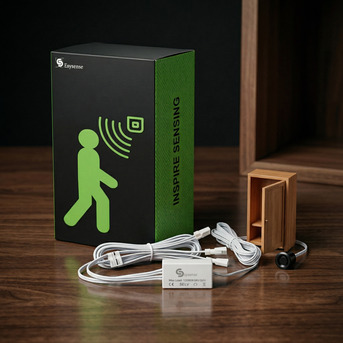
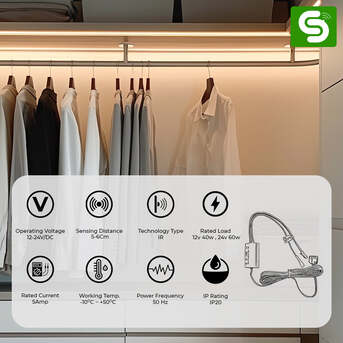
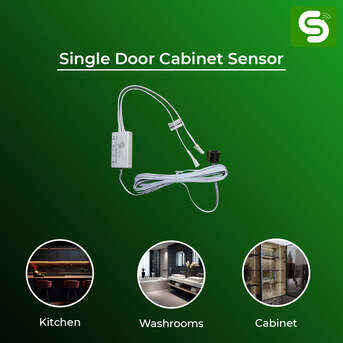
An IR motion sensor for lighting control is a PIR (Passive Infrared) device that detects the heat signature of a moving person to trigger automatic lighting — no emission, no radiation, completely passive. Esysense offers IR sensors: standard PIR for room lighting, adjustable PIR for fine-tuned office and retail use, wall mount PIR for corridor entry detection, and active IR proximity sensor (ESY-M22) for cabinet and wardrobe door-state detection. For Indian summer conditions above 38 degrees C, microwave radar sensors are more reliable — but PIR remains practical and cost-effective for cooler and air-conditioned environments.
1. PIR (Passive IR) — Room Sensor
(i) Principle: Passive heat detection
(ii) Detection: Area motion within a room
(iii) Best Applications: Corridors, rooms, general lighting automation
(iv) Link: esysense.com/collections/smart-sensors
2. Adjustable PIR Sensor
(i) Principle: Passive heat detection
(ii) Detection: Area coverage with user-adjustable sensitivity and range
(iii) Best Applications: Office cabins, retail stores, libraries
(iv) Link: esysense.com/products/180-adjustable-pir-motion-sensor
3. Wall Mount PIR Sensor
(i) Principle: Passive heat detection
(ii) Detection: Directed entry cone
(iii) Best Applications: Corridors, doorways, staircase entrances
(iv) Link: esysense.com/products/wall-mount-pir-sensor
4. IR Proximity Sensor (ESY-M22)
(i) Principle: Active IR reflective sensing
(ii) Detection: Door proximity (approximately 5–6 cm)
(iii) Best Applications: Cabinet and wardrobe door automation
(iv) Link: esysense.com/products/single-door-cabinet-ir-sensor
Understanding the three distinct IR sensing approaches helps you choose the right product for each application — passive PIR for room area detection, active IR proximity for cabinet door detection, and active IR beam for staircase direction-aware triggering.
How IR Motion Detection Works — Three Different Technologies
Passive PIR (most common for room lighting): the human body emits infrared radiation continuously at 8-12 micrometer wavelength. A pyroelectric crystal inside the sensor generates a tiny electrical charge when the infrared pattern across its Fresnel lens detection zones changes — caused by a warm body moving from one zone to another. The signal triggers the relay output.
Active IR proximity (cabinet sensor ESY-M22): an IR LED emits a short-range beam. The reflected signal from the cabinet door is detected — when the door closes within 5-6 cm, reflection is strong (door closed, light OFF); when the door opens beyond 5-6 cm, reflection drops (door open, light ON).
Active IR beam (staircase sensor): IR transmitter emits a horizontal beam across the staircase width. IR receiver detects when the beam is physically broken by a person crossing. Direction is determined by which beam (top or bottom) breaks first — ascending vs descending — enabling sequential step activation from the correct end.
Bottom line:
The three IR technologies serve three different purposes: passive PIR for room occupancy area detection, active proximity for precise door-state sensing, and active beam for definitive crossing-point detection at staircase entries. Never substitute one for another — they are fundamentally different technologies.
IR vs Microwave Sensor — Which Is Right for India?
1. IR (PIR) Sensor
(i) Indian Summer Performance (38–45°C): Reduced effectiveness as heat differential approaches body temperature
(ii) Ceiling Fan False Triggers: Moderate possibility due to heat and airflow variations
(iii) Vehicle Detection: Poor
(iv) Detection Through Glass/Partitions: No
(v) Stationary Occupant Detection: Poor — requires movement for re-triggering
(vi) Cost (2026): Lower
(vii) Best Indian Applications: Air-conditioned offices, indoor spaces, cooler environments
2. Microwave Radar Sensor
(i) Indian Summer Performance (38–45°C): Excellent — unaffected by temperature
(ii) Ceiling Fan False Triggers: Rare
(iii) Vehicle Detection: Excellent
(iv) Detection Through Thin Glass/Partitions: Yes
(v) Stationary Occupant Detection: Good — detects subtle movements
(vi) Cost (2026): Slight premium over PIR
(vii) Best Indian Applications: Year-round use, parking areas, warehouses, outdoor installations, rooms with ceiling fans
Bottom line:
For Indian offices with AC running below 24 degrees C: PIR is reliable and cost-effective. For any space without AC, with ceiling fans, or in summer ambient above 35 degrees C: choose microwave radar. For parking and outdoor: always microwave.
Adjustable PIR Sensor — Settings for Each Indian Office Space
1. Private Office Cabin
(i) Sensitivity: Medium (3–5m)
(ii) Delay: 10–12 minutes
(iii) Reason: Prevents triggers from adjacent spaces while supporting desk-based work
2. Open Office Workstation
(i) Sensitivity: High (5–7m)
(ii) Delay: 5–10 minutes
(iii) Reason: Covers desk zones effectively while maintaining energy savings
3. Meeting Room
(i) Sensitivity: High (5–7m)
(ii) Delay: 10–12 minutes
(iii) Reason: Prevents lights switching off during presentations or discussions
4. Retail Checkout Counter
(i) Sensitivity: Medium (3–4m)
(ii) Delay: 30–60 seconds
(iii) Reason: Short occupancy cycles benefit from quick switch-off
5. Small WC / Toilet
(i) Sensitivity: Low to Medium (2–3m)
(ii) Delay: 3–5 minutes
(iii) Reason: Suitable for confined spaces with short occupancy periods
Bottom line:
The adjustable PIR is the right choice when one fixed sensitivity setting cannot serve all spaces in a building — tune each sensor independently for the specific room dimensions and typical usage patterns.
IR Sensor Installation — Wiring Principle
All passive PIR sensors for lighting wire in series with the controlled light's Live wire:
1. Mains Live → Sensor Live-In → Sensor Live-Out → Light fixture Live terminal
2. Mains Neutral → Light Neutral direct (bypasses sensor entirely)
3. Earth → Light Earth direct (bypasses sensor)
4. One sensor controls multiple lights: connect all lights' Live in parallel to sensor Live-Out — as long as combined wattage is within sensor's load rating
Active IR proximity sensor (ESY-M22 cabinet) wires differently: 12-24V DC supply to input, LED strip to output. Active IR beam sensors (staircase) connect to the staircase controller's sensor input terminals per the controller wiring diagram.
Which Esysense IR Sensor Is Best for Each Application?
1. Home Corridor Lighting
(i) Recommended Sensor: Standard PIR or Wall Mount PIR
(ii) Reason: Effective area coverage and entry detection for pass-through spaces
2. Office Private Cabin
(i) Recommended Sensor: Adjustable PIR
(ii) Reason: Sensitivity and delay can be tuned to cabin size and occupancy patterns
3. Staircase Sequential Lighting
(i) Recommended Sensor: IR Beam Sensor (used with staircase controllers)
(ii