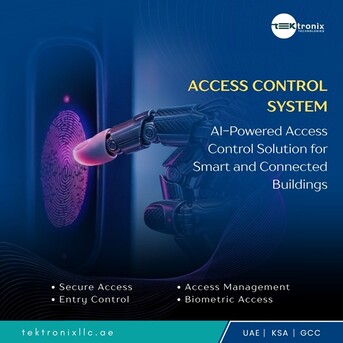
The UAE's Unique Security Environment and Why It Demands Advanced Solutions
The United Arab Emirates is one of the world's fastest-growing business hubs, hosting multinational corporations, government institutions, hospitality giants, and critical infrastructure operators under one roof. This density of high-value targets - combined with a 24/7 operational culture - creates a security environment unlike almost any other on the planet.
Local regulations enforced by bodies such as the Dubai Police Smart Services, ADJD (Abu Dhabi Judicial Department), and various free-zone authorities mandate stringent physical security protocols. Businesses operating in sectors like banking, healthcare, data centres, and government contracting are particularly obligated to demonstrate documented access governance - making a professional Security Access Control infrastructure not merely advisable but legally prudent.
Beyond compliance, the UAE's multicultural workforce and high employee turnover in certain sectors necessitate a system that can grant, modify, and revoke credentials instantly - without the delays and vulnerabilities inherent in traditional lock-and-key security.
What Is an Access Control System and How Does It Work?
At its core, a modern Door Access Control solution is an electronic mechanism that verifies identity before permitting entry to a secured space. Instead of relying on physical keys that can be lost, duplicated, or stolen, these systems authenticate users through credentials they know (PINs), possess (smart cards, mobile credentials), or are (biometric traits).
A complete system typically comprises three layers:
• Identification Layer: Card readers, keypads, mobile apps, or biometric scanners that capture credentials at the entry point.
• Decision Layer: A controller or software engine that validates the credential against a pre-defined permission matrix and audit log.
• Execution Layer: Electric strikes, magnetic locks, turnstiles, or barrier gates that physically permit or deny passage based on the controller's verdict.
Modern platforms integrate seamlessly with IP-based CCTV, visitor management software, HR databases, and building management systems - delivering a unified security ecosystem rather than isolated silos.
Biometric Access Control in Dubai: Setting the Standard for Precision Security
Biometric Access Control Dubai has emerged as the gold standard for organizations requiring the highest tier of identity assurance. Unlike card-based credentials that can be shared or cloned, biometric authentication relies on unique physiological characteristics that cannot be transferred - making it the most tamper-resistant form of identity verification available today.
Biometric modalities widely deployed across the UAE include:
• Fingerprint Recognition: Fast, cost-effective, and highly accurate - ideal for manufacturing plants, warehouses, and mid-size commercial offices.
• Facial Recognition: Touchless authentication that gained significant traction post-pandemic; deployed in airports, luxury hotels, and government buildings across Dubai and Abu Dhabi.
• Iris Scanning: Ultra-high accuracy for data centres, pharmaceutical vaults, and defence-related facilities demanding zero false-acceptance rates.
• Palm Vein & Hand Geometry: Hygiene-conscious alternatives gaining ground in healthcare environments and food processing zones.
Tektronix LLC designs and deploys biometric entry solutions calibrated to the UAE's harsh climate — ensuring devices perform reliably under extreme heat, dust, and humidity conditions common across the region.
Advanced Access Control System: Technologies Driving the Next Generation
The term Advanced Access Control System refers to platforms that go beyond simple card-in / door-open functionality. Today's leading solutions incorporate artificial intelligence, cloud computing, and IoT connectivity to deliver predictive, adaptive, and remotely manageable security infrastructure.
Cloud-Based Management
Cloud-hosted platforms allow security administrators to manage permissions, review audit trails, and respond to alerts from anywhere in the world - a critical capability for enterprises with multi-site operations spanning Access Control System Dubai, Abu Dhabi, and Sharjah locations from a single dashboard.
Mobile Credentials and Digital Keys
Smartphone-based credentials using Bluetooth Low Energy (BLE) and Near Field Communication (NFC) are replacing physical access cards, reducing card-printing overhead and enabling instant remote revocation when an employee leaves the organization.
AI-Powered Anomaly Detection
Intelligent controllers now flag atypical access patterns in real time - such as an employee badge being used at two locations simultaneously ("multi-pass" detection) or repeated failed attempts within a defined timeframe - and automatically escalate alerts to security personnel.
Visitor Management Integration
Pre-registration portals issue time-limited, zone-restricted digital passes to contractors and guests, maintaining a complete digital visitor log required by many UAE free-zone authorities for compliance audits.
Access Control Solutions Tailored for Key UAE Sectors
Tektronix LLC's Access Control Solutions are engineered for the specific operational profiles of diverse industries prominent across the Emirates:
Corporate Offices and Commercial Towers
Multi-tenant office buildings require granular zoning - allowing individual tenants to control their own floor access while building management retains oversight of common areas, server rooms, and executive levels.
Hospitality and Luxury Properties
Hotels across Dubai's tourism corridor need seamless guest experiences: mobile room keys, staff-zone segregation, and VIP access levels - all while maintaining a guest-facing aesthetic that does not compromise the brand's luxury positioning.
Access Control System UAE: City-by-City Perspective
Access Control System Abu Dhabi
The UAE's capital is home to some of the region's most strategically sensitive facilities - oil and gas infrastructure, federal government ministries, and major financial institutions. Access Control System Abu Dhabi deployments in this context must meet ISO 27001 and ADSIC (Abu Dhabi Systems and Information Centre) cybersecurity requirements, making end-to-end encrypted, hardware-secured systems the default expectation.
Access Control System Sharjah
Access Control System Sharjah demand is driven largely by the emirate's thriving industrial base. Sharjah's free zones - including SAIF Zone, Hamriyah Free Zone, and Sharjah Airport International Free Zone - house thousands of manufacturing, logistics, and trading companies, each requiring scalable entry management for large blue-collar workforces, often operating across multiple shifts.
Access Control System Dubai
Dubai's diversity of real estate - from smart city districts like Dubai Silicon Oasis to ret