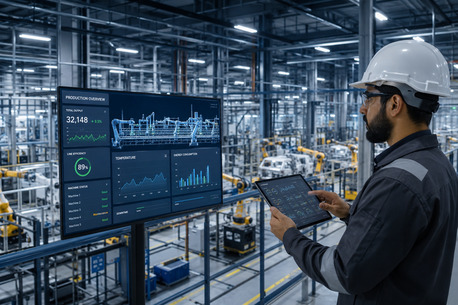
The UAE's industrial sector is evolving towards greater connectivity and operational visibility. As manufacturing, energy, logistics, and infrastructure become more digitalized, the need for analyzing operational data is growing. Modern facilities generate extensive data on equipment performance and energy consumption. This shift is transforming the role of EPC contractors in Dubai, who must now offer integrated solutions for automation, real-time monitoring, and predictive analytics. To achieve operational excellence, UAE organizations need to combine engineering expertise with advanced data capabilities in their smart industrial development efforts.
The Shift Toward Data-Driven Industrial Infrastructure
Historically, industrial facilities were designed with a primary focus on production capacity, equipment reliability, and construction efficiency. While these priorities remain important, businesses now recognize that operational intelligence is equally critical.
Industrial operators increasingly seek answers to questions such as:
Which assets consume the most energy?
Where are production bottlenecks occurring?
How can maintenance costs be reduced?
Which processes contribute to unplanned downtime?
How can safety and compliance performance be improved?
Answering these questions needs more than just high-quality equipment; it requires a digital infrastructure to capture and interpret operational data from the start. Consequently, top EPC companies in the UAE are integrating digital infrastructure into the early stages of project planning and facility design.
Why Operational Data Has Become a Strategic Asset
Industrial organizations can no longer rely solely on manual reporting or periodic inspections to manage increasingly complex operations. Real-time data provides the visibility needed to make informed decisions and continuously improve performance.
When effectively utilized, operational data helps organizations:
Monitor equipment health and performance
Track energy consumption and resource utilization
Identify process inefficiencies
Improve production planning
Enhance maintenance strategies
Support regulatory compliance
Reduce operational risks
By transforming raw information into actionable insights, companies can improve productivity while reducing costs and downtime.
Why the UAE Is Accelerating Data-Driven Industrial Development
The UAE is emerging as a regional hub for advanced manufacturing and smart industrial development. Organizations are investing in digital technologies to improve efficiency, visibility, and resilience in increasingly complex industrial facilities. Operators are under pressure to optimize resources, reduce costs, and enhance sustainability, leading to the integration of automation, data analytics, and intelligent monitoring. This shift is transforming project planning, with EPC contractors focusing on long-term digital transformation alongside operational needs, emphasizing the importance of data infrastructure.
The Role of Industrial IoT in Data-Driven Infrastructure
Industrial Internet of Things (IIoT) technologies are revolutionizing data collection in facilities by connecting sensors, devices, and systems. This enhances decision-making through continuous information flow, enabling seamless communication between assets and centralized management. IIoT provides real-time insights into equipment performance, environmental conditions, production processes, and energy consumption.
Key benefits of industrial IoT include the following:
Continuous asset monitoring
Real-time operational visibility
Faster fault detection
Improved maintenance planning
Enhanced resource management
Increased operational efficiency
As IIoT adoption continues to grow, industrial facilities are becoming increasingly intelligent, connected, and responsive to changing operational demands.
The Expanding Role of EPC Contractors in Digital Industrial Projects
EPC contractors now have responsibilities that go beyond engineering design and construction. Modern projects require collaboration among engineering, automation, IT, cybersecurity, and operational teams to ensure facilities meet current needs and future digital goals.
A data-ready facility typically incorporates the following:
Smart Instrumentation and Sensing Systems
Sensors and field instruments are strategically deployed throughout the facility to collect operational data from critical assets and processes.
Industrial Communication Networks
Reliable communication infrastructure enables seamless data transmission between equipment, control systems, and monitoring platforms.
Automation and Control Systems
Integrated control architectures provide centralized visibility and operational control while supporting advanced automation strategies.
Monitoring and Analytics Platforms
Modern facilities are using software platforms to aggregate data and generate insights for performance optimization. By integrating these capabilities during project development, organizations can prevent costly retrofits and ensure scalability.
How Industrial Automation Drives Data Collection
Industrial automation serves as the foundation of data-driven operations. Automated systems continuously capture information from equipment, processes, and production environments, creating the data necessary for informed decision-making.
Sensors and Field Devices
Industrial sensors monitor critical parameters, including:
Temperature
Pressure
Flow rates
Vibration
Humidity
Energy consumption
Equipment condition
These measurements provide continuous visibility into operational performance.
Programmable Logic Controllers (PLCs)
PLCs are essential in industrial automation, controlling machinery and collecting data. This information helps facilities monitor performance, optimize workflows, and quickly address operational issues.
SCADA Systems
SCADA systems consolidate data from various assets into a centralized interface, allowing operators to monitor performance, identify anomalies, and make informed decisions based on real-time data.
Turning Data into Action Through Advanced Analytics
Data by itself does not create value; it is analysis that transforms it into meaningful insights. Advanced analytics platforms enable organizations to recognize patterns, predict outcomes, and make proactive decisions.
Predictive Maintenance
Predictive maintenance uses equipment performance data to identify early warning signs of potential failures.
Benefits include:
Reduced unplanned downtime
Lower maintenance costs
Extended equipment lifespan
Improved operational reliability
Energy Optimization
Analytics tools can identify abnormal energy consumption and highlight opportunities for efficiency improvements. By reducing unnecessary energy use, organizations can lower costs and advance sustainability goals.
Production Performance Improvement
Manufacturers can leverage operational data to identify bottlenecks and optimize workflows, enhancing production efficiency and maximizing output while ensuring quality.
Challenges in Developing Data-Driven Industrial Facilities
While the benefits are substantial, implementing data-centric industrial infrast