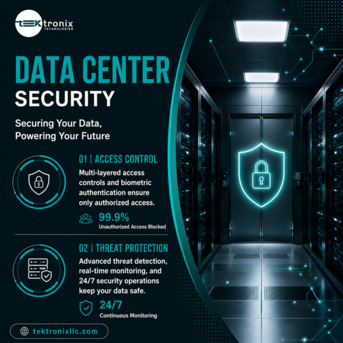
Tektronix LLC, a SIRA-approved physical and cybersecurity systems integrator operating across Oman, UAE, Kuwait, Bahrain, and Qatar since 2009, designs and deploys comprehensive, multi-layered data centre protection frameworks that address every threat vector — from the perimeter fence to the server rack. With ISO 9001:2015 certification, 500+ installations, and manufacturer authorisations from Genetec, HID Global, Suprema, ZKTeco, and Dahua, our Data Center Solutions are trusted by telecommunications operators, financial institutions, government ministries, and cloud service providers across the GCC.
The Evolving Threat Landscape Facing GCC Data Centres in 2024 and Beyond
GCC data centres operate in one of the world's most targeted cybersecurity environments. Regional geopolitical tensions, the concentration of sovereign wealth and energy sector data, and the rapid pace of digital transformation have combined to make Oman, the UAE, Saudi Arabia, Bahrain, and Qatar high-priority targets for state-sponsored threat actors, ransomware syndicates, and insider threat operations. Understanding this threat landscape is the prerequisite for designing Data Center Security GCC frameworks that are genuinely protective rather than merely compliant on paper.
The attack surface of a modern data centre spans four distinct domains. Physical intrusion — unauthorised human access to server halls, cabling infrastructure, and cooling systems — remains one of the most underappreciated risks, with physical access to a server rack capable of bypassing even the most sophisticated logical security controls in minutes. Network-layer attacks target perimeter and internal firewalls, exploiting unpatched vulnerabilities or misconfigured segmentation rules. Application and data layer attacks leverage stolen credentials, API vulnerabilities, and supply-chain compromises to exfiltrate sensitive datasets. Finally, insider threats — whether deliberate sabotage by disgruntled employees or inadvertent misconfiguration by over-privileged contractors — account for a disproportionate share of GCC data breach incidents according to regional cybersecurity authorities including the UAE's NESA and Oman's ITA.
The Six-Layer Data Center Security Model: A Framework for Total Protection
Tektronix LLC's architecture for Data Center Security Oman and GCC-wide deployments is built on a six-layer concentric protection model, where each layer independently reduces risk and collectively creates a defence-in-depth posture that forces any attacker — physical or digital — to overcome multiple independent barriers before reaching the target asset. This model aligns with Uptime Institute Tier III and IV design principles, ANSI/TIA-942-B data centre standards, and the regulatory requirements of ITA Oman, NESA UAE, and SAMA in Saudi Arabia.
Layer 1 — Perimeter Defence and Data Center Surveillance
The outermost protection layer establishes a monitored, controlled perimeter around the data centre campus. Data Center Surveillance at this layer encompasses a network of IP PTZ cameras, thermal imaging sensors for after-hours perimeter monitoring, and AI-powered video analytics that detect and classify intruder movement, vehicle approach, and fence-line disturbance in real time. Tektronix LLC deploys Genetec Security Center as the unified video management platform, enabling security operations centres (SOC) to receive instant visual verification of perimeter alarms with no manual camera tour required.
Physical barriers — anti-ram bollards, security fencing with vibration detection, and vehicle access control with automatic number plate recognition (ANPR) — complement the surveillance layer to prevent both opportunistic and targeted physical access attempts at the perimeter boundary.
Layer 2 — Data Center Access Control: Restricting Human Entry to Authorised Personnel
Inside the perimeter, Data Center Access Control governs who can enter the facility, which zones they can reach, and when. Tektronix LLC architects multi-factor, biometric-enforced access control for data centre entry using HID Amico facial recognition terminals at building access points, Suprema BioEntry biometric readers at server hall doors, and HID Aero Controllers managing zone-level permissions through OSDP-secured reader communication.
Anti-passback enforcement prevents credential sharing by ensuring that a cardholder who has entered a zone cannot be used to grant access to a second individual without an independent credential verification event. Mantrap vestibules — interlocked double-door airlocks — at critical zone transitions prevent tailgating entirely, as only one door can open at a time and only after the occupant's credential is validated against weight sensors and camera confirmation. All access events are logged with timestamp, credential ID, and camera snapshot to an immutable audit database meeting ITA and ROP evidentiary standards.
Layer 3 — Data Center Threat Detection: Identifying Anomalies Before They Escalate
Physical and logical Data Center Threat Detection operates continuously across all facility zones, correlating sensor data from multiple sources to identify security anomalies that no single sensor could detect in isolation. Tektronix LLC integrates the following detection technologies into a unified SOC dashboard:
• Motion and Presence Sensors: Passive infrared (PIR) and microwave dual-technology sensors detect human presence in server halls outside authorised access hours, triggering immediate SOC alerts and camera call-ups.
• Cabinet Tamper Detection: Magnetic contact sensors on individual server rack doors generate per-cabinet alerts when a rack is opened, logging the timestamp and correlating with access control events to confirm or flag unauthorised intervention.
• Environmental Anomaly Sensors: Sudden temperature spikes, water leak detection beneath raised floors, and smoke-detection changes can indicate both equipment failures and physical sabotage attempts — all integrated into the same threat detection workflow.
• AI Video Analytics: Genetec Security Center's AI analytics module runs loitering detection, object-left-behind classification, and crowd-density monitoring within the facility, alerting SOC operators to behavioural anomalies before they develop into incidents.
Conclusion
As Oman and the GCC's digital infrastructure expands and the threat landscape grows correspondingly sophisticated, Data Center Security demands a holistic, layered response that integrates Data Center Surveillance, Data Center Access Control, Data Center Threat Detection, Data Center Intrusion Detection, Data Center Firewalls, and Data Center Encryption into a single, unified protection architecture. Tektronix LLC's six-layer model, backed by regulator