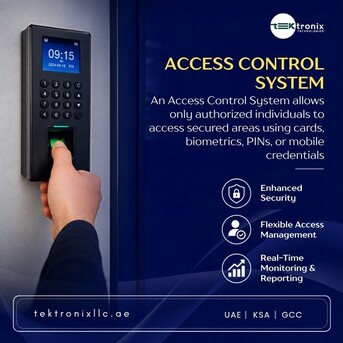
Why UAE Businesses Can No Longer Rely on Traditional Lock-and-Key Security
Conventional mechanical locks offer no audit trail, no time-zone enforcement, no remote management, and no integration with the broader security ecosystem. When a key is copied, lost, or stolen, the entire lock cylinder must be replaced and new keys issued to every authorised user - a time-consuming, costly, and operationally disruptive process. For UAE organisations operating in JAFZA, DMCC, DIFC, ADGM, KIZAD, and SAIF Zone, where staff rosters change frequently, contractor populations are large, and regulatory audits demand verifiable access documentation, these limitations create unacceptable security and compliance gaps.
An Advanced Access Control System replaces every weakness of mechanical security with measurable digital capability: cryptographically secured credentials that cannot be duplicated, granular time-zone-based access policies enforceable at individual door level, real-time access event logging that creates an immutable audit trail, and remote administration that allows security teams to add, modify, or revoke access rights for any user within seconds - from any authorised device, at any location. For SIRA-licensed facilities undergoing physical security audits, the access event log produced by a digital access control platform is the primary documentary evidence of access governance - evidence that a mechanical lock simply cannot provide.
The Technology Architecture of a Modern Access Control Deployment
Credential Technologies: From Cards to Biometrics to Mobile
The credential layer - the technology a user presents to gain access - has evolved dramatically, and Biometric Access Control Dubai deployments now represent the fastest-growing segment of the UAE access control market. Tektronix LLC deploys the full spectrum of credential technologies to match each client's security requirements and user experience expectations. Smart card credentials using iCLASS SE, MIFARE DESFire EV3, and HID Seos technologies provide cryptographic security that proximity (125 kHz) cards cannot match - eliminating the card cloning vulnerability that has made older card formats a known attack vector. Facial recognition terminals from Hikvision, Dahua, Suprema, and ZKTeco deliver one-to-one biometric verification that authenticates the person, not merely the credential they carry. Mobile credentials delivered via HID Mobile Access turn employees' smartphones into secure access tokens using NFC and Bluetooth Low Energy (BLE), eliminating card issuance overhead entirely. For the most sensitive areas, multi-factor combinations - card plus PIN, or biometric plus mobile credential - provide the layered authentication assurance demanded by NCEMA critical infrastructure guidelines and ISO/IEC 27001 Annex A.7.2.
Controllers, Panels, and Network Architecture
Behind every reader sits the Security Access Control panel - the intelligence layer that evaluates credential presentations against programmed access policies and signals the door hardware to lock or unlock. Tektronix LLC deploys controller platforms from HID Global (Aero A4000, VertX V2000), Lenel S2, Honeywell Pro-Watch, and Bosch Access Management System - platforms that support from two to hundreds of readers per controller and store access policy databases locally for uninterrupted operation during network outages. For UAE facilities requiring cloud-managed access control, the HID ORIGO cloud platform and Genetec Synergis Cloud Link provide centralised policy management across unlimited sites from a single web interface, with all event data replicated to UAE-resident cloud infrastructure consistent with Federal Decree-Law No. 45 of 2021 data sovereignty requirements. Controller panels are installed in tamper-protected, redundant-power enclosures with battery backup, ensuring access control decisions continue uninterrupted during mains power interruptions - a critical life-safety consideration aligned with Dubai Municipality and Abu Dhabi Civil Defence egress requirements.
Door Hardware: The Physical Execution Layer
A Door Access Control deployment is only as reliable as the electromechanical hardware through which access decisions are physically enforced. Tektronix LLC specifies and installs the full range of door control hardware appropriate to each opening's traffic volume, security classification, and fire-egress requirements. Electromagnetic locks (maglocks) rated at 600 kg holding force are deployed on high-security perimeter doors, with fail-safe or fail-secure configuration selected according to fire safety requirements assessed under the UAE Fire and Life Safety Code of Practice. Electric strikes and electric bolt locks are specified for interior doors where mechanical override during power failure must be maintained. For high-throughput pedestrian entry points in JAFZA logistics hubs, DIFC corporate towers, and Masdar City smart buildings, full-height turnstiles and speed gate barriers are integrated with the access control panel to enforce one-person-per-credential-presentation tailgate prevention - a physical anti-pass back control that card readers alone cannot achieve.
Access Control Devices: Purpose-Built Hardware for Every Application
Selecting the correct Access Control Device for each specific application is one of the most consequential decisions in a security system design. A reader specified for an indoor corporate lobby - where ambient light is controlled, temperatures are stable, and aesthetics matter - has entirely different requirements from a reader deployed at an outdoor gate in Hamriyah Free Zone, where direct Gulf sunlight, salt-laden humidity, and construction dust create an operating environment that will defeat consumer-grade hardware within months. Tektronix LLC's specification process evaluates every reader location against eight environmental and operational criteria: IP rating requirement, operating temperature range, credential technology compatibility, throughput requirement, tamper resistance classification, aesthetic integration with the architectural environment, OSDP v2 or Wiegand protocol compatibility with the installed controller, and interoperability with the overall PSIM or VMS platform.
The device families Tektronix LLC deploys include HID Global Signo 40K readers (IP65, multi-technology, OSDP v2 encrypted) for perimeter applications requiring credential flexibility; Suprema BioEntry W3 fingerprint and facial recognition readers for biometric-primary deployments; ZKTeco ProFace X facial recognition terminals for hi