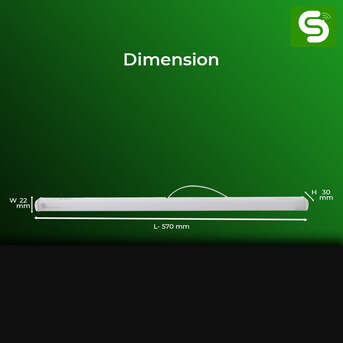
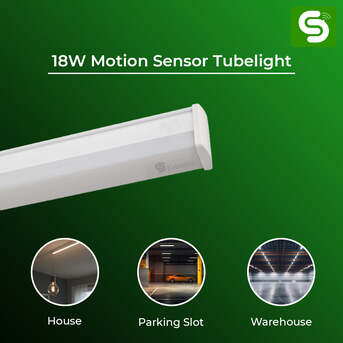
The best motion sensor tubelight for hallways in Indian homes is a T5 Motion Sensor LED Tubelight with radar-based motion detection and automatic illumination. It automatically switches ON when a person enters the hallway and switches OFF or DIMS after the area becomes vacant. This eliminates the need for manual switching, improves safety during nighttime movement, and significantly reduces electricity consumption compared to conventional hallway lighting.
Product Comparison:
1. T5 Motion Sensor Tubelight Auto On/Off
(i) Operation: Fully switches on when motion is detected and turns off after the set delay
(ii) Wattage Options: 18W / 20W
(iii) Detection Range: Up to 9 meters
(iv) Detection Angle: 180°
(v) Delay Time: Up to 60 seconds
(vi) Housing: T5 LED Tubelight
(vii) IP Rating: IP20
(viii) Best Application: Residential hallways, corridors, and passages
2. T5 Motion Sensor Tubelight Auto Dimmable
(i) Operation: Provides full brightness when occupied and switches to dim standby mode when vacant
(ii) Wattage Options: 18W / 20W
(iii) Detection Range: Up to 9 meters
(iv) Detection Angle: 180°
(v) Delay Time: Up to 30 seconds
(vi) Housing: T5 LED Tubelight
(vii) IP Rating: IP20
(viii) Best Application: Premium corridors, commercial hallways, and apartment lobbies
Why Hallways Need Motion Sensor Tubelights
Hallways are among the most frequently used yet least occupied spaces inside a building. Traditional lighting remains switched ON unnecessarily for long durations, resulting in wasted electricity.
A motion sensor hallway tubelight solves this problem by activating only when movement is detected.
Common hallway applications include:
(i) Residential apartment corridors
(ii) Independent house passages
(iii) Bedroom-to-bathroom hallways
(iv) Hostel corridors
(v) Hotel hallways
(vi) Office corridors
(vii) Commercial building passages
(viii) Basement walkways
Since occupancy is temporary in these areas, motion sensing becomes one of the most effective energy-saving lighting solutions available.
Bottom Line:
Hallways experience short-duration occupancy. Motion sensor tubelights ensure lighting is available only when required, making them ideal for energy-efficient corridor illumination.
How Motion Sensor Tubelights Work
A radar motion sensor continuously monitors movement within its detection zone.
When a person enters the hallway:
(i) Motion is detected.
(ii) The LED tubelight turns ON automatically.
(iii) The light remains active while movement continues.
(iv) After the configured delay period, the light switches OFF or enters dim mode.
Modern radar sensing technology offers better detection reliability compared to traditional manual switching because occupants never need to search for a switch in darkness.
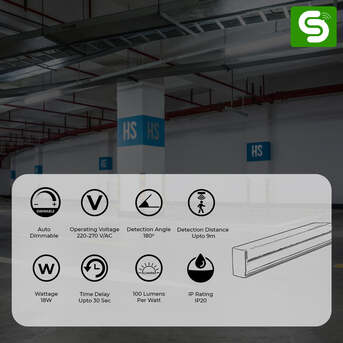
Typical Detection Performance
(i) Detection Range: Value: Up to 9 meters
(ii) Detection Angle: Value: 180°
(iii) Delay Time: Value: 30–60 seconds
(iv) Input Voltage: Value: 220–270V AC
(v) Housing Type: Value: T5
(vi) Indoor Rating: Value: IP20
Best Locations for Hallway Motion Sensor Tubelights
1. Apartment Corridors
Apartment hallways often remain illuminated throughout the night. Motion sensor tubelights provide lighting only when residents walk through the corridor.
2. Bedroom to Bathroom Passage
Night-time bathroom visits become safer because the light activates automatically without disturbing other family members.
3. Staircase Landings
Installing motion sensor tubelights near staircase landings improves visibility and reduces the risk of accidents.
4. Office Corridors
Many office corridors remain vacant for most of the day. Automatic sensor lighting minimizes electricity costs while maintaining convenience.
5. Parking Walkways
Covered parking corridors and pedestrian pathways benefit from automatic lighting activation whenever someone approaches.
Bottom Line:
The highest-return installations are residential hallways, apartment corridors, office passages, and staircase landings where occupancy is brief but frequent.
Auto On/Off vs Auto Dimmable: Which Is Better?
Auto On/Off
The light turns fully ON when motion is detected and switches completely OFF after inactivity.
Best For:
(i) Homes
(ii) Small offices
(iii) Storerooms
(iv) Utility passages
Auto Dimmable
The light remains at low standby brightness and automatically increases to full brightness when occupancy is detected.
Best For:
(i) Premium residences
(ii) Hotels
(iii) Commercial buildings
(iv) Apartment lobbies
Comparison
1. Energy Saving
(i) Auto On/Off: Excellent
(ii) Auto Dimmable: Excellent
2. User Comfort
(i) Auto On/Off: High
(ii) Auto Dimmable: Very High
3. Visibility During Vacancy
(i) Auto On/Off: No illumination during vacant periods
(ii) Auto Dimmable: Maintains low-level standby illumination
4. Commercial Appearance
(i) Auto On/Off: Good
(ii) Auto Dimmable: Premium appearance and ambience
Bottom Line:
For most Indian homes, Auto On/Off is the most economical choice. Auto Dimmable is preferred when continuous low-level visibility is desired.
How Much Electricity Can Be Saved?
Consider a conventional 20W hallway light operating 12 hours daily.
Annual Energy Consumption:
20W × 12 hours × 365 days = 87.6 kWh
With a motion sensor tubelight operating only when occupied, usage can drop dramatically because hallways are vacant most of the time.
In many residential installations, energy savings can reach 60–80% depending on traffic patterns and occupancy duration. Product specifications indicate automatic occupancy-based operation specifically designed to reduce unnecessary lighting hours.
Frequently Asked Questions
Q: Which motion sensor tubelight is best for hallways?
A: A T5 motion sensor LED tubelight with radar detection, 180° sensing angle and up to 9-meter detection range is ideal for most residential and commercial hallways.
Q: What is the ideal hallway tubelight wattage?
A: For standard residential corridors, 18W and 20W T5 motion sensor tubelights provide sufficient illumination while maintaining excellent energy efficiency.
Q: Can motion sensor tubelights work in apartment corridors?
A: Yes. Motion sensor tubelights are specifically suited for apartment corridors because occupancy is temporary and automatic activation improves both safety and energy savings.
Q: What is the difference between PIR and radar motion sensing?
A: Radar sensing can detect movement through advanced microwave-based detection and generally provides reliable occupancy detection in hallways, passages and corridors. Esysense motion sensor tubelights utilize advanced motion detection technologies for automated occupancy-based lighting.
People Also Ask
Q: What is the best motion sensor tubelight for a hallway?
A: The best option is a T5 motion sensor LED tubelight with automatic occupancy detection, 9-metre sensing range and hands-free operation. It delivers convenience, safety and en