Laser hair removal has become one of the most commonly performed aesthetic procedures in Dubai, driven by increasing demand for long-term hair reduction and reduced reliance on shaving or waxing. In a region where year-round sun exposure, diverse skin types, and cosmetic awareness intersect, the procedure is approached not only as a cosmetic choice but also as a medically guided skin treatment.
Unlike temporary hair removal methods that act at the surface level, laser treatment targets the hair follicle itself. The objective is not immediate removal, but gradual disruption of the follicular growth cycle, resulting in progressive reduction in hair density over multiple sessions.
Understanding the Biological Mechanism Behind Laser Hair Removal
Laser hair removal is based on a principle known as selective photothermolysis, where a specific wavelength of light is absorbed by a targeted chromophore—in this case, melanin within the hair shaft.
When laser energy penetrates the skin, melanin absorbs the light and converts it into controlled heat. This heat is confined to the follicular unit, where it gradually affects the structures responsible for hair regeneration. The surrounding skin is largely spared due to controlled pulse duration, cooling systems, and selective targeting.
Clinical effectiveness depends not only on device technology but also on hair growth dynamics, which determine when follicles are biologically responsive to treatment.
The Hair Growth Cycle and Its Clinical Importance
Hair growth occurs in cyclical phases, and laser treatment is only effective during specific stages:
Anagen (growth phase): The follicle is actively producing hair and is most responsive to laser energy.
Catagen (transition phase): Follicular activity slows and begins to regress.
Telogen (resting phase): The follicle is inactive and eventually sheds the hair shaft.
At any given time, only a proportion of hairs are in the anagen phase. This biological limitation explains why multiple treatment sessions are required to achieve uniform reduction across an entire treatment area.
The spacing of sessions is designed to synchronize with these cycles, allowing successive targeting of newly active follicles.
Laser Technologies Commonly Used in Dubai Clinical Practice
Dubai clinics typically use medically approved laser systems selected based on Fitzpatrick skin type, hair density, and treatment area. Device selection is individualized rather than standardized.
Diode Laser (800–810 nm)
The diode laser is widely used due to its balanced depth of penetration and safety profile. It is effective for coarse hair and commonly used in areas such as the underarms, bikini line, and limbs. It is considered suitable for a broad range of skin tones.
Alexandrite Laser (755 nm)
The Alexandrite laser is highly efficient for patients with lighter skin types and fine-to-medium hair. It is often preferred for larger treatment areas due to its speed. However, its use is typically limited in deeper skin tones due to increased risk of pigmentation changes.
Nd: YAG Laser (1064 nm)
The Nd: YAG laser penetrates more deeply while bypassing a significant portion of epidermal melanin absorption. This makes it the preferred modality for darker skin types commonly seen among South Asian, African, and Middle Eastern populations in Dubai.
Many modern platforms integrate contact cooling or cryogen spray systems to maintain epidermal safety and improve patient comfort during treatment.
What Happens During a First Laser Hair Removal Session
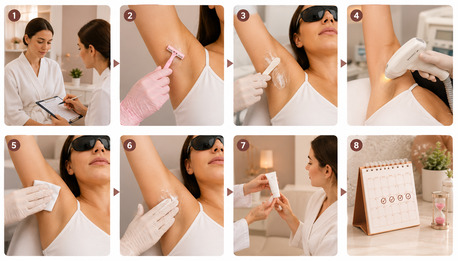
A first session typically begins with a clinical consultation. During this stage, the practitioner assesses skin type, hair thickness, hormonal factors, and prior hair removal methods. A patch test may be performed to determine skin sensitivity and appropriate energy settings.
On the day of treatment, the area is cleansed and shaved. Shaving is essential because it removes surface hair while preserving the follicular structure beneath the skin, which is required for laser targeting. Waxing and plucking are avoided for several weeks prior, as these methods remove the hair root, reducing treatment effectiveness.
Protective eyewear is provided to both patient and practitioner. A cooling system or gel is applied to minimize thermal discomfort and protect the epidermis.
Laser energy is delivered in controlled pulses across the treatment area. Patients commonly describe the sensation as a mild snapping or tingling feeling. Treatment duration varies depending on surface area, ranging from a few minutes for small zones to approximately one hour for larger regions.
Skin Response and Aftercare in a High UV Environment
Post-treatment reactions are generally mild and self-limiting. Erythema (redness) and perifollicular edema (slight swelling around hair follicles) are common and typically resolve within several hours to 24 hours.
Hair shedding occurs gradually over one to three weeks as treated follicles are expelled through normal skin turnover.
In environments such as Dubai, where ultraviolet exposure is consistently high, post-treatment care plays a critical role in preventing complications such as post-inflammatory hyperpigmentation.
Key aftercare recommendations include:
Daily use of broad-spectrum SPF 50+ sunscreen
Avoid direct sun exposure for at least 48 hours post-treatment
Temporary avoidance of heat exposure, such as saunas and steam rooms
Avoidance of waxing or plucking between sessions (shaving is permitted)
Gentle skincare with avoidance of aggressive exfoliation immediately after treatment
UV protection is particularly important because post-laser skin is temporarily more reactive to melanogenic stimulation.
Expected Clinical Outcomes Over Time
Laser hair removal outcomes are gradual and influenced by hormonal profile, hair thickness, follicular density, and treatment consistency.
Typical progression includes:
After 1–2 sessions: Reduced regrowth speed and early changes in hair texture
After 4–6 sessions: Noticeable reduction in density and patchy regrowth
After 6–8 sessions: Significant long-term reduction in treated areas
Response rates vary by anatomical region. Areas such as the underarms and bikini line often respond more rapidly, while hormonally influenced regions such as the face may require maintenance sessions due to ongoing follicular stimulation.
Laser hair removal should be understood as long-term hair reduction rather than complete permanent elimination.
Patient Suitability and Clinical Considerations
Laser hair removal is most effective when there is sufficient contrast between hair pigment and surrounding skin. However, advances in laser technology have expanded treatment suitability across a wider range of skin types.
Ideal candidates typically include individuals with:
Dark terminal hair
Light to medium skin tones
Moderate to high hair density
Treatment may be postponed or modified in the presence of:
Active dermatological infections or inflammation
Recent tanning or sunburn
Use of photosensitizing medications
Pregnancy (generally deferred as a precautionary measure)
Laser Hair Removal Compared to Traditional Methods
Traditional methods of hair removal