An LDR Sensor (Light Dependent Resistor) and a Photocell Sensor are both used for automatic day-night lighting control. They detect ambient light levels and automatically switch connected lights ON at dusk and OFF at dawn.
For residential, commercial and street lighting applications, a photocell sensor provides a practical and energy-efficient solution by eliminating manual switching and ensuring lights operate only when required.
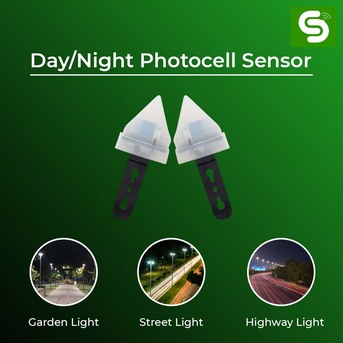
A pole mount photocell sensor is particularly suitable for street lights, parking lots, pathways, gardens and outdoor security lighting.
Product Comparison:
1. LDR Sensor
(i) Function: Light detection
(ii) Installation: Internal or compact systems
(iii) Weather Resistance: Basic
(iv) Street Light Use: Limited
(v) Commercial Use: Good
(vi) Best Application: Indoor automation
2. Pole Mount Photocell Sensor
(i) Function: Automatic day-night switching
(ii) Installation: Outdoor pole mounting
(iii) Weather Resistance: Outdoor rated
(iv) Street Light Use: Excellent
(v) Commercial Use: Excellent
(vi) Best Application: Outdoor lighting automation
What is an LDR Sensor?
LDR stands for Light Dependent Resistor. An LDR changes its electrical resistance according to the amount of light falling on its surface.
During Daytime:
(i) High ambient light
(ii) Low resistance
(iii) Controller detects daylight
(iv) Lights remain OFF
During Nighttime:
(i) Low ambient light
(ii) Resistance increases
(iii) Controller detects darkness
(iv) Lights switch ON
Because of its simplicity and reliability, the LDR sensor has been used in automatic lighting systems for decades.
Bottom Line:
An LDR sensor is the sensing element responsible for detecting changes in ambient light levels.
What is a Photocell Sensor?
A photocell sensor is a complete automation device that uses light sensing technology to control electrical loads automatically.
Unlike a standalone LDR component, a photocell sensor includes:
(i) Light sensing circuit
(ii) Control electronics
(iii) Switching relay
(iv) Protective housing
The device continuously monitors ambient light and automatically controls connected lighting fixtures.
Typical Operation
(i) Bright Daylight: Sensor Response - Light OFF
(ii) Evening Dusk: Sensor Response - Light ON
(iii) Night: Sensor Response - Light ON
Morning Sunrise: Sensor Response - Light OFF
Bottom Line:
A photocell sensor is a complete ready-to-install lighting automation solution.
LDR Sensor vs Photocell Sensor
Many users use these terms interchangeably, but there are important differences.
1. Component Type
(i) LDR Sensor: Light-sensitive resistor
(ii) Photocell Sensor: Complete control device
2. Direct Installation
(i) LDR Sensor: No
(ii) Photocell Sensor: Yes
3. Switching Capability
(i) LDR Sensor: No
(ii) Photocell Sensor: Yes
4. Outdoor Application
(i) LDR Sensor: Limited suitability
(ii) Photocell Sensor: Excellent suitability
5. Street Light Control
(i) LDR Sensor: Not directly supported
(ii) Photocell Sensor: Yes, designed for street light automation
6. User Convenience
(i) LDR Sensor: Requires an external controller
(ii) Photocell Sensor: Ready-to-use solution
Bottom Line:
The LDR is the sensing technology, while the photocell sensor is the complete automation product.
Why Day-Night Photocell Sensors Are Important?
1. Without automation:
(i) Lights are manually switched ON
(ii) Lights are manually switched OFF
(iii) Human error is common
(iv) Energy is wasted
2. With a day-night photocell sensor:
(i) Lights turn ON automatically at dusk
(ii) Lights turn OFF automatically at dawn
(iii) No user intervention required
(iv) Energy efficiency improves
Best Applications for Photocell Sensors
1. Street Lights
(i) Street lights must operate every evening and morning without fail.
(ii) Photocell sensors ensure reliable operation while reducing maintenance requirements.
2. Parking Areas
(i) Automatic illumination improves security and visibility after sunset.
3. Garden Lighting
(i) Landscape lights operate only when required.
4. Building Exteriors
(i) Commercial buildings benefit from automated façade lighting.
5. Industrial Premises
(i) Factories and warehouses use photocell sensors to control perimeter lighting.
Bottom Line:
Any outdoor lighting system that follows a day-night cycle can benefit from photocell automation.
Pole Mount Photocell Sensor Applications
Pole mount photocell sensors are specifically designed for outdoor environments.
1. Advantages include:
(i) Weather-resistant construction
(ii) Easy installation on lighting poles
(iii) Reliable day-night operation
(iv) Suitable for street lighting
(v) Reduced maintenance
2. Common applications:
(i) Municipal street lights
(ii) Housing societies
(iii) Parking lots
(iv) Industrial campuses
(v) Commercial complexes
(vi) Highway lighting
Bottom Line:
For outdoor lighting automation, pole mount photocell sensors remain one of the most practical and cost-effective solutions available.
Energy Saving Benefits
A common mistake in outdoor lighting systems is operating lights during daylight hours.
Even a few hours of unnecessary operation each day can significantly increase annual electricity costs.
Photocell sensors eliminate this issue by ensuring lights operate only when ambient light levels fall below the configured threshold.
Benefits include:
(i) Reduced electricity bills
(ii) Longer lamp life
(iii) Reduced maintenance
(iv) Consistent lighting schedules
(v) Improved operational efficiency
Why are Photocell Sensors Popular in India?
Indian lighting installations often include:
(i) Street lights
(ii) Parking lots
(iii) Residential societies
(iv) Farmhouses
(v) Gardens
(vi) Commercial buildings
Because these applications require daily ON/OFF operation, photocell automation provides a simple and reliable solution without requiring timers or manual intervention.
Frequently Asked Questions
Q: What is the difference between an LDR sensor and a photocell sensor?
A: An LDR sensor is a light-sensitive component, while a photocell sensor is a complete device that uses light sensing technology to automatically control lighting loads.
Q: Can photocell sensors be used for street lights?
A: Yes. Pole mount photocell sensors are specifically designed for automatic street light operation.
Q: What is a day-night photocell sensor?
A: A day-night photocell sensor automatically switches lights ON during darkness and OFF during daylight.
Q: Do photocell sensors save electricity?
A: Yes. They prevent unnecessary lighting operation during daytime and ensure lights operate only when required.
People Also Ask
Q: Which is better, LDR sensor or photocell sensor?
A: For direct li